
By Rafiyat Sadiq
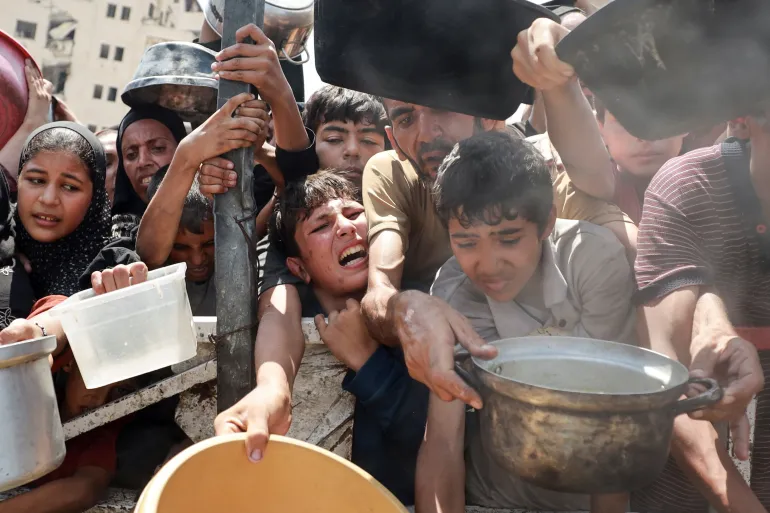
An infant was among at least 15 Palestinians who died of hunger-related complications within 24 hours across the Gaza Strip as the humanitarian crisis in the besieged territory worsens.
Health officials at al-Shifa Hospital confirmed the deaths on Monday, bringing the total number of starvation-related fatalities to 147 since Israel launched its military campaign in October 2023. According to Gaza’s Ministry of Health, 88 of the victims have been children.
The situation continues to deteriorate, with severe shortages of food, baby formula, and medical supplies due to Israel’s blockade, which has heavily restricted humanitarian access. Although Israel eased the blockade slightly in May, only a limited number of aid convoys have entered the enclave.
Before a bilateral meeting in Scotland on Monday, U.S. President Donald Trump said there was clear evidence of “real starvation” in Gaza. He acknowledged that Israel bore “a lot of responsibility” for the deepening crisis.
READ ALSO: FG Adds 50.4 MW to National Grid – Adelabu
Trump’s comments came a day after Israeli Prime Minister Benjamin Netanyahu denied the existence of starvation in the territory, insisting there was no policy to that effect. When journalists asked Trump if he agreed with Netanyahu’s statement, he responded, “I don’t know. Based on television, I would say not particularly, because those children look very hungry.”
Standing alongside Trump, British Prime Minister Keir Starmer called the situation “desperate” and stressed the need for an immediate ceasefire.
Medical Staff Report Infant Deaths Amid Formula Shortage
A medical source at al-Shifa Hospital told journalists that a baby, Muhammad Ibrahim Adas, had died of malnutrition due to the ongoing shortage of infant formula.
According to Gaza’s Government Media Office, more than 40,000 infants under one year old remain at risk of slow death due to the prolonged restriction of essential supplies. The office accused Israeli authorities of blocking the entry of formula for over 150 days.
“We urgently demand the immediate and unconditional opening of all crossings and the swift entry of baby formula and humanitarian aid,” the statement read.
Aid Blocked Despite Worsening Conditions
Reports from Deir el-Balah indicate that Israeli forces continue to target civilians, including those seeking food. Eyewitnesses described desperate scenes of Palestinians climbing onto aid trucks, citing unbearable hunger and no other option.
“They said their children have been starving for days,” one resident told journalists. “They didn’t have time to wait.”
More than 1,000 people have reportedly been killed near food distribution centres operated by the U.S.- and Israeli-backed Gaza Humanitarian Foundation (GHF), which began operations in late May. The foundation has faced criticism for inadequate distribution and failure to secure delivery zones.
On Monday, Israeli forces killed at least 65 people across Gaza, including 23 individuals waiting for food assistance. Shelling continued even as discussions around humanitarian corridors progressed.
UN Urges Immediate Scaling Up of Aid
United Nations officials welcomed Israel’s decision to allow more aid convoys but warned the scale remains grossly insufficient.
“This is a welcome step in the right direction,” said Tom Fletcher, the UN Under-Secretary-General for Humanitarian Affairs. “But clearly, we need to get in vast amounts of aid at a much greater scale than we’ve been able to do so far.”
He added that deliveries remain “a drop in the ocean” compared to the urgent needs of Gaza’s population. Fletcher stressed that humanitarian operations continue to face roadblocks, including closed crossings and unresolved security threats.
“What international law demands is that we can turn up and drive through freely to deliver aid. But we are not yet at that point,” he said.
Israel’s Offensive Continues Despite International Pressure
Despite mounting international calls for a ceasefire, Israel has continued its offensive on Gaza, launched in response to the October 7, 2023, Hamas-led attack on southern Israel, which killed 1,139 people and resulted in over 200 hostages.
Since then, nearly 60,000 Palestinians have been killed, the majority of them women and children, according to Gaza health authorities. Israel now faces a genocide case at the International Court of Justice in The Hague over its conduct in the war.
Although Israel recently announced limited “humanitarian pauses, ”journalists and aid workers on the ground say these are short-lived, uncoordinated, and restricted to certain areas without international oversight.
“They lack any real coordination with humanitarian agencies,” one aid worker said. “People are still dying of hunger, even during these so-called pauses.”
The humanitarian situation in Gaza remains critical, with medical personnel, aid agencies, and local authorities warning that unless full-scale relief efforts begin immediately, the death toll will continue to rise.
SOURCE: JAZEERA

Rafiyat Sadiq is a political, justice, and human rights reporter with Pinnacle Daily, known for fearless reporting and impactful storytelling. At Pinnacle Daily, she brings clarity and depth to issues shaping governance, democracy, and the protection of citizens’ rights.