

The 2025 Africa Cup of Nations (AFCON) in Morocco delivered flair, intensity, and elite African football talent. Yet, beyond the goals and celebrations, persistent officiating controversies cast a long shadow over the tournament.
Morocco’s hosting of the 2025 Africa Cup of Nations drew widespread praise for its world-class infrastructure, with players and coaches highlighting the quality of venues and facilities.
Senegal winger Krépin Diatta said the standard of stadiums and playing surfaces was “very high,” noting they offered ideal conditions for top-level football throughout the tournament.
Mali head coach Tom Saintfiet also said he was blown away by the modern stadiums, training facilities and accommodations provided for teams, which he felt allowed participants to perform at their best.
These remarks reflect how the upgraded venues across Morocco set a strong foundation for a memorable event.
Beyond the pitch, the tournament acted as a showcase for Morocco’s broader infrastructure investments, including transport and hospitality.
Host cities benefitted from recent upgrades to high-speed rail links, airports and road networks that helped handle the influx of fans and delegations with minimal delays.
Hotels, restaurants and fan zones across multiple cities reported high occupancy and lively atmospheres, underlining the country’s ability to manage major sporting events at a global standard. Observers saw this level of preparation as evidence that African hosts can deliver tournaments with facilities on par with the world’s best.
However, from the knockout rounds to the final, disputed refereeing calls and inconsistent use of the Video Assistant Referee (VAR) raised serious concerns about fairness, transparency, and credibility. Players, coaches, pundits, and fans across the continent questioned whether Africa’s biggest football stage lived up to global standards off the pitch.
Concerns over refereeing emerged early in the knockout phase. VAR interventions appeared uneven, while similar incidents received different outcomes across matches. These inconsistencies fuelled accusations of bias and eroded trust in match officials.
By the time the competition reached its climax in Rabat, tensions had already simmered across fan bases and football communities.
Speaking after the semi-final match between Nigeria and Morocco, Victor Osimhen said, “To be honest, today’s game was nothing to write home about in terms of the officiating; it was that bad.”
Osimhen openly criticised the Ghanaian referee Daniel Nii Laryea after Nigeria’s semifinal loss, calling several decisions questionable.
Also speaking on officiating, Nigerian actor and fan, Pere Egbi said, “AFCON should never have referees from Africa officiating its games again… Bring in European or American referees who would referee a game with fairness and zero prejudice.”
Egbi criticised officiating and called for international referees to improve fairness.
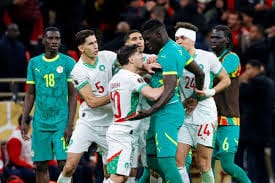
The final between Senegal and host nation Morocco became the defining flashpoint of AFCON 2025. With the score level deep into stoppage time, referee Jean-Jacques Ndala Ngambo awarded Morocco a late penalty after a VAR review.
The decision provoked immediate outrage. Senegalese players, led by head coach Pape Thiaw, walked off the pitch in protest for nearly 14 minutes. The action halted play and plunged the Prince Moulay Abdellah Stadium into chaos.

Angry Senegalese supporters threw objects and attempted to enter the field. Security struggled to contain the situation. Morocco stood moments away from winning the title with what appeared to be the final kick of regulation time.
Senegal captain Sadio Mané stepped in to calm his teammates and urged them to return to the pitch. His intervention saved the match from total collapse.
When play resumed, Morocco’s Brahim Díaz attempted a Panenka penalty. Senegal goalkeeper Edouard Mendy read the effort and made a crucial save that shifted momentum.
Senegal later sealed a 1–0 extra-time victory through midfielder Pape Gueye, clinching their second AFCON title. However, the drama that preceded the goal overshadowed the triumph.
CAF Condemns Conduct, Launches Investigation
Within 24 hours, the Confederation of African Football (CAF) broke its silence. In a statement published on Monday, CAF condemned the behaviour of some players and officials during the final.
“The Confédération Africaine de Football condemns the unacceptable behaviour of some players and officials during the TotalEnergies CAF Africa Cup of Nations Morocco 2025 Final between Morocco and Senegal in Rabat.”
CAF said it strongly opposes any inappropriate conduct, especially actions directed at match officials and organisers.
The body confirmed it is reviewing all available footage and will forward its findings to the relevant judicial bodies for disciplinary action.
READ ALSO:
- AFCON Heroics Propel Super Eagles to 26th in FIFA Rankings
- AFCON 2025: Super Eagles Target Third-place Finish Against Egypt – Bassey
- Super Eagles Break 5 Jinxes Ahead of Morocco Semi-Final Showdown
- AFCON 2025: Super Eagles Earn $80,000 in Goal Bonuses
Former Super Eagles striker Odion Ighalo, speaking on SuperSport, offered one of the strongest technical critiques of the officiating: “For the goal Senegal scored, the ref did not check the VAR, and for the one for Morocco, he checked the VAR.”
He pointed to Senegal’s 92nd-minute goal, ruled out without VAR review, and contrasted it with the penalty awarded to Morocco after intervention.
Despite his frustration, Ighalo admitted Senegal were the better side and deserved the title.
FIFA President Gianni Infantino, who attended the final, described the scenes in Rabat as “ugly” and warned that they threatened the essence of football.
“It is unacceptable to leave the field of play in this manner, and violence cannot be tolerated in our sport,” Infantino wrote on Instagram.
He urged CAF’s disciplinary bodies to act decisively and stressed the need to respect match officials.
However, Infantino’s praise of Morocco as “exceptional hosts”, along with his public thanks to King Mohammed VI, triggered backlash.
Critics argued that officiating concerns and security complaints were being downplayed.
Before the final, the Senegalese Football Federation (FSF) lodged formal complaints. The federation alleged “sabotage”, claiming its players lacked adequate security at train stations and received substandard accommodation.
These grievances added to the perception that the tournament favoured the host nation.

Esther Ososanya is an investigative journalist with Pinnacle Daily, reporting across health, business, environment, metro, Fct and crime. Known for her bold, empathetic storytelling, she uncovers hidden truths, challenges broken systems, and gives voice to overlooked Nigerians. Her work drives national conversations and demands accountability one powerful story at a time.