


When a Nigerian court orders the forfeiture of a mansion in Abuja, a fleet of luxury vehicles in Lagos, or millions of dollars linked to corruption and drug trafficking, the announcement dominates headlines. Anti-graft agencies celebrate the win, and government officials assure Nigerians that the recovered wealth will serve the public good.
But once the cameras leave, one question remains: What happens to these forfeited assets?
The Accountability Gap For decades, successive governments have announced the recovery of billions of naira, thousands of properties, luxury vehicles, cash, and foreign assets from politically exposed persons and convicted criminals.
Yet Nigeria still lacks a publicly accessible, comprehensive national database showing what has been recovered, what has been sold, what remains in government custody, how much money has reached public coffers, and where those funds were eventually applied.
Despite the enactment of the Proceeds of Crime (Recovery and Management) Act, 2022 (POCA) by the Federal Government through the Nigerian Ministry of Justice to harmonise asset recovery, forfeiture and management procedures across relevant agencies, a search of the ministry’s official website did not reveal a publicly accessible database of forfeited assets.
Without a unified record, tracking recovered assets from seizure to final disposal remains a challenge, raising concerns about accountability and public confidence.
This lack of transparency has fuelled concern. While some Nigerians say government is getting better at recovering assets, others argue that it remains weak at managing them.
Reps Probe Asset Recovery Management Since 1999
The accountability gap has now drawn attention from the House of Representatives, which has resolved to investigate all seized, forfeited, recovered, managed, disposed of, and repatriated assets from 1999 to date and probe them.
The resolution followed a motion by Ibe Okwara Osonwa, a member representing the Arochukwu/Ohafia Federal Constituency, Abia State.
RELATED NEWS:
- Supreme Court Affirms Forfeiture of Properties Linked to Emefiele
- Reps Order Probe of Recovered Assets Since 1999, Demand Nationwide Audit
- University, Hotels, Radio Station, Petrol Stations Among Properties Malami Will Lose To FG
- Ex-Aviation Minister Stella Oduah Faces N5bn Corruption Charges
- Corruption Thrives Under Protection of Influential Nigerians – Mahdi
He noted that anti-corruption agencies have recovered cash, properties, shares, petroleum assets, luxury vehicles, aircraft, investments, and digital assets linked to financial crimes — collectively worth trillions of naira — without a centralised register showing their status, value, location, management, disposal, and proceeds.
Citing Sections 88 and 89 of the 1999 Constitution, the House invoked its oversight powers to examine the inventory, value, and locations of recovered assets.
Key concerns raised include poor record-keeping, asset deterioration, and the absence of a unified national asset register.
The House Committee on Public Assets inaugurated a subcommittee for the investigation, requesting a centralised digital national asset recovery registry
Nigerians are watching to see whether the investigation will provide clear answers on location, value, management, and disposal — and whether asset recovery is delivering tangible value to citizens.
The Evolution of Asset Forfeiture Laws in Nigeria
Nigeria’s asset forfeiture regime has evolved through three major legal periods. It began during the colonial era, when customs laws allowed the seizure of smuggled or illegally traded goods and vessels.
During the military era, successive decrees expanded forfeiture powers to cover assets linked to corruption, drug trafficking and financial crimes. The NDLEA Act of 1989 and laws governing failed banks further strengthened asset seizure and recovery mechanisms.
Since the return to democracy in 1999, Nigeria has developed a broader institutional framework for asset forfeiture. The ICPC Act (2000) and EFCC Act (2002/2004) established stronger mechanisms for recovering proceeds of corruption and financial crimes, while the Proceeds of Crime (Recovery and Management) Act, 2022 (POCA) sought to harmonise asset recovery, forfeiture and management procedures across relevant agencies.
Despite its enactment, there is still no central register of recovered assets available online for public assessment.
Major Asset Forfeiture Cases Since 1999
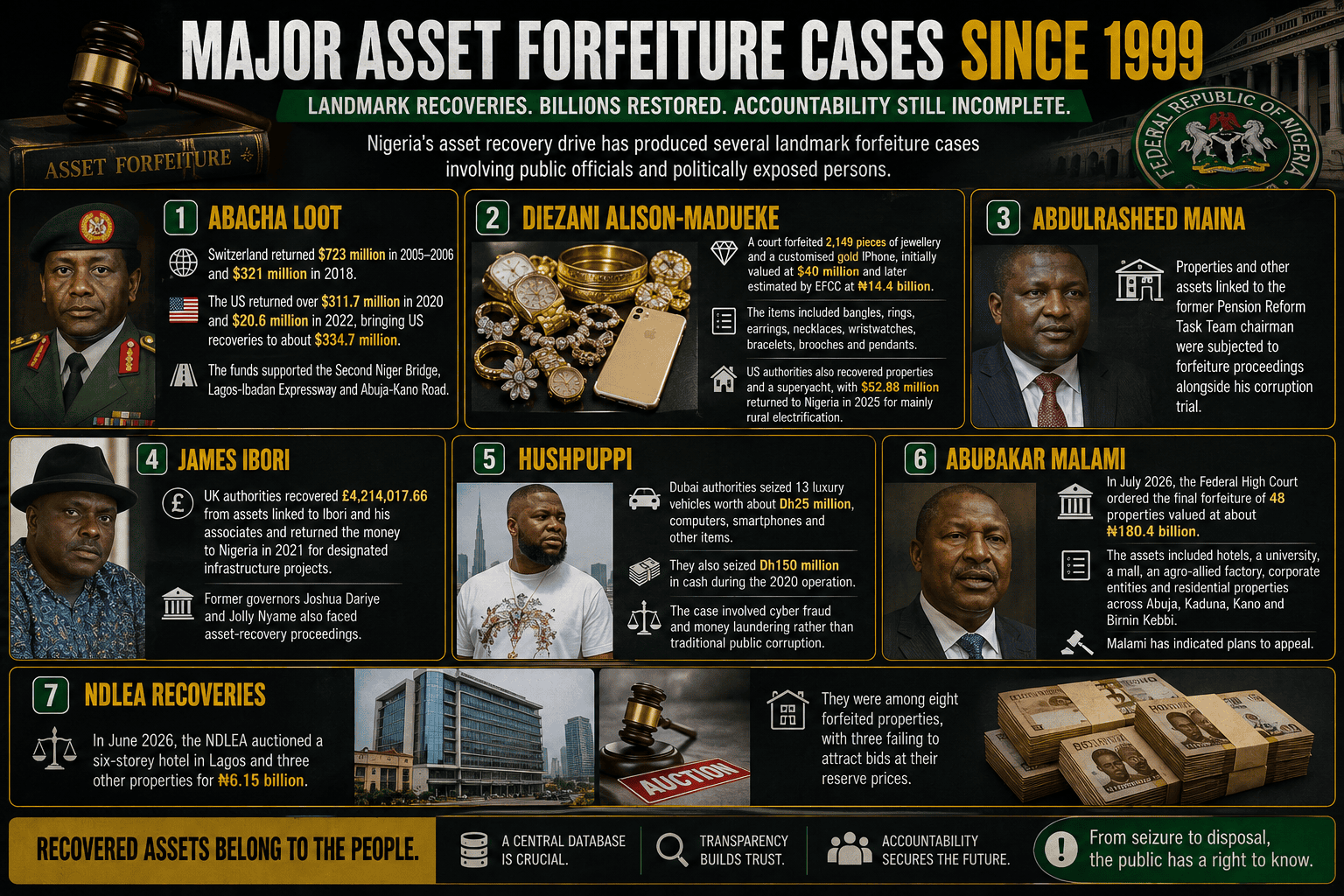
Nigeria’s asset recovery drive has produced several landmark forfeiture cases involving public officials and politically exposed persons.
- Abacha Loot: Switzerland returned $723 million in 2005–2006 and $321 million in 2018. The US returned over $311.7 million in 2020 and $20.6 million in 2022, bringing US recoveries to about $334.7 million. The funds supported the Second Niger Bridge, Lagos-Ibadan Motorway and Abuja-Kano Road.
- Diezani Alison-Madueke: A court forfeited 2,149 pieces of jewellery and a customised gold iPhone, initially valued at $40 million and later estimated by EFCC at ₦14.4 billion. The items included bangles, rings, earrings, necklaces, wristwatches, bracelets, brooches and pendants. US authorities also recovered properties and a superyacht, with $52.88 million returned to Nigeria in 2025 for mainly rural electrification.
- Abdulrasheed Maina: Properties and other assets linked to the former Pension Reform Task Team chairman were subjected to forfeiture proceedings alongside his corruption trial.
- James Ibori: UK authorities recovered £4,214,017.66 from assets linked to Ibori and his associates and returned the money to Nigeria in 2021 for designated infrastructure projects. Former governors Joshua Dariye and Jolly Nyame also faced asset-recovery proceedings.
- Hushpuppi: Dubai authorities seized 13 luxury vehicles worth about Dh25 million, computers, smartphones and other items, as well as Dh150 million in cash during the 2020 operation. The case involved cyber fraud and money laundering rather than traditional public corruption.
- Godwin Emefiele: Former CBN Governor Godwin Emefiele faced forfeiture of $2.045 million, seven properties and share certificates, affirmed by the Supreme Court in July 2026. In separate cases, courts also ordered the forfeiture of $4.7 million, ₦830.9 million and other properties, including an Abuja estate comprising 753 housing units.
- Abubakar Malami: In July 2026, the Federal High Court ordered the final forfeiture of 48 properties valued at about ₦180.4 billion. The assets included hotels, a university, a mall, an agro-allied factory, corporate entities and residential properties across Abuja, Kaduna, Kano and Birnin Kebbi. Malami has indicated plans to appeal.
- NDLEA Recoveries: In June 2026, the NDLEA auctioned a six-storey hotel in Lagos and three other properties for ₦6.15 billion. They were among eight forfeited properties, with three failing to attract bids at their reserve prices.
Professor Kamilu Sani Fage: Weak Laws, Poor Accountability and the Glorification of Corruption, How Looted Funds are Being Relooted.
Professor Kamilu Sani Fage, a professor of political science at Bayero University Kano, said Nigeria has been recovering looted properties and funds but has failed to adequately account for how the assets are managed or utilised. He said the situation is particularly troubling because assets recovered from alleged looters can themselves be lost or allegedly looted by those entrusted with them.
“In most cases, we hear that the confiscated loot was itself looted by someone. I think this shows the weakness of our laws.
It also shows a lack of seriousness, poor record-keeping and a lack of accountability. Things get recovered, and over time, they just go missing.
Even the people who are entrusted with confiscating or recovering these things can also end up looting them,” he said.
According to him, the problem reflects the weakness of Nigeria’s laws, poor record-keeping, lack of seriousness and weak accountability mechanisms.
He called for existing laws to be strengthened and applied without fear or favour, with punitive measures imposed on both those who originally looted public resources and those who subsequently misuse recovered assets.
He also criticised arrangements in which alleged looters negotiate the return of part of their assets in exchange for concessions, arguing that such practices can undermine accountability when the recovered assets are subsequently mismanaged or looted again.
“I think they are public funds or public assets that people who are in positions of power and who are in charge of them on behalf of the public have looted,” he said.
Prof. Fage said the better approach is to prevent corruption from occurring in the first place by making it difficult and unattractive, including addressing conditions of service and ensuring that anyone found culpable is punished according to the law. He said countries that have made progress against corruption did so by firmly enforcing the law.
“In the past, anybody who committed such offences would face social consequences. But if you look at it now, things have changed.
“Somebody will be a pauper today. If he is given public office, he will become the richest person in the state, in his town or in the country. Yet, instead of society rejecting such a person, we now begin to honour them,” he said.
While the Socio-Economic Rights and Accountability Project (SERAP) says the government continues to ignore requests for information on the management of forfeited assets, the Federal Director of Public Prosecutions in the Office of the Attorney-General of the Federation, Rotimi Oyedepo (SAN), dismissed claims of the “relooting” of recovered funds during an interview with Channels Television.
Oyedepo said plans are underway to establish a central register of all recovered assets.
Barrister Monday Adjeh: Secrecy, Missing Data and the Failure of Asset Accountability
Senior lawyer Barrister Monday Adjeh questioned the ability of the proposed National Assembly investigation into recovered and forfeited assets dating back to 1999 to deliver meaningful accountability. He described the probe as potentially another political exercise, pointing to what he said was the poor record of previous investigations conducted by both the Senate and House of Representatives.
Adjeh argued that parliamentary probes often begin with public displays of seriousness but eventually fail to produce lasting outcomes, while lawmakers receive sitting and other allowances in the process. He cited the controversial “off-the-mic” episode as an example of an investigation that eventually became a subject of public ridicule.
For Adjeh, however, the problem extends beyond the National Assembly to Nigeria’s wider culture of secrecy in governance. He said government at the local, state and federal levels is not sufficiently open to public scrutiny, despite democratic governance requiring citizens to have access to information about how public resources are managed.
He said this secrecy also surrounds recovered assets, with Nigerians unable to establish how much money and property has been recovered, how much remains, where the funds are kept or what happens to forfeited properties after court orders.
Adjeh questioned what happens to large volumes of recovered properties, arguing that if properly managed, such assets could make a significant contribution to Nigeria’s housing needs. He warned that without transparency, properties and assets could be cornered by individuals connected to those in power or bought by their cronies.
He identified the absence of a comprehensive and accessible national database of forfeited assets as a major institutional weakness. Although the Ministry of Justice has reportedly said it is responsible for maintaining recovery data, Adjeh said Nigerians have not seen a comprehensive database detailing all forfeited properties and assets.
He stressed that proper documentation and record-keeping should be fundamental to governance, arguing that countries such as the UK have systems through which public information can be accessed relatively easily, while Nigeria continues to operate without reliable data even on basic government information.
Adjeh said every major recovery should be traceable from seizure through custody and eventual disposal. He questioned why government announcements about recovering hundreds or thousands of properties often stop at the announcement without explaining what happened to the assets afterwards.
He also questioned the constitutional and public-interest purpose for which forfeited assets are managed, saying Nigerians should know what happens to the billions and trillions of naira worth of properties and investments forfeited to the government.
He further blamed citizens for being too passive in demanding accountability.
Adjeh warned that the lack of transparency creates opportunities for recovered funds and properties to be subjected to the same corruption that led to their recovery.
According to him, meaningful change will require both government institutions and citizens to reject the practices that have allowed the system to continue operating without adequate accountability. He warned that the cycle cannot continue indefinitely, arguing that systems of power eventually change and that those who appear dominant can eventually lose their position.
Transparency: The Real Test
With seven days left for the National Assembly committee to submit its report on forfeited funds, Nigerians are awaiting answers on the management of recovered wealth.
Experts warn that weak institutions, secrecy and repeated parliamentary probes have allowed Nigeria’s asset-forfeiture system to become a cycle of “looting the loot” without lasting accountability.
They are calling for a central, publicly accessible register where citizens can track forfeited assets from seizure to disposal and the use of proceeds, alongside sanctions for officials who mismanage them.
The committee’s report will test whether the government can move beyond investigations and establish lasting transparency in the management of Nigeria’s recovered wealth.

Rafiyat Sadiq is a political, justice, and human rights reporter with Pinnacle Daily, known for fearless reporting and impactful storytelling. At Pinnacle Daily, she brings clarity and depth to issues shaping governance, democracy, and the protection of citizens’ rights.