

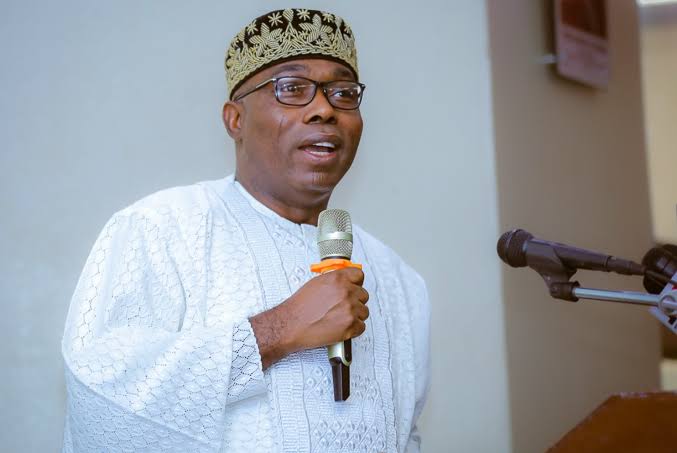
For SDP presidential candidate Prince Adewole Adebayo, the first 100 days of a presidency would not be enough to unveil plans or make promises. His proposed governance model would put every major commitment on a clock — with targets, quarterly reviews, public scorecards and consequences for missed deliverables.
As Nigeria moves towards the 2027 presidential election, the Social Democratic Party (SDP) presidential candidate, Prince Adewole Adebayo, is putting a different emphasis on what he says should determine the success or failure of a government.
According to him, every administration should have a measurable delivery within defined timelines.
The SDP presidential candidate unveiled his policy blueprint titled “Farewell to Poverty and Insecurity” on Tuesday, September 8, in Abuja, where he decried the economic and security challenges currently confronting the country. He attributed the challenges to past leadership failures, stressing the need for a refreshing approach to governance for measurable development.
Adebayo said a four-year term is enough time for any administration focused on specific goals to deliver tangible results, comparing it to completing a university degree.
He said the party’s focus is to eliminate poverty and tackle insecurity within four years if elected in the 2027 presidential election.
“At the end of the four-year term, we will have eliminated poverty. I’m not saying every Nigerian is going to be a billionaire, but we will eliminate poverty and deal with insecurity,” he stated in a televised interview.
At the centre of his Farewell to Poverty and Insecurity blueprint is a proposed Presidential Delivery and Performance Office, backed by baseline audits, quarterly targets, public performance reports and corrective measures for programmes that fall short.
He said the approach would effectively put the presidency on a stopwatch.
Under the proposed system, major government promises would begin with a baseline — establishing the actual condition of a sector — followed by measurable targets, timelines and clearly assigned responsibilities. Performance would then be reviewed periodically to determine what has changed.
The objective is to shift governance from announcing policies and spending budgets to demonstrating measurable outcomes.
A President on the Clock
Adebayo’s model envisages the President not only as the nation’s chief political executive but also as its chief delivery officer.
It highlights that ministries and agencies would be expected to work against defined outcomes across critical sectors including electricity, agriculture, healthcare, education, employment and security.
The central question would be simple: What changed?
A ministry could spend billions of naira or commission hundreds of projects without necessarily resolving the problem it was created to address. A performance-based system would instead focus on whether government interventions produced tangible improvements.
Baseline Before Promises
One of the key proposals is the use of baseline audits.
Before setting targets, government would establish the actual state of the economy and public services — from electricity supply and employment to healthcare, education, roads, food production and industrial capacity.
It stressed that such data would provide a reference point for measuring progress and make it more difficult for governments to claim success through selective statistics.
READ ALSO:
- Power Minister Adelabu Resigns to Join Oyo Guber Race
- Kogi High Court Denies Ordering NDC Deregistration
- Tinubu Will Secure 65% of 2027 Votes – Kano Rep
- Alliance Warns Nigeria Nearing Institutional Collapse, Urges Reforms
- CBN Orders Banks to Deploy Automated Anti-Money Laundering Systems in 18 Months
Quarterly Scorecard
The blueprint also proposes that a quarterly review system would alter Nigeria’s traditional four-year accountability cycle.
Rather than waiting until the end of an administration to assess its record, programmes could be reviewed within months.
Where targets are missed, the system would seek to establish why — whether because of inadequate funding, institutional failure, flawed assumptions, legislative bottlenecks or changing economic conditions — and determine whether the programme should be redesigned.
Failure, therefore, would become a signal for intervention rather than something to be concealed.
Government Reporting to Citizens
Public reporting is another major component of the proposal.
It emphasised that if performance data are regularly published, citizens would have a basis to scrutinise government claims. Farmers could track agricultural targets, businesses could assess the operating environment, students could monitor education outcomes and electricity consumers could measure promised improvements in supply.
That would move transparency beyond the publication of official documents to continuous public assessment of government performance.
The Real Test
The practical test, however, would be implementation.
Adebayo’s proposed governance architecture would have to operate within Nigeria’s fiscal constraints, institutional weaknesses and political realities. Establishing targets is one thing; securing reliable data, funding, institutional cooperation and political discipline to meet them is another.
Still, the central proposition is clear: government should be judged less by the size of its promises or budgets than by measurable improvements in citizens’ lives.
Under the model, a campaign promise would become a target, the target an obligation, and the obligation a basis for accountability.
For Adebayo, the clock would not start at the end of the first year — it would start on day one.
