

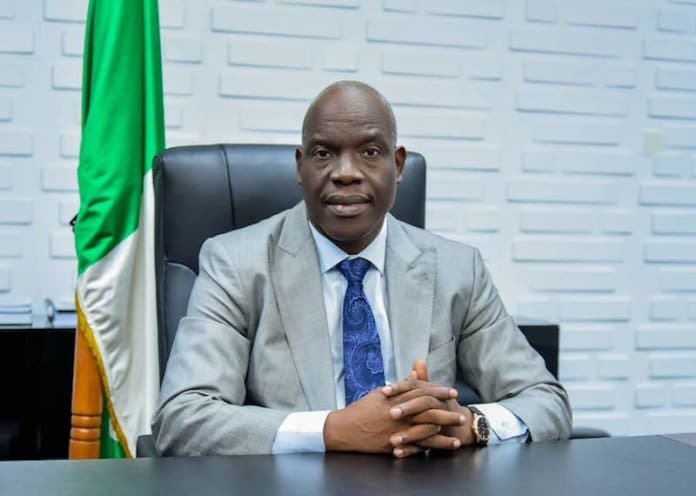
Nigeria’s oil and gas sector reforms have delivered 28 Field Development Plans with $18.2 billion worth of investment commitments in 2025 alone, says Engr. Gbenga Komolafe, Chief Executive of the Nigerian Upstream Petroleum Regulatory Commission (NUPRC).
Komolafe said these commitments are also expected to unlock 1.4 billion barrels of oil and 5.4 trillion cubic feet (TCF) of gas, adding an expected 591,000 barrels of oil per day and 2.1 BSCFD of gas, boosting the country’s aspiration to deliver over 3 million barrels per day of crude oil production.
The NUPRC Chief Executive, who made this known on Tuesday at the Africa Oil Week, held in Accra, Ghana, attributed the achievements to President Bola Tinubu’s renewed hope vision.
In his presentation titled ‘Nigeria’s Competitive Reform Agenda for Unlocking Potentials in Upstream Oil & Gas’, Komolafe reiterated the importance of energy security as the cornerstone of economic growth, national resilience, and shared prosperity in Africa.
He noted that Nigeria’s new energy regime under the Petroleum Industry Act, 2021, ushered in a new era of governance, fiscal reform, and institutional realignment, adding that the NUPRC, which was established by the PIA, has demonstrated that it is a forward-thinking regulator.
Komolafe disclosed that the Commission has rolled out 24 transformative regulations, 19 of which are now gazetted to operationalise key provisions of the PIA.
He said the upstream regulator has unveiled a comprehensive Regulatory Action Plan (RAP), aligned with the PIA, to tackle regulatory bottlenecks, remove entry barriers, and ensure timely and transparent licensing rounds.
According to him, the NUPRC’s transformative initiatives have delivered results, including increasing rig counts from eight in 2021 to 43 as of September 2025.
In 2025 alone, the Commission has approved 28 new Field Development Plans, unlocking 1.4 billion barrels of oil and 5.4 TCF of gas, adding an expected 591,000 barrels of oil per day and 2.1 BSCFD of gas,” Komolafe stated.
These FDPs, with $18.2 billion in CAPEX commitments, underscore Nigeria’s transformation into one of the most dynamic and attractive upstream investment frontiers in the world,” he added.
READ ALSO: NUPRC Defends 2024 Oil Block Licensing, Dines Improper Awards
Other results of the initiatives, according to him, include the $5 billion FID for the Bonga North deep offshore development and the $500 million Ubeta Gas Project. He said these projects “signal renewed long-term commitments, with additional FIDs expected in projects like HI NAG Development, Ima Gas, Owowo Deep Offshore, and Preowei Fields.”
Highlighting other activities of the Tinubu administration since assumption of office, Komolafe mentioned that he has approved five major acquisition deals worth over $5 billion, unlocking opportunities for indigenous players.
He highlighted how transparent execution of the recent bid rounds and concession awards, including the 57 Petroleum Prospecting Licence (PPL) awards in 2022, the 2022 Mini-Bid Round, and the 2024 Licensing Round, fostered competitiveness, drawing exceptional investor participation.
READ ALSO: Nigeria’s Oil Production: Five Years of Fluctuations, Recovery, Key Insights
He explained how optimising signature bonus requirements and removing barriers to entry ensured wider accessibility, resulting in 27 out of 31 blocks offered in 2024 being successfully taken up.
According to him, these developments are laying a strong foundation for fresh investments and accelerated sectoral growth.
He emphasised that while the PIA has laid the foundation, presidential executive orders and other transformative regulatory initiatives have reinforced it, making the country’s oil and gas sector open to veritable investments as they build “a world-class upstream oil and gas environment that rewards ambition, innovation, and responsibility.”

Victor Ezeja is a Nigerian journalist skilled in producing insightful news analyses, feature stories, and interviews that simplify complex issues and drive informed public discourse. His work combines rigorous research, balanced reporting, and compelling storytelling to highlight developments shaping industries and society. Victor, who holds a Master's Degree in Mass Communication, specializes in energy, aviation, business, and economic reporting. He can be reached via @VICTOREZEJA on X