

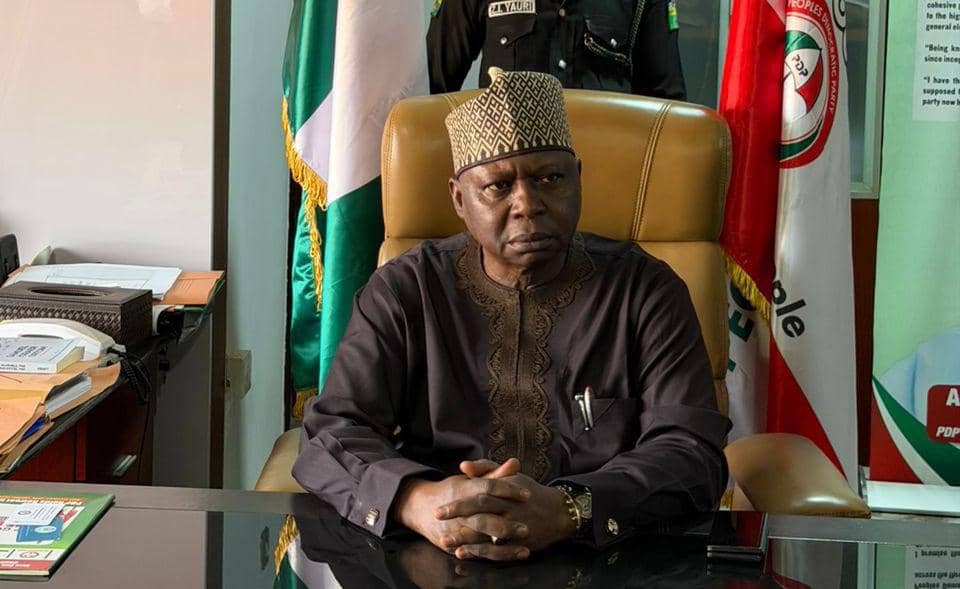
The Supreme Court has ordered a speedy hearing of an appeal challenging the nullification of the Peoples Democratic Party (PDP) national convention held in Ibadan, Oyo State, on November 15 and 16, 2025.
A five-member panel led by Mohammed Lawal granted the request for accelerated hearing of the appeal marked SC/CV/166/2026.
The appeal was filed by the factional national executives of the PDP led by Taminu Turaki, which emerged from the disputed convention.
The appellants, the PDP, its National Working Committee (NWC), and National Executive Committee (NEC) had approached the court through their counsel, Chris Uche, seeking a reduction in the time allowed for parties to file their briefs.
Parties Agree On Urgent Hearing
Arguing the motion, Uche said the matter required urgent determination in the interest of justice, noting that the Independent National Electoral Commission (INEC) has fixed April 23 for the commencement of submission of candidates by political parties.
He told the court that an affidavit of extreme urgency and a 23-paragraph supporting document had been filed.
RELATED NEWS:
- Again, Court Voids Ibadan PDP Convention, Grants Wike Faction Secretariat Control
- PDP Convention: Wike Faction Inaugurates New NWC in Abuja
- Turaki-led PDP to Appeal Court Ruling Nullifying Ibadan Convention
Counsel to the faction aligned with the FCT minister, Nyesom Wike, Emmanuel Ukala, did not oppose the application but asked for 15 days to respond.
INEC and other respondents also raised no objection but requested 10 days to file their processes.
Court Sets Filing Deadline, Hearing Date
In its ruling, the court granted the request for an expedited hearing, directing all respondents to file their responses within five days.
It also ordered the appellants to file replies immediately after receiving those responses.
The apex court fixed April 21 for the completion of all filings and scheduled April 22 for hearing of the substantive appeal.
Appeal Court Upheld Convention Nullification
The dispute stems from a March 9 judgment of the Court of Appeal in Abuja, which upheld earlier decisions stopping the PDP from proceeding with the Ibadan convention.
The appellate court ruled that the convention, which produced the Turaki-led leadership, had no legal backing as it violated two earlier Federal High Court judgments delivered on October 31 and November 14, 2025.
In a judgment delivered by Uchechukwu Onyemenam, the court held that the lower court acted within the law in assuming jurisdiction, as the case involved compliance with the Electoral Act, the 1999 Constitution (as amended), and the PDP’s internal guidelines.
The court also dismissed claims that the matter was purely an internal affair of the party and rejected arguments challenging the legal standing of the plaintiffs.
High Court Faulted PDP Over Procedures
The suit was filed by three PDP members consisting of Austin Nwachukwu, Amah Abraham Nnanna, and Turnah Alabh George aligned with the Wike faction.
Earlier, the Federal High Court ruled that the PDP failed to conduct valid congresses in 14 states before the convention, a requirement for producing delegates.
The court also found that the notice for the convention was improperly issued, as it was signed only by the national chairman without the national secretary, rendering it invalid.
As a result, the court barred INEC from recognising the outcome of the convention until the party complies with constitutional and electoral requirements.
Crisis Deepens As Factions Hold Parallel Conventions
Despite the ruling, the Turaki-led faction proceeded with the convention and later appealed, but the Court of Appeal dismissed the case and awarded N2 million costs against them.
Meanwhile, the faction aligned with Nyesom Wike has held a separate convention in Abuja and produced its own leadership, further deepening the crisis within the PDP.

Rafiyat Sadiq is a political, justice, and human rights reporter with Pinnacle Daily, known for fearless reporting and impactful storytelling. At Pinnacle Daily, she brings clarity and depth to issues shaping governance, democracy, and the protection of citizens’ rights.