

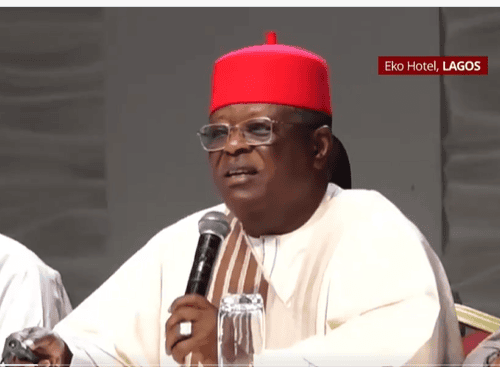
The Works Minister says the Coastal Highway is not responsible for Lagos flooding
Minister of Works, David Umahi, has urged Lagos residents to stop dumping refuse in drainage channels, insisting that it contributes significantly to flooding in parts of the state.
The minister firmly denied that the Lagos-Calabar Coastal Highway is responsible for the recent flooding in the state.
Following a directive from President Bola Tinubu, Umahi and members of the National Assembly conducted an inspection of the highway corridor to address public concerns fueled by social media claims about the coastal highway being responsible for flooding in the area.
During a stakeholder engagement in Lagos on Tuesday, July 7, the Minister explained that the highway was specifically designed to reduce flood risks.
The inspection and subsequent stakeholder engagement followed public reactions that trailed weeks of heavy rainfall that inundated several parts of Lagos, leaving major roads submerged, disrupting traffic and damaging homes and businesses.
The Minister stated that the design of the coastal highway includes multiple culverts, drainage channels, and water evacuation corridors to protect communities from ocean surges and manage stormwater.
“The coastal highway is addressing flooding within this corridor… Before the project, ocean surges threw water into residential areas. What we have done is raise the highway to a mitigated level and introduce multiple culverts and evacuation channels. It has nothing to do with causing flooding,” Umahi insisted.
He further argued that flooding in areas like Victoria Island predates the coastal highway project and that the road acts as a barrier against seawater while improving drainage into the lagoon.
Blame on Refuse Dumping and Blocked Drains
Umahi attributed the flooding to human activities and a failure to implement the state’s drainage master plan. He specifically called on residents to stop blocking culverts and dumping refuse into manholes and drainage channels.
“What is happening is that residents are blocking the culverts, dumping refuse inside the manholes and building on waterways. You cannot eat your cake and have it back. Let the residents stop blocking the culverts, stop dumping refuse into drainage channels and stop building on waterways,” he stated.
He expressed dissatisfaction with the amount of refuse on Lagos roads, saying it contributes significantly to the flooding of roads. He also noted that some designated drainage outlets have not been developed, contributing to the problem.
This view was echoed by the Lagos State Governor Babajide Sanwo-Olu, who said blocked drainage channels remained one of the major causes of flooding in the state.
Governor Sanwo-Olu described Lagos as a coastal city where seasonal flooding is an environmental reality, but emphasised that floodwaters should recede quickly with effective drainage channels.
“Lagos is a coastal city. When people say Lagos has flooded, without mincing words, we will always experience some level of flooding. We only pray that it will not be severe. These are natural occurrences associated with coastal environments across the world,” Sanwo-Olu stated.
On tackling refuse challenges and general environmental management, the governor said the state had begun a major clean-up of the Lagos-Badagry Expressway, adding that environmental regulations are being enforced to protect roads and drainage infrastructure.
READ ALSO:
- Lagos Residents Count Losses as Flood Disrupts Businesses, Submerges Homes
- Bad Roads, Flood Risks Expose Gaps in Edo Infrastructure Spending
- TCN Restores Power Supply After Flooding Triggered Outage in Parts of Lagos
- Video: Heavy Downpour Leaves Parts of Abuja Waterlogged, Raises Flood Concerns
The governor further revealed that the state has signed an agreement with a mechanized street-cleaning firm to deploy specialized six-lane sweeping machines daily to keep the coastal corridor clear of debris.
Recent flooding in the state affected areas including Gbagada, Iyana Ipaja, Ikorodu Road, Ikeja, Maryland, Mushin, Ogudu, Lekki, Oshodi, Agege, Alimosho and Obalende, with sections of the Lagos-Ibadan, Lagos-Abeokuta, Apapa-Oshodi and Lekki-Epe expressways also inundated after persistent rainfall.
Government Response
To address the situation, the Lagos State Government announced approval for the immediate dredging and maintenance of 28 primary drainage channels across the state following recent heavy rainfall.
The government also said it continues to warn residents against indiscriminate refuse dumping, which obstructs the free flow of stormwater and worsens flooding.
Umahi said the Ministry of Works will incorporate additional service lanes and internal drainage channels to help lower-lying communities channel water effectively into the lagoon.
To make room for these new integrated drainage systems and service lanes, the minister said all properties located within 15 metres of the highway corridor will be removed.
He promised comprehensive stakeholder engagements with landlord associations before any demolitions commence.
He also announced the immediate recruitment of 40 surveillance personnel (split into day and night shifts) to monitor the highway, stop illegal refuse dumping, and protect road furniture from vandalism

Victor Ezeja is a Nigerian journalist skilled in producing insightful news analyses, feature stories, and interviews that simplify complex issues and drive informed public discourse. His work combines rigorous research, balanced reporting, and compelling storytelling to highlight developments shaping industries and society. Victor, who holds a Master's Degree in Mass Communication, specializes in energy, aviation, business, and economic reporting. He can be reached via @VICTOREZEJA on X