

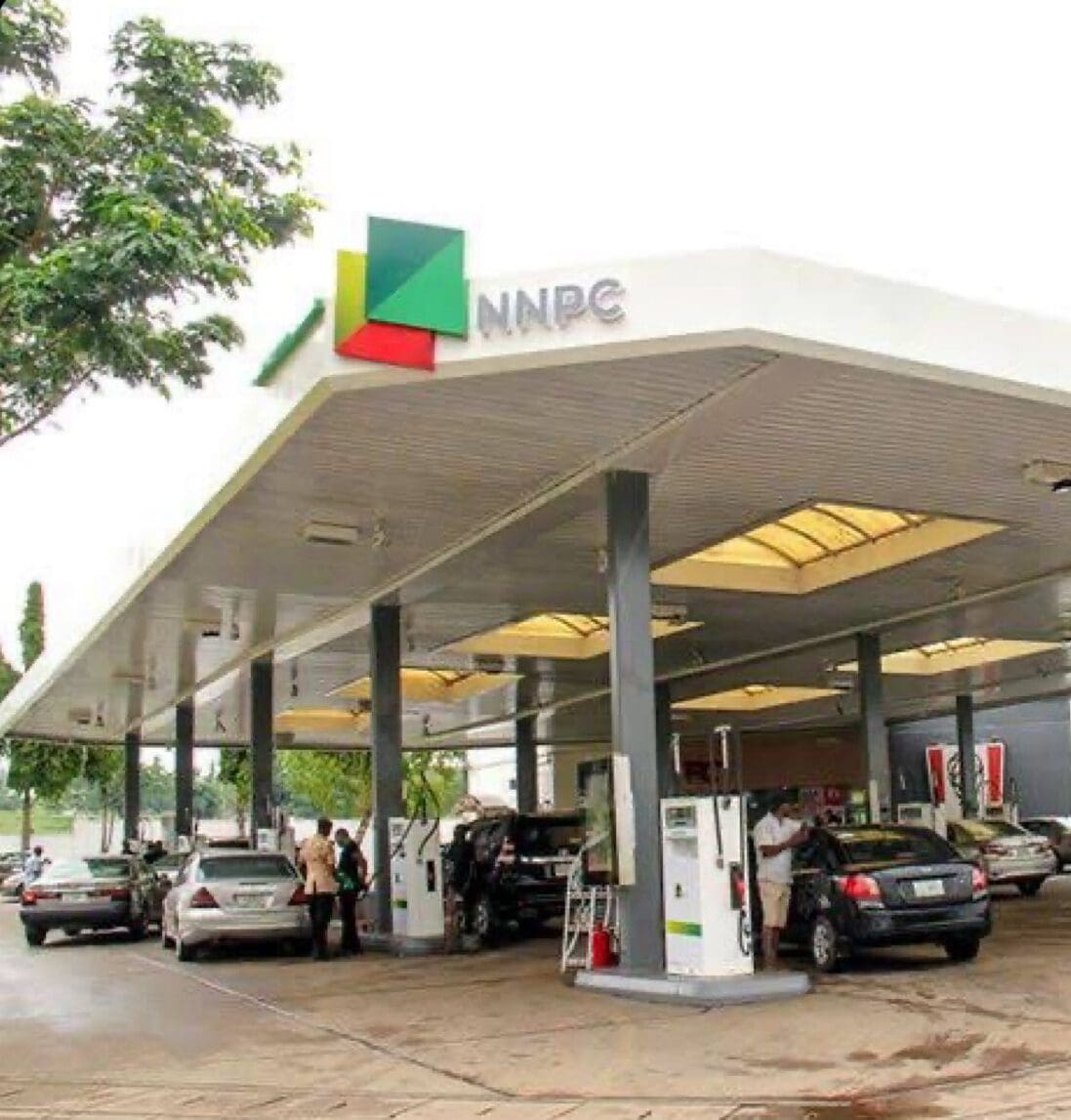
Nigerians have called on the Nigerian National Petroleum Company (NNPC) Limited to drop its pump prices of petrol below what is sold by Dangote Refinery distribution partners.
This public demand further highlights a fascinating shift in Nigeria’s downstream oil market, now characterized by rising competition between the state-owned oil firm and private marketers.
The public demand comes as NNPCL reportedly reduced its petrol pump price to an average of ₦835 per litre in major cities across the country. NNPC retail outlets in Lagos now sell between ₦838 and ₦845 per litre, and Abuja stations at ₦835 per litre.
Analysts described NNPC’s move as a direct response to Dangote’s strategy, which is seen to have sparked intense competition in Nigeria’s downstream petroleum sector.
However, NNPC’s latest petrol pump price is still below the new retail price of ₦739 per litre set by Dangote Refinery’s retail partners, including MRS Oil.
Pinnacle Daily reports that Dangote Refinery, on December 12, announced a significant drop in its ex-depot price (which is what marketers pay to load fuel at the refinery gate) from ₦828 to ₦699 per litre. Subsequently, the President of the Dangote Group, Aliko Dangote, said the refinery would collaborate with independent marketers to ensure that petrol sells below ₦800 per litre to make the commodity more affordable to the Nigerian public.
Twenty-four hours after Dangote’s announcement, a couple of MRS filling stations in parts of Lagos started selling petrol at ₦739 per litre, attracting long queues of commuters and motorists who came to buy the commodity.
READ ALSO: NNPC Revenue Rises by 18.9% as Profit Doubles in October
The price war, which is coming during the festive season, with heightened travel demand, is believed to offer relief to consumers, at least in the short term.
Why Nigerians are Urging NNPC to Go Lower
The calls for NNPC to sell cheaper price than Dangote are driven by several factors, including the notion of state-owned advantage, market leadership expectations, and pressure on transport costs. As gleaned from responses of those who spoke to Pinnacle Daily and comments of Nigerians on social media in reaction to the price cuts, many citizens believe that, as a state-owned entity with access to “cheaper” domestic crude and existing infrastructure, NNPC should naturally have the lowest prices to serve as a social safety net.
Historically, NNPC stations (NNPC Retail) have always been the “cheapest” option. Seeing a private refinery undercut the state company has changed the public’s perception of what is possible under deregulation.
READ ALSO:
- Dangote Says Petrol Pump Price will drop to N740/litre, Accuses NMDPRA of Sabotage
- Fuel, Elections, Bad Loans: 15 Things CBN’s Experts Warned Could Hurt Nigerians
- Petrol Imports Drop as Dangote Refinery Covers 91% Domestic Supply
Also, while ₦835 is a relief from previous highs of over ₦1,000, NNPC’s price is still nearly ₦100 higher than Dangote’s price, hence commuters are pushing for a uniform lower rate to force transport fares down across board.
“The NNPC we used to know should lead the way by selling petrol cheaper to Nigerians than a private refinery like Dangote,” Mark Edward, a trader at Ladipo market, Lagos, told Pinnacle Daily in a chat.
Ahmed Nasiru, a commercial driver, said NNPC should show it has the upper hand in bringing relief to the masses by making sure its prices are lower than Dangote retail partners. “We want the competition to continue so that fuel prices will continue to go down. The people are suffering due to the high cost of things. NNPC should show us it is a government company by making its fuel cheaper,” Nasiru said. He added, “We used to form long lines at NNPC filling stations when they were known for selling cheaper price.”
“Dangote is still cheaper, I was expecting NNPC to compete with Dangote and slash theirs to 500 Naira,” an X user, Onyeani Kalu, stated.
“NNPC should sell lower than Dangote in reality,” another X user, Yasser Asekome, stated.
“There’s still a ₦100 difference. I know where to buy,” Dolapa, another X user wrote.
While some expressed their delight at the impact of the ensuing competition on price, others raised concerns about the potential implications when Dangote Refinery succeeds in dominating the market.
READ ALSO: Dangote to Petrol Marketers: Register and Enjoy ₦699 Gantry Price
However, countering the concerns about potential monopoly, an X user identified as Hon. Red Pen said if NNPC, which has “structural and institutional advantages” that Dangote Refinery does not have, is unable to effectively compete with the refinery, then the issue is not beyond an imagined monopoly.
According to him, NNPC is an oil producer, has four refineries and an extensive nationwide network of pipelines and depots, which Dangote does not have. “If, despite these structural and institutional advantages, NNPC is unable to compete effectively, then the issue is not Dangote or an imagined monopoly,” he added. “A state-backed oil giant with superior assets should not be outperformed by a private refinery unless something is fundamentally broken.”
Challenges for NNPC
Analysts observed that NNPC faces a dilemma. If it drops prices too far below its landing or production costs, it risks returning to a “hidden subsidy” era, which the government has officially ended. However, if it keeps prices higher than Dangote, it loses customers to filling stations owned by independent marketers, as evidenced by the vanishing queues at many NNPC retail outlets in recent times.
Tunde Ayinde, a data analyst and public affairs commentator, called on NNPC to focus on forging strategic partnerships with competent private investors to build larger functional refineries to boost local production.
“NNPC has no business selling petrol at filling stations. It should partner with private investors to build a larger capacity refinery, sell crude to other refineries and refined products to independent marketers,” Ayinde stated on X. He also called for an end to the importation of refined crude, stressing the implications on foreign exchange reserves, and energy self-sufficiency.
Over 1,000 trucks load petrol daily at Dangote Refinery
Meanwhile, Dangote Refinery has announced that over 1,000 trucks now load petrol at the refinery’s gantry daily.
A statement released on Friday said the recent reduction of gantry price has led to overwhelming interest from marketers, with the refinery now recording over 1,000 trucks loading petrol daily from its facility.
“Since the announcement, the response from fuel marketers has been overwhelming. The refinery now records over 1,000 trucks loading PMS daily from its gantry, a clear testament to market trust in the Dangote Refinery’s efficiency and leadership in the downstream sector,” the refinery stated.
In a post on its X handle on Saturday, December 20, the refinery also announced that it has reduced its minimum order quantity for bulk buyers from 500,000 to 250,000 litres to enjoy a 10-day credit facility backed by a bank guarantee.
“All existing and new customers can now purchase 250,000 litres with the benefit of a 10-day credit facility backed with a bank guarantee,” it stated, adding that free delivery to registered petrol stations starts soon.

Victor Ezeja is a Nigerian journalist skilled in producing insightful news analyses, feature stories, and interviews that simplify complex issues and drive informed public discourse. His work combines rigorous research, balanced reporting, and compelling storytelling to highlight developments shaping industries and society. Victor, who holds a Master's Degree in Mass Communication, specializes in energy, aviation, business, and economic reporting. He can be reached via @VICTOREZEJA on X