

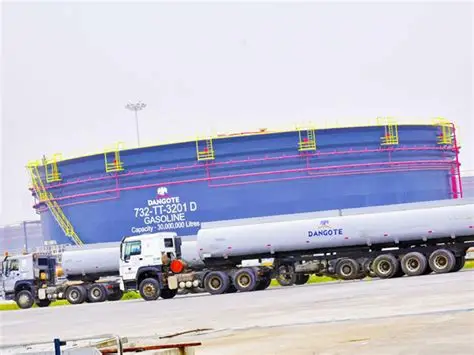
Dangote Petroleum Refinery & Petrochemicals has reassured the Nigerian public of its capacity and commitment to supply a substantial volume of petrol to meet the nation’s daily needs.
The refinery, which recently hit its full capacity of 650,000 barrels per day after a major turnaround maintenance, said it will supply between 60 and 65 million litres of Premium Motor Spirit (PMS), also known as petrol, daily to the domestic market.
President of Dangote Group, Aliko Dangote, who revealed this in Lagos on Tuesday, said the supply will be channeled through a select group of depot owners and major marketers in a move to stabilize distribution and achieve fuel self-sufficiency.
“We have agreed an offtake framework to supply up to 65 million litres daily for the domestic market,” Dangote said, adding, “Any surplus, estimated at between 15 and 20 million litres, will be exported,” Dangote stated.
This surpasses Nigeria’s average daily consumption of 50-60 million litres.
A Fact Sheet released by the Nigerian Midstream and Downstream Petroleum Regulatory Authority (NMDPRA) recently showed that Nigeria’s daily consumption of petrol in January was 60.2 million litres, down from 63.7 million litres per day recorded in December 2025.
READ ALSO:
- Fuel Sufficiency Boost as Dangote Refinery Finally Hits 650,000bpd Capacity
- Dangote Overtakes Importers, Supplies 62% of Nigeria’s Petrol Market
- Dangote Refinery Cuts Petrol Ex-Depot Price to ₦774 per Litre Amid Rising Competition with Importers
- NNPC’s Gas Master Plan Targets 12 bcf/d by 2030, Attract Massive Investments
During a visit to the refinery in Lagos last weekend, NNPC Group Chief Executive Officer, Engr Bayo Ojulari, confirmed that the facility has even surpassed its nameplate capacity, reaching 661,000 bpd according to live data they observed.
In the revised distribution system approved by NMPDRA, an offtake agreement has been signed with 12 major marketing companies to ensure nationwide availability. They include NNPC Retail, MRS Oil, TotalEnergies, Ardova Plc, Conoil, Mobil, Rainoil, Masters Energy, Northwest Petroleum & Gas Company, Bovas, AA Rano, and AYM Shafa.
Dangote stressed that the new distribution framework is designed to eliminate supply bottlenecks, reduce hoarding, and stabilize pump prices across the country.
The move represents a significant shift from the previous system in which products were sold to all classes of petroleum marketers, including independent marketers.
This controlled distribution structure is similar to the framework introduced earlier when only a limited number of major marketers were granted direct access to refined petroleum products.
Under the new arrangement, depot owners and major marketers will lift products from the refinery and then be responsible for distributing petrol from their facilities, determining ex-depot prices for subsequent buyers, including independent marketers.
Industry analysts said this new model aims to create a more efficient and reliable supply chain, marking a significant break from Nigeria’s long history of fuel import dependence.
The January 2026 NMPDRA report showed that the domestic supply of petrol by Dangote Refinery has reached 62 per cent of the total supply, surpassing imports, which had previously dominated the supply mix.
Economic Impact
This shift to local refining is expected to save Nigeria billions of dollars annually that were previously spent on imports, which could help ease pressure on the naira and strengthen foreign reserves. Analysts estimate the shift could save Nigeria up to $10 billion annually in foreign exchange and significantly ease pressure on the Naira.

Victor Ezeja is a Nigerian journalist skilled in producing insightful news analyses, feature stories, and interviews that simplify complex issues and drive informed public discourse. His work combines rigorous research, balanced reporting, and compelling storytelling to highlight developments shaping industries and society. Victor, who holds a Master's Degree in Mass Communication, specializes in energy, aviation, business, and economic reporting. He can be reached via @VICTOREZEJA on X