

After billionaire Elon Musk claimed Nigeria recorded more births in 2025 than the entire European Union, Pinnacle Daily examined the data behind the debate. The findings suggest the country’s biggest challenge may not be population growth, but where people live and where opportunities exist.
When billionaire entrepreneur Elon Musk posted that Nigeria recorded four million more births in 2025 than the entire European Union, the statement quickly ignited debate across social media.
Some Nigerians viewed it as further evidence that the country’s rapidly growing population is becoming an economic burden, placing increasing pressure on jobs, schools, hospitals, housing and other public services.
Others disagreed, arguing that Nigeria’s challenge is not the number of children being born but decades of poor planning, weak infrastructure and uneven economic development.
The contrasting reactions prompted Pinnacle Daily to examine the data behind the debate.
Is Nigeria truly overpopulated, as many believe? Or is the country’s development challenge more complex than population figures alone suggest?
To answer these questions, Pinnacle Daily analysed the latest global population density rankings alongside demographic data and expert arguments that emerged following Musk’s post.
The findings challenge one of the most common assumptions about Nigeria.
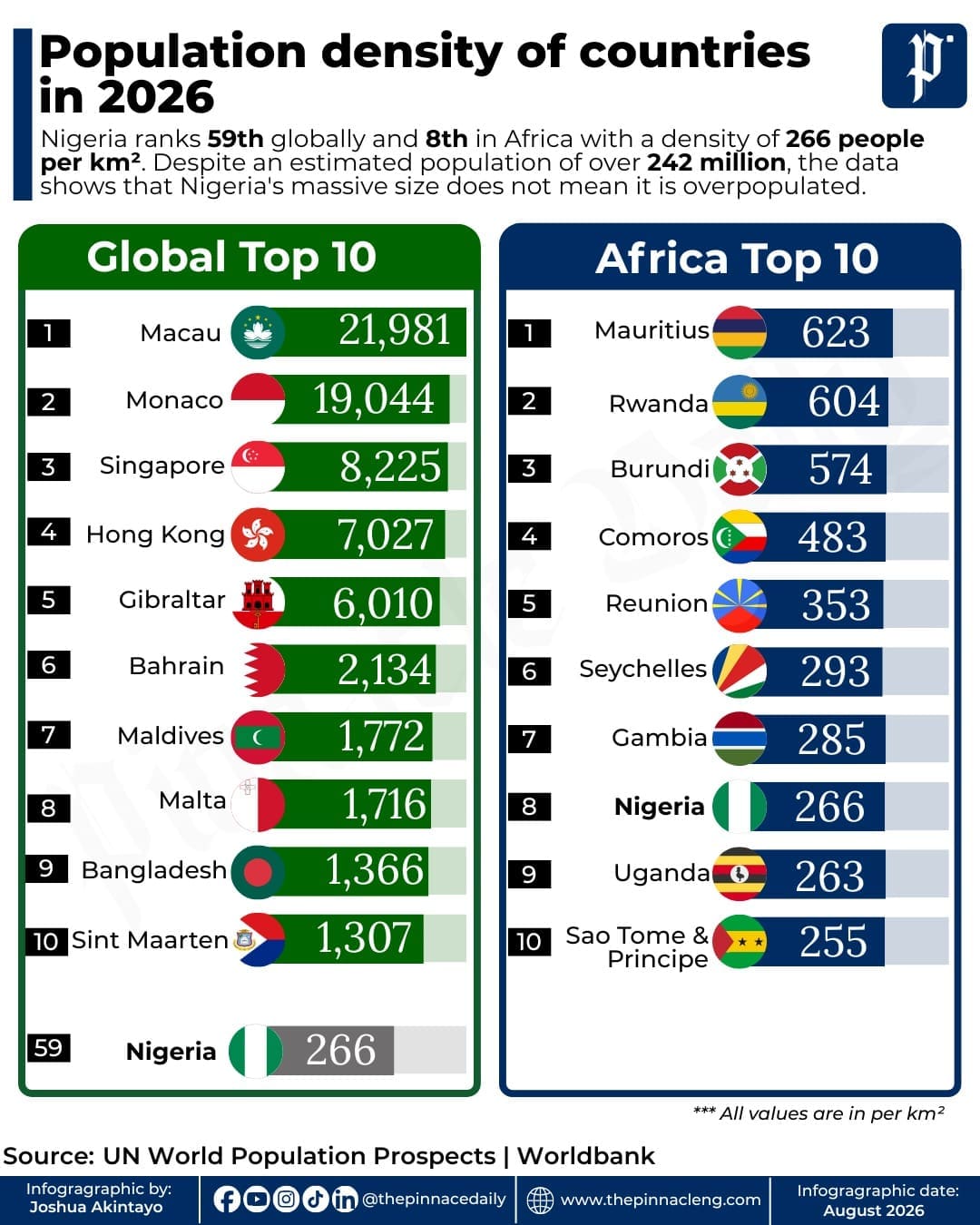
Despite being Africa’s most populous nation with an estimated 242 million people, Nigeria is not among the world’s most densely populated countries.
Instead, the country ranks 59th globally and eighth in Africa, with an average population density of about 266 people per square kilometre.
The figures suggest that Nigeria’s biggest challenge may not simply be how many people it has, but how economic opportunities, infrastructure and public services are distributed across the country.
The Tweet That Shifted the Debate
As Musk’s comments continued to generate reactions, Nigerian investigative journalist David Hundeyin argued that the debate was focusing on the wrong metric.
Responding on X, Hundeyin said discussions about overpopulation should be based on population density rather than population size, pointing to countries with far higher densities that continue to provide better living standards.

“The only way to end this argument is to use data. People should Google the Netherlands’ population density and compare it to anywhere in Africa. Yet despite that number, have you ever heard anyone refer to the Netherlands as ‘overpopulated’? And if not, why? Argument over.”
His post shifted the conversation from birth rates to a broader question:
Is Nigeria’s problem population growth or decades of uneven development?
That question became the focus of Pinnacle Daily’s analysis.
Population Size Is Not Population Density
One of the biggest misconceptions in public discussions is treating population size and population density as the same thing. They are not.
Population refers to the total number of people living in a country. Population density measures how many people occupy every square kilometre of land.
A country may have a very large population but still have relatively low density if it occupies a large landmass. That is exactly Nigeria’s situation.
According to the latest population density figures, Nigeria has an estimated population of more than 242 million people, yet averages only 266 people per square kilometre.
That places the country 59th globally and eighth in Africa.
The figures suggest that despite having Africa’s largest population, Nigeria is nowhere near the world’s most densely populated nations.
The Global Rankings Tell a Different Story
Globally, Macau tops the list with approximately 21,981 people per square kilometre.
It is followed by Monaco (19,044), Singapore (8,225), Hong Kong (7,027) and Gibraltar (6,010).
Nigeria’s 266 people per square kilometre is only a fraction of those figures.
Even within Africa, Nigeria is far from the continent’s most densely populated country.
Mauritius ranks first with 623 people per square kilometre, followed by Rwanda (604), Burundi (574) and Comoros (483).
Nigeria ranks behind seven African countries despite having the continent’s largest population.
The numbers challenge the widespread assumption that Nigeria’s development challenges stem simply from having too many people.
So Why Does Nigeria Feel Overcrowded?
If Nigeria is not among the world’s most densely populated countries, why do Lagos, Abuja, Kano, Port Harcourt and other major cities appear overwhelmed?
The answer lies in where Nigerians live.
For decades, industries, government institutions, financial services, manufacturing, healthcare, higher education and employment opportunities have remained concentrated in relatively few cities.
Millions of Nigerians continue to migrate to these urban centres in search of better lives.
The result is enormous pressure on roads, transportation systems, schools, hospitals, electricity, water supply and housing.
Meanwhile, vast parts of the country remain sparsely populated, with fewer industries, weaker infrastructure and limited economic opportunities.
The country’s challenge, therefore, is less about population size and more about the uneven distribution of people and development.
When Opportunity Exists in Only a Few Places
Nigeria’s rapid urbanisation reflects a deeper economic imbalance. Businesses naturally establish operations where infrastructure already exists.
Young graduates relocate where jobs are available. Investors prefer cities with better roads, electricity and access to markets.
As a result, Lagos, Abuja and a handful of other cities continue to attract millions of new residents every year while many smaller towns struggle to attract investment.
This uneven pattern has created overcrowded urban centres alongside underdeveloped rural communities.
Housing Pressure Is More Than a Population Problem
Nigeria’s housing deficit is frequently blamed on population growth. However, the data suggests a more complex reality.
Experts have consistently pointed to poor urban planning, rising construction costs, expensive mortgages, weak land administration and inadequate investment in affordable housing as major drivers of the crisis.
As millions compete for limited housing in the same cities, rents continue to rise while informal settlements expand.
The issue is therefore not simply that Nigeria has too many people. It is that too many people are competing for opportunities in too few locations.
Can Population Become an Economic Advantage?
History suggests that large populations can become powerful economic assets.
China and India transformed their large populations into manufacturing powerhouses by investing heavily in education, industrialisation and infrastructure.
Several countries with significantly higher population densities continue to enjoy high standards of living.
Singapore accommodates more than 8,000 people per square kilometre.
The Netherlands is among Europe’s most densely populated countries.
Yet neither is routinely described as “overpopulated.”
Their experience demonstrates that prosperity depends less on how many people a country has and more on how effectively those people are educated, employed and supported by infrastructure.
What Nigeria’s Numbers Really Mean
The Pinnacle Daily analysis suggests that the country’s development debate may have focused on the wrong question.
Instead of asking whether Nigeria has too many people, policymakers may need to ask why economic opportunities remain concentrated in only a handful of cities.
The country’s demographic challenge is not merely population growth.
It is ensuring that growth is matched by investments in education, healthcare, infrastructure, industrialisation, agriculture, technology and job creation across every region.
Without balanced development, migration into already congested cities will continue regardless of birth rates.
READ ALSO:
- FG Unveils Miss Nigeria as Official Representative to Miss World 2026
- 2027 Elections: Why Millions of Eligible Nigerians May Not Vote
- Nigeria, Africa Could Add 4% to GDP by Removing AI Barriers — IMF
- NiDCOM Secures Release of Nigerian Girls Detained in Mauritius
Elon Musk’s comments reopened an important conversation. David Hundeyin’s response reminded Nigerians that population debates should be grounded in evidence rather than assumptions.
The data provides valuable context. Despite being Africa’s largest country by population, Nigeria ranks only 59th globally in population density.
The figures suggest that the country’s greatest challenge may not be the number of people it has, but how opportunities, industries, infrastructure and public services are distributed across its vast landmass.
As Nigeria’s population continues to grow, the debate may need to shift from birth rates to better planning.
Because the real question is no longer whether Nigeria is overpopulated.
It is whether the country can transform its growing population into a demographic dividend through inclusive development, strategic investment and effective governance.
Ultimately, Nigeria’s future will depend less on how many people it has, and more on what it does with them.
PINNACLE DAILY DATA DESK BY JOSHUA AKINTAYO
Nigeria at a Glance (2026)
| Indicator | Data |
|---|---|
| Estimated Population | 242 million+ |
| Global Population Density Rank | 59th |
| Africa Population Density Rank | 8th |
| Population Density | 266 people per km² |
Africa’s Top 10 Most Densely Populated Countries
| Rank | Country | People/km² |
|---|---|---|
| 1 | Mauritius | 623 |
| 2 | Rwanda | 604 |
| 3 | Burundi | 574 |
| 4 | Comoros | 483 |
| 5 | Réunion | 353 |
| 6 | Seychelles | 293 |
| 7 | Gambia | 285 |
| 8 | Nigeria | 266 |
| 9 | Uganda | 263 |
| 10 | São Tomé & Príncipe | 255 |
Global Top Five
| Rank | Country | People/km² |
|---|---|---|
| 1 | Macau | 21,981 |
| 2 | Monaco | 19,044 |
| 3 | Singapore | 8,225 |
| 4 | Hong Kong | 7,027 |
| 5 | Gibraltar | 6,010 |

Esther Ososanya is an investigative journalist with Pinnacle Daily, reporting across health, business, environment, metro, Fct and crime. Known for her bold, empathetic storytelling, she uncovers hidden truths, challenges broken systems, and gives voice to overlooked Nigerians. Her work drives national conversations and demands accountability one powerful story at a time.