

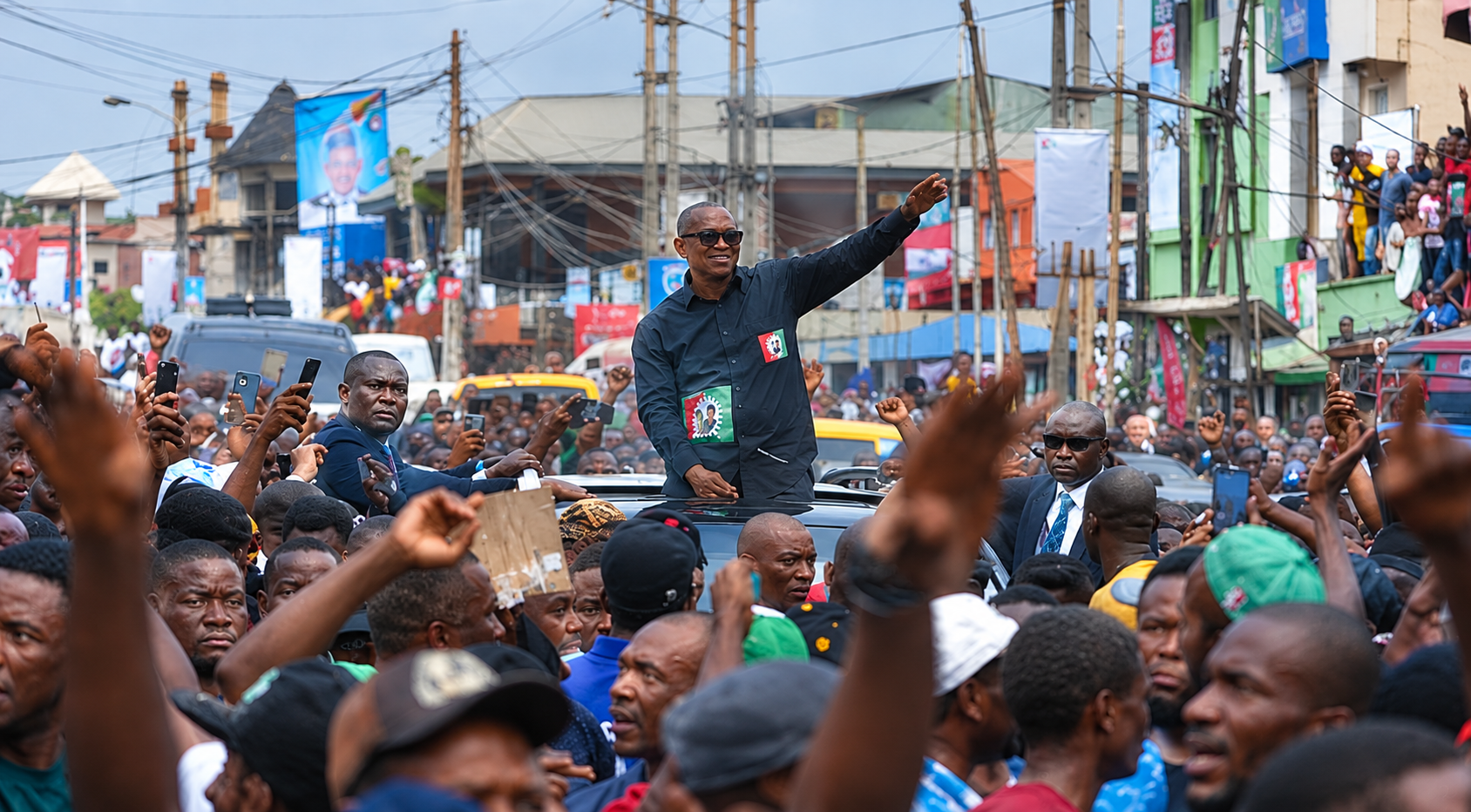
From a cancelled humanitarian visit in Benue to a warning in Edo that he should not return without security clearance, and later an armed attack on a convoy carrying him and other opposition figures, Peter Obi’s movements across some Nigerian states have repeatedly become matters of political and security controversy.
The incidents, occurring at different times and under different circumstances, have produced competing explanations from state governments, political parties, security agencies, lawyers and other stakeholders.
The latest episode came on September 8, 2026, when Obi, now the presidential candidate of the Nigeria Democratic Congress (NDC), was stopped from proceeding along the Makurdi-Gboko federal highway during a visit to Benue State.
Obi said he was on his way to Yelwata to meet families affected by the deadly June 2025 killings when youths blocked his convoy and shouted for him to leave.
The Benue State Government denied sending anyone to obstruct him, while the police confirmed that his movement had been blocked and later arrested 46 suspects in connection with the incident.
The development has revived an old question in Nigerian politics: where does a government’s responsibility for security and public order end, and where does an opposition politician’s constitutional right to move and campaign begin?
The Benue Roadblock: Two Accounts, One Disrupted Visit
Obi, who arrived in Benue on September 8, said he intended to visit Yelwata in Guma Local Government Area to sympathise with families affected by the June 2025 killings.
According to Obi, his convoy encountered a roadblock near the Nigerian Air Force Base on the Makurdi-Gboko road. He alleged that youths, some carrying sticks and other objects, prevented the convoy from proceeding.
RELATED NEWS:
- Obi’s Style of Politics: Hope for the Masses or Hustle for Power
- Tanko Releases Obi’s 2014 Handover Report Amid Anambra Debt Dispute
- Anambra Govt Releases Details of Obi Loans, Disputes N2.13bn Ecological Fund Claim
- Is 4 Years Enough? The Big Question Behind Obi’s One-Term Promise
- ‘I Left ₦2.13bn Ecological Fund Intact’, Obi Replies Anambra Govt
Videos from the scene showed a large group blocking the road as Obi’s convoy turned back. Obi called for the intervention of the Inspector-General of Police and other security agencies, saying political actors should not use youths to obstruct opponents.
The NDC alleged that the group was led by an aide to Governor Hyacinth Alia and called for an investigation. The party described the incident as an obstruction of a visit intended to offer condolences to victims of the Yelwata killings.
But the Benue State Government rejected the allegation.
Governor Alia’s Chief Press Secretary, Kula Tersoo, said the state government was not aware of Obi’s visit and denied deploying thugs to stop him. The government argued that any disagreements involving Obi and political actors in the state should not be attributed to the administration.
The state Commissioner for Information and Culture, Solomon Lorpev, similarly said Alia had not been officially notified. He maintained that the government could not have organised an operation against a visitor whose arrival, according to its account, it did not know about.
That explanation, however, ran into a complication from the police account.
Reactions Trail Obi Benue Alleged Attack

The Benue incident has generated responses from across the political spectrum.
Former Benue State Governor Samuel Ortom condemned the blockade and said Obi should have been allowed to visit Yelwata to sympathise with victims. He described the incident as inconsistent with democratic principles.
Minister of Aviation and Aerospace Development Festus Keyamo also condemned the obstruction. Keyamo said that whether the protest arose from internal NDC disagreements, was sponsored by the APC, or was motivated by another political interest, it should not be part of democratic practice.
Oyo State Governor and APM presidential candidate Seyi Makinde also condemned the incident and alleged that the blockade reflected an effort to intimidate opposition figures. That allegation remains his political position and has not been established by the police investigation cited above.
NDC leaders, including Ovie Omo-Agege, called for an investigation to identify not only those physically involved but also whoever organised or financed the blockade.
The three major Benue socio-cultural organisations — Mdzough U Tiv, Ochetoha K’Idoma and Omi Ny’Igede — also condemned the obstruction and urged youths to reject violence while calling for greater protection for visitors undertaking humanitarian missions.
An APC faction in Benue also condemned the incident and called for an apology from the governor, while the wider Benue Government continued to deny involvement.
Police Say They Were Notified
Benue Police Commissioner Cletus Nwadiogbu said police were notified of Peter Obi’s visit on September 7 and deployed security personnel to escort him.
The police commissioner later clarified that the NDC did not ask him to transmit the notification letter to Governor Alia. He said the party had approached the police primarily to facilitate security arrangements and that the command provided the requested protection.
After his convoy was blocked, officers escorted him back to the airport and arrested 46 suspects. The police said there was no evidence at the time linking the suspects to the APC or Benue Government, which denied involvement.
A Second Benue Episode After The 2025 Warning

The September 2026 blockade was not Obi’s first disputed encounter with Benue authorities.
In April 2025, the former Labour Party presidential candidate planned a visit to Benue as part of a humanitarian outreach involving IDP camps, schools and health institutions.
Governor Alia’s office issued a warning against what it described as an unscheduled visit. The statement said the government could not guarantee the safety of people entering the state without its knowledge and said visitors to IDP camps should obtain written permission from the Benue State Emergency Management Agency.
Obi subsequently cancelled the Benue leg of the trip. He said he had tried to reach Alia and his aides before travelling from Plateau State but received no confirmation. He argued that his planned activities were humanitarian rather than political.
Alia later defended the decision, saying it was motivated by security and protocol concerns rather than politics. He said high-profile visitors should inform the state government and relevant authorities in advance.
Then Came Edo: ‘Do Not Come Without Security Clearance’
The issue also resurfaced dramatically in Edo State in July 2025.
Obi visited Benin City on July 7, 2025, and donated N15 million to St Philomena Hospital School of Nursing Sciences to support ongoing projects.
Eleven days later, Governor Monday Okpebholo, speaking at a political event in Uromi, warned Obi against returning to Edo without security clearance. The governor linked the former Anambra governor’s previous visit to a subsequent resurgence of violence and the deaths of three people.
The wording triggered immediate backlash from lawyers, political figures and Obi’s supporters.
Human rights lawyer and Senior Advocate of Nigeria, Femi Falana, asked Okpebholo to withdraw the warning and apologise.
The Labour Party’s Senate caucus also condemned the statement and cited Section 41 of the Constitution, arguing that Obi’s movement could not be curtailed by an executive directive.
Former Labour Party campaign spokesperson Kenneth Okonkwo similarly argued that Section 41 protects the right of Nigerian citizens to move freely throughout the country.
Obi himself later said he was not afraid of visiting any state, particularly when his purpose was to support education, healthcare and poverty alleviation.
But Okpebholo subsequently said his comment had been misunderstood.
Through his Chief Press Secretary, Fred Itua, the governor said he had not threatened Obi but was emphasising security protocols for high-profile and politically exposed persons visiting the state. Okpebholo later repeated that he wanted Obi to notify him as Edo’s Chief Security Officer when visiting the state.
Edo Also Recorded A Separate Gun Attack

The Edo controversy got another dimension in February 2026, when gunmen reportedly attacked an ADC gathering in Benin City.
Obi and former Edo governor John Odigie-Oyegun were among opposition figures who had attended an event at the ADC secretariat following Olumide Akpata’s move into the party. Reports said armed men later opened fire on the convoy as it moved towards Oyegun’s residence.
Vehicles were damaged, while Obi and other occupants were reported to have escaped unharmed. The identity and motive of the attackers were not immediately established in the reports.
An Anambra lawmaker, Ifeanyi Uzokwe, subsequently called on the police to investigate the incident, alleging that it was an assassination attempt.
The Pattern Predates The 2027 Race
The disputes involving Obi did not begin with the present election cycle.
During the 2023 campaign, Obi’s campaign said his convoy was attacked after a rally in Katsina in January 2023. The campaign alleged that hoodlums threw heavy stones at his vehicle on the way to the airport, damaging the car, although Obi and the other occupants were unhurt. It also reported damage to vehicles around the rally venue.
The Socio-Economic Rights and Accountability Project (SERAP) subsequently called for an investigation into the incident and other cases of election-related intimidation and violence.
A few weeks later, Labour Party supporters travelling to Obi’s final presidential campaign rally in Lagos were attacked by hoodlums. The Lagos police confirmed that four people were injured and said an investigation had commenced. The APC in Lagos denied involvement.
Earlier, in September 2022, police disrupted a pro-Obi solidarity march in Abakaliki, Ebonyi State, using tear gas. Governor David Umahi denied ordering the disruption, while the police said the operation was related to maintaining law and order. The rally later continued.
Taken individually, the incidents had different circumstances. Collectively, however, they show that access, rally coordination, security and political tolerance have repeatedly intersected around Obi and his supporters.
Beyond Obi: When Security Measures Become Political Questions
In March 2025, the Kogi State Government banned rallies and public gatherings, citing security threats, and required clearance for convoys entering the state with security personnel.
The move came ahead of suspended Senator Natasha Akpoti-Uduaghan’s planned homecoming. While the government said the measures were temporary and generally applicable, the SDP accused it of targeting opposition activities, underscoring the tension between security concerns and political freedoms.
What Does The Constitution Actually Say?
In an interview with Pinnacle Daily, Senior Advocate of Nigeria, Jibrin Samuel Okutepa, addressed the broader constitutional question raised by the incidents.
Asked whether authorities could restrict a presidential candidate’s movement, Okutepa said: “The Constitution, as I have said, guarantees freedom of movement.”
He argued that the Constitution is supreme and binding on government authorities and political actors.
“Not too long ago, a presidential candidate was stopped from moving. Despite the fact that under Sections 39 and 40 of the Nigerian Constitution, freedom of movement and related rights are protected,” he said.
Section 41(1) provides that every Nigerian citizen is entitled to move freely throughout Nigeria and reside in any part of the country.
The right is not entirely absolute. Section 41(2) recognises certain restrictions provided by law, including restrictions on the movement of a person who has committed or is reasonably suspected of committing a criminal offence in order to prevent the person from leaving Nigeria. Section 45 also permits certain limitations on fundamental rights where a law is reasonably justifiable in a democratic society for specified purposes, including public safety and public order.
Okutepa, however, explained that while notifying security agencies such as the police is necessary for operational logistics and public safety, informing a state governor is a matter of courtesy and political protocol, not a legal prerequisite.
He emphasized that once aware of a visitor’s presence, a state governor—as chief executive—holds a duty to ensure the safety of all lives within the state, rather than using security concerns as a pretext for restriction.
Okutepa expressed worry that Nigerian politics has increasingly shifted away from a competing marketplace of policy ideas toward obstructive confrontation. He argued that healthy democratic competition relies on the free exchange of arguments and policies, allowing citizens to evaluate candidates on merit during periodic elections rather than through administrative barriers.
The 2027 Question
The incidents in Benue, Edo, and other states underscore a key debate ahead of the 2027 elections: how to balance state security responsibilities with constitutional guarantees of free movement under Section 41. While state governments cite public safety and protocol concerns, opposition figures and legal experts argue these measures risk functioning as administrative barriers to political access.
As the 2027 campaigns begin, the key issue will be whether security regulations are enforced fairly and lawfully without becoming tools for limiting opposition access.
As Okutepa told Pinnacle Daily: “There is nowhere democracy thrives where the rule of law has taken a background stage.”

Rafiyat Sadiq is a political, justice, and human rights reporter with Pinnacle Daily, known for fearless reporting and impactful storytelling. At Pinnacle Daily, she brings clarity and depth to issues shaping governance, democracy, and the protection of citizens’ rights.