

By Sunday Michael Ogwu
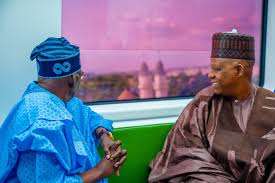
A storm may be brewing at Nigeria’s highest political table. What started as whispers of tension between President Bola Ahmed Tinubu and Vice President Kashim Shettima has grown into what many insiders describe as a quiet but strategic cold war.
The recent fallout over the handling of the Rivers State political crisis has further deepened suspicions, with both camps now walking a political tightrope.
Cracks in the Foundation
It began with a speech—seemingly benign but packed with political undertones. Vice President Shettima, while speaking at the launch of a memoir by former Attorney General Mohammed Bello Adoke, recounted how the Jonathan administration once sought to remove him as governor of Borno State during the Boko Haram insurgency.
He credited Adoke for resisting the move and upholding constitutional integrity.
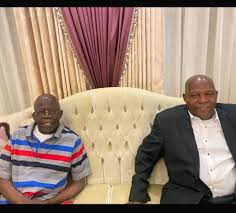
“I admire Mr Adoke fundamentally for his courage, his conviction, and his capacity to stand for what he believes in,” Shettima said, adding, “He told the then President, ‘Mr President, you do not have the power to remove the Governor.’”
Though Shettima made no direct reference to President Tinubu or current events, many drew parallels between his experience and the state of emergency recently declared in Rivers State. Under that proclamation, Governor Sim Fubara and his deputy were suspended, and a sole administrator was appointed.
Presidency Pushes Back
The presidency swiftly denied any rift. Stanley Nkwocha, a senior aide to the vice president, dismissed the interpretation as a “gross misrepresentation” and said Shettima’s speech was purely historical. “It was an intellectual discourse on Nigeria’s constitutional evolution, not a commentary on the current political landscape,” he explained.
Nkwocha further defended President Tinubu’s actions in Rivers, arguing they were legally grounded in Section 305 of the 1999 Constitution. “There was no removal—only a suspension to address grave political instability and looming threats to public safety,” he added.
Old Judgement, New Relevance
Legal observers, however, see deeper implications. A 2007 Supreme Court ruling declared that while a vice president must be loyal to the president, he is “not a slave with no will or opinion of his own”. The judgement—delivered during the Obasanjo-Atiku rift—reverberates today as Shettima seems determined to assert his individuality.
READ ALSO: Peter Obi: ADC Adoption Was a Tough But Necessary Decision
In the words of journalist Andrew Agbese, “The vice president is not a subordinate appendage. He’s a constitutional actor with his own mandate.”
2027 and the Politics of Endorsement
Fuelling the tension are rumblings from within the All Progressives Congress (APC).
A recent North-East APC consultative meeting in Gombe ended in chaos after key leaders endorsed President Tinubu for 2027 but omitted Shettima from the ticket.
Delegates from Borno, Shettima’s home state, reacted with fury. Security had to escort party officials from the venue.
In a bid to contain the fallout, Governor Babagana Zulum and other leaders later reaffirmed support for the Tinubu-Shettima ticket. But the damage was done. The omission, whether intentional or not, signalled to many that a shake-up could be underway.
“There are whispers that Tinubu may replace Shettima with a candidate from the North-West,” one APC source said. “We’re not going to fold our arms.”
Emerging Northern Bloc
The North-East Governors’ Forum has grown more vocal, with some members warning that dropping Shettima would fracture the region’s support. Zulum recently declared, “No Kashim, no APC.”
Many believe Shettima is already building alliances behind the scenes, potentially teaming up with other ‘disillusioned’ powerbrokers like Nasir El-Rufai and Abdullahi Ganduje, who both feel sidelined.
“Shettima is not a pushover,” said Musa Kontagora, a political analyst. “He’s intelligent, strategic, and knows how to build consensus quietly. This could become more dangerous to Tinubu than El-Rufai’s open rebellion.”
An Uneasy Alliance
Insiders say Shettima has tolerated the growing marginalisation for two years, but recent events suggest he may now be drawing a line.
“He has opened the can of worms,” Kontagora observed. “From judiciary compromise to legislative rubber-stamping, Shettima’s comments have indirectly pointed fingers at how the administration is being run.”
READ ALSO: Aregbesola: ADC Will Unseat APC in 2027 if Opposition Unites
More than just personal grievances, the fallout has rekindled criticism of the “Muslim-Muslim ticket”, once touted as a strategic political move but now seen as a source of imbalance.
“Many who supported that ticket feel betrayed. If Shettima walks, he won’t walk alone,” said a northern APC delegate.
Implications for 2027
If the rift widens, it could have grave consequences for the APC. The North remains crucial to any presidential victory, and losing its unity could cost the party dearly.
While Tinubu enjoys support in the South-West, his path to re-election becomes rocky without northern solidarity.
Meanwhile, the opposition watches closely. The PDP and ADC are expected to capitalise on any division within the ruling party.
A Calculated Distance or Brewing Revolt?
Whether this is a tactical assertion of independence or the start of an all-out political divorce remains to be seen. But what’s clear, according to some insiders, is that Vice President Shettima is no longer content to remain in Tinubu’s shadow.
As the 2027 election season quietly begins to stir, Nigeria’s political elite may need to brace for realignments that could redraw the power map.
For now, the Cold War continues—silent, strategic, and simmering.

Sunday Michael Ogwu is a Nigerian journalist and editor of Pinnacle Daily. He is known for his work in business and economic reporting. He has held editorial roles in prominent Nigerian media outlets, where he has focused on economic policy, financial markets, and developmental issues affecting Nigeria and Africa more broadly.