

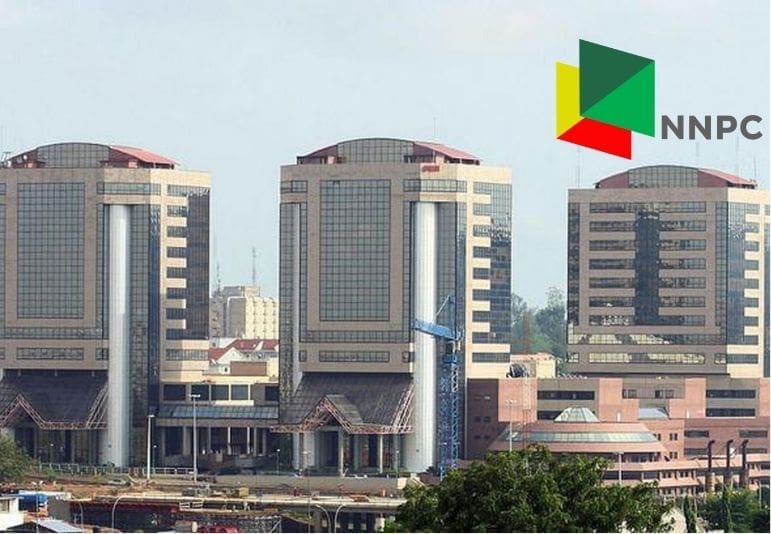
The Nigerian National Petroleum Company Limited (NNPC) sold a total of 136.93 million barrels of crude oil and condensates and generated ₦21.72 trillion in revenue in the first six months (H1) of 2026.
These figures are based on analysis of the monthly crude oil and condensate sales and revenues recorded in NNPC’s monthly reports from January to June 2026.
Monthly Sales Volume Breakdown
For the first half of 2026, NNPC recorded total crude oil sales of 132.97 MMbbls. When combined with 3.96 MMbbls of condensate sales, the cumulative volume for January to June 2026 reached 136.93 MMbbls.
A breakdown shows that in January, the company recorded 25.75 MMbbls. The sales dropped in February to 23.08 MMbbls and 17.27 MMbbls in March. It rose slightly above the February level to 23.65 MMbbls but dropped again to 18.95 MMbbls in May. However, it surged to 28.23 MMbbls in June. While June recorded the highest sales volume of the period, with 28.23 MMbbls in total sales, March saw the lowest sales at 17.27 MMbbls.
Revenue Trajectory
For revenue, the national oil company recorded ₦2.57 trillion in January. It rose to ₦2.68 trillion in February and ₦2.77 trillion in March. The company recorded the biggest jump in revenue in April when it hit ₦4.97 trillion, nearly doubling the figures from the previous month (March), reflecting a month-on-month increase of 79.19 per cent. It, however, dropped to ₦4.34 trillion in May and rose by 1.25 per cent to ₦4.39 trillion in June.
April recorded the highest monthly revenue for the period, accounting for 22.90 per cent of the six months’ total. The revenue for June represents 20.20 per cent, while that of May represents 19.97 per cent.
Revenue remained strong through May and June, maintaining levels above ₦4.3 trillion per month.
Why Revenue Jumped in April
Pinnacle Daily’s analysis of the NNPC reports shows that the revenue spike to ₦4.97 trillion in April 2026 was primarily driven by a significant recovery in crude oil and condensate sales volumes and improved facility reliability following operational setbacks in previous months. Total crude oil and condensate sales rose from 17.27 million barrels (MMbbls) in March to 23.65 MMbbls in April. This represents a nearly 37 per cent increase in volume month-on-month. The April report explicitly attributes the improved month-on-month production performance to improved facilities uptime across various assets. It highlighted that production in the preceding month (March) had been severely hampered by an outage on the Trans Forcados Pipeline caused by a leak at the Keremor axis, which led to widespread curtailments across several assets. The resolution of these evacuation constraints allowed for a rebound in April.
This led to a higher production rate as daily crude oil and condensate production increased to 1.68 million barrels per day (mmbopd) in April, up from 1.56 mmbopd in March and 1.51 mmbopd in February.
Despite this record revenue, the April performance was still partially constrained by the delayed start-up of the Trans-Ramos Pipeline (TRP) following maintenance, due to newly identified leaks and other facility integrity issues.
H1 2026 Profitability Performance
Based on the monthly reports, NNPC recorded a cumulative profit after tax of ₦2.275 trillion for the first half of 2026 (January to June). The monthly breakdown of profit after tax shows that ₦385 billion was recorded in January. It dropped to ₦136 billion in February, rose to ₦276 billion in March, and almost doubled in April (₦481 billion). It, however, saw a decline to ₦462 billion in May before rising again to ₦535 billion in June.
As observed in the data, the major recovery in performance recorded in April was equally reflected in the profit after tax, which hit ₦481 billion, a 74 per cent increase compared to the ₦276 billion profit recorded in March. It, however, dropped in May by ₦19 billion (3.95 per cent).
While June recorded the highest monthly profit of the period at ₦535 billion, February saw the lowest profit (₦136 billion), which was largely due to the Trans Forcados Pipeline (TFP) outage and various operational challenges like maintenance at Agbami.

Operational Factors Driving Q2 Growth
Other key observations in the NNPC’s first-half 2026 profit record are that it saw a significant increase in the second quarter (April–June), with each month surpassing ₦450 billion. This growth was driven by factors such as improved facility uptime and production recovery following the completion of major maintenance activities.
The June record profit of ₦535 billion was primarily driven by a surge in sales volumes and peak operational efficiency. Total crude oil and condensate sales jumped to 28.23 MMbbls in June, the highest volume recorded in the six months. This was a significant increase (approximately 49 per cent) from the 18.95 MMbbls sold in May.
The profit performance was also supported by a boost in production following the completion of Turnaround Maintenance (TAM) on facilities such as the Assa-Rumuekpe and 28-inch Trans Niger Pipeline (TNP). There was a peak in pipeline availability as upstream pipeline availability reached 100 per cent in June, marking the best performance for the year following steady improvements in previous months (76 per cent in March, 79 per cent in April, and 98 per cent in May).
Throughout the period, sales were periodically affected by factors including asset integrity issues, subsurface challenges, and maintenance-related shutdowns at major facilities.
Expansion in Natural Gas Production and Infrastructure
There was also an increase in natural gas production, which reached a high of 7,841 mmscf/d in June, continuing a steady growth trend from earlier in the year.
This production growth for natural gas coincided with advancements in key gas infrastructure, including the Ajaokuta-Kaduna-Kano (AKK) pipeline, which reached 94% completion by mid-year, and the Obiafu-Obrikom-Oben (OB3) pipeline, which was 98% complete by June with final tie-in works ongoing.
The record profit was also supported by a continued focus on improving facility reliability, minimising unscheduled downtime (UDT), and optimising crude export operations.
While June achieved record profitability, the reports note that production was still partially impacted by subsurface challenges and operational disruptions across some assets.
Statutory Remittances to the Federation
The statutory payments to the Federation for the period of January to June 2026 increased to ₦6.286 trillion, underscoring NNPC’s sustained contribution to national revenue generation.
In January, the company remitted ₦726 billion. This rose to ₦1.804 trillion in February, ₦2.888 trillion in March, ₦3.714 trillion in April, ₦4.858 trillion in May, and ₦6.286 trillion.
READ ALSO:
- NNPC Profit Rises 15.8% to N535bn in June
- Nigeria’s Oil Reserves Stand at 37Bn Barrels, to Last 59 Years – NUPRC
- Domestic Refineries Record 33.4 Million Barrels of Crude Supply Shortfall in Q1
- Nigeria’s Footprint in U.S. Energy Market Shrinks as Crude Export Plunges 47%
- Nigeria Records N5.1 Trn Oil Revenue Shortfall in 6 Months
Domestic Price Volatility and Geopolitical Risks
While the national oil company continues to record an increase in sales volume of crude oil and condensates and a significant revenue surge, there are concerns about the need for the Federal Government to create a system that enables the country to reap the benefits of crude oil revenue, especially during windfalls, while ensuring that domestic consumers are shielded from oil price shocks and volatilities.
Industry analysts note that for Nigeria, a surge in global crude oil prices presents a mixed effect. On one hand, it potentially means an increase in revenue to the federation, especially when matched with a significant ramp-up in production. However, on the other hand, high crude prices lead to an increase in fuel cost in the domestic market, as refiners factor it into their cost of production, which consequently affects transport, logistics, and the general cost of living.
Energy experts and industry stakeholders have stated that Nigeria needs to learn lessons from the impact of the ongoing war in Iran on the global energy market and take necessary steps to boost energy security.
In its half-year 2026 Downstream Industry report, released recently, the Major Energies Marketers Association of Nigeria (MEMAN) disclosed that Nigeria recorded a 39.5 per cent surge in petrol prices—the highest in Africa – due to high crude oil prices triggered by supply disruptions caused by the closure of the Strait of Hormuz, a vital sea route for shipping oil and gas products globally.
Calls for Strategic Petroleum Reserves
While highlighting the threat of geopolitical tensions on the country’s energy security, especially the drastic drop in fuel stock sufficiency and price shocks, MEMAN called for the establishment of state-backed Strategic Product Reserves alongside a dedicated Crude Oil Feedstock Reserve to safeguard domestic refineries and consumers from sudden foreign supply disruptions.
“The rapid depletion of refined sufficiency days during the global shipping crisis underscored Nigeria’s lack of a resilient buffer, prioritizing the urgent downstream requirement to establish robust, state-backed Strategic Product Reserves and a dedicated Crude Oil Feedstock Reserve to insulate domestic refineries and consumers from sudden external supply chain closures,” MEMAN stated.
Dr Chinan Dikwal, Vice Chair, African Energy Council, also made a similar call, stressing that building strategic reserves would help to guarantee a stable supply of crude oil and refined products to the domestic market and shield consumers and refiners from external price shocks in times of geopolitical tensions that roil the global energy market.
In a televised interview, Dikwal cited G7 (developed) countries that have been releasing products from their strategic reserves in response to the global supply disruptions in the oil and gas sector due to the Middle East conflict.
“Nigeria, as it stands today, does not have one. Theoretically on paper, we do have one, but functionally, we don’t have a strategic petroleum reserve that we can deploy,” Dikwal stated.

Victor Ezeja is a Nigerian journalist skilled in producing insightful news analyses, feature stories, and interviews that simplify complex issues and drive informed public discourse. His work combines rigorous research, balanced reporting, and compelling storytelling to highlight developments shaping industries and society. Victor, who holds a Master's Degree in Mass Communication, specializes in energy, aviation, business, and economic reporting. He can be reached via @VICTOREZEJA on X