


The petrol pricing landscape in Nigeria has undergone a significant shift in the past three years with the removal of subsidy policy and the resurgence of domestic refining championed by the Dangote Petroleum Refinery.
While the return of local fuel refining is being celebrated as part of activities towards advancing Nigeria’s energy security drive, consumers have raised questions about the rising cost of fuel.
This is as Dangote Refinery’s Premium Motor Spirit (PMS) gantry price rose by about 65 per cent in one year, from ₦820 per litre at launch to a record ₦1,350 per litre.
The latest increase, which took effect on September 12, 2026, represents an ₦85 rise from the previous ₦1,265 per litre and marks the fourth upward review by the refinery since August 21. In the 22-day period, the refinery’s gantry price climbed by ₦185, or 15.9 per cent.
The bigger picture, however, is the notable movement in the refinery’s petrol pricing.
Dangote Refinery launched its ex-depot price of Premium Motor Spirit, also known as petrol, at ₦820 per litre on September 15, 2025. At ₦1,350 today, the price has risen by ₦530 per litre, translating to approximately 64.6 per cent in 12 months.
In effect, a product that left the refinery at ₦820 per litre a year ago now costs ₦1,350 at the gantry before additional downstream costs such as transportation, storage, margins and other distribution expenses are factored into retail prices.
21 Price Changes in 12 Months
Pinnacle Daily’s analysis of the refinery’s pricing trends shows that it has changed 21 times in the past 12 months, an average of roughly once every 17 days. The most volatile period came in March 2026, when the price reportedly changed seven times in just 24 days, including a ₦180 jump within two days.
The refinery’s petrol price also moved in the opposite direction at various points, demonstrating the extent to which domestic pump prices have become exposed to changing market conditions.
The price hit an all-time low of ₦699 per litre on December 16, 2025, before beginning a sustained climb that eventually culminated in the latest record of ₦1,350 per litre on September 12, 2026.
The price history therefore tells a story of a market moving from relative stability into repeated episodes of sharp increases and reductions.
By March, for instance, Dangote had increased its petrol gantry price from about ₦774 to ₦874 per litre in one adjustment, before further changes pushed it substantially higher.
The refinery subsequently reduced the price to ₦1,075 per litre on March 10, following three successive increases, before another adjustment took it to ₦1,245 by March 21.
It later cut the price to ₦1,200 per litre on March 26, underscoring the volatility that has characterised the market.
When the refinery announced its petrol gantry price of ₦820 in September 2025, the move was part of its strategy to expand direct supply to marketers and reduce distribution costs.
The refinery began direct PMS supply to selected states from September 15, 2025, with a gantry price of ₦820 per litre.
One year later, the same benchmark has moved to ₦1,350.
The latest increase followed successive upward revisions from ₦1,165 to ₦1,185 on August 21, ₦1,200 on August 26, ₦1,265 on August 29 and finally ₦1,350 on September 12.
The development has heightened concerns among marketers and consumers as changes at the refinery’s gantry are generally transmitted through the downstream distribution chain, although the eventual pump price varies according to location, logistics, retail margins and other costs.
Global Oil Shock Meets Domestic Market
The latest increases have occurred against a backdrop of unusually high international crude prices and disruption to global energy markets, triggered by the ongoing war in the Middle East between the United States, Israel and Iran. The conflict has affected vessel movement across the Strait of Hormuz and has contributed to renewed pressure on crude and refined-product markets.
Brent crude has continued to trade above $100 per barrel in recent times amid the heightened geopolitical tensions and disruptions affecting global oil flows.
Pinnacle Daily reported in March that Nigeria’s petrol prices had surged sharply as the Dangote Refinery faced difficulties securing sufficient domestic crude and was exposed to higher international crude costs. The refinery had reportedly been able to access only a fraction of the local crude cargoes it needed, forcing greater reliance on imported crude.
Pinnacle Daily’s analysis of data released by the Nigerian Midstream and Downstream Petroleum Regulatory Authority (NMDPRA) showed that crude oil imports jumped 12.5 times in four months, from 0.41 million barrels in April to 5.13 million barrels in July 2026.
Within the same period, crude oil supply to domestic refineries from local producers dropped by 29 per cent from 17.96 million barrels to 12.75 million barrels.
The international market has remained a critical factor in determining the economics of Nigeria’s supposedly domestic fuel supply chain.
This has exposed one of the paradoxes of the Dangote Refinery era: while the refinery has significantly increased domestic refining capacity and reduced reliance on imported petrol, the price of its locally refined petrol remains closely linked to international crude and refined-product market conditions.
Refinery Changes Nigeria’s Fuel Equation
In the past two years since it commenced full commercial operations, the Dangote Refinery is believed to have altered Nigeria’s downstream petroleum market.
Industry data have shown that the 700,000-barrel-per-day facility has become a major supplier of petrol to the Nigerian market and has also expanded its exports of other refined petroleum products.
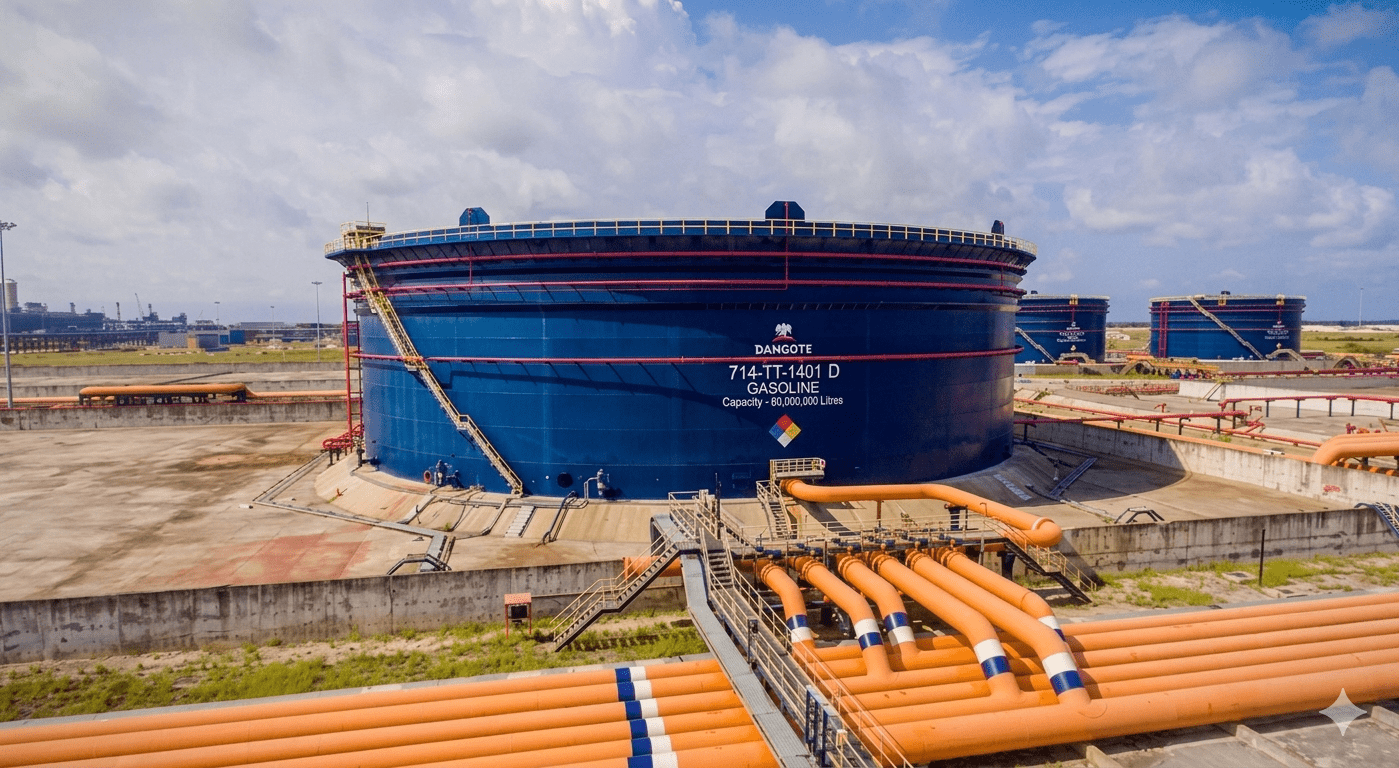
The refinery achieved a ₦19.47 trillion revenue and ₦2.55 trillion profit in the first half of 2026, while increasing exports of jet fuel and other products amid disruptions in global energy markets.
READ ALSO:
- Dangote Refinery Reduces Petrol Gantry Price to ₦1,200 Despite Oil Supply Disruption
- Dangote Petrol Cheaper than Imported Products Despite Price Increase
- Explainer: 10 Things to Know Before Buying Dangote IPO
- Explainer: What Foreigners Need to Buy Dangote IPO
- Subsidy Return, Fuel Price Controls Threaten Revenue Growth, Dangote Refinery Warns
Nigeria has also moved towards prioritising domestic refinery output. In February and March 2026, regulators suspended the issuance of new petrol import licences, citing provisions of the Petroleum Industry Act that prioritise domestic supply where local production is adequate. However, this policy has seen a reversal in recent months with the rise in fuel imports as authorities claim it is part of measures to boost supply to the local market.
But the latest gantry price trajectory raises a critical question: does local refining automatically translate into cheaper petrol for Nigerian consumers?
The answer increasingly appears to depend on factors beyond refining capacity alone.
Energy experts have highlighted a couple of factors that influence the final price. These include crude supply arrangements, international oil prices, foreign exchange conditions, logistics, financing costs, domestic demand and the structure of the downstream market.
In an interview with Arise News Television on Tuesday, President of Dangote Group, Aliko Dangote, said petrol price has remained high in Nigeria, contrary to people’s expectation, because local refining is not completely immune from the realities of global crude oil prices and market disruptions.
Dangote said his refinery buys crude oil, the major feedstock, at prevailing international market prices and sometimes pays significant premiums, making it difficult to sell refined petroleum products below sustainable market levels.
Even at that, he claimed that the price in Nigeria is still cheaper than in neighbouring countries.
He alleged that the price difference has made smuggling of the same petrol his refinery produces to other countries where it is expensive to persist.
Consumers at the Receiving End
For motorists and households, the distinction between the refinery’s gantry price and the pump price offers little comfort when wholesale increases eventually filter into the retail market.
Every ₦100 increase at the refinery creates pressure across the distribution chain. Transport operators face higher operating costs, businesses pay more to move goods, and households ultimately absorb higher logistics costs through food and other essential commodities.
The impact is particularly significant in an economy where petrol remains deeply embedded in transportation, electricity generation and commercial activity.
The latest ₦1,350 gantry price has therefore become more than another adjustment. It is another marker of the changing economics of Nigeria’s post-subsidy fuel market.
The latest adjustment of the refinery’s ex-depot price has sent retail pump prices to between ₦1,390 and ₦1,450 per litre depending on location.
With the current reality, analysts have noted that the central challenge for Nigeria is not merely to refine more petrol, but to build a crude supply, pricing and distribution framework capable of insulating domestic consumers from extreme swings in international energy markets while keeping local refineries commercially viable.

Victor Ezeja is a Nigerian journalist skilled in producing insightful news analyses, feature stories, and interviews that simplify complex issues and drive informed public discourse. His work combines rigorous research, balanced reporting, and compelling storytelling to highlight developments shaping industries and society. Victor, who holds a Master's Degree in Mass Communication, specializes in energy, aviation, business, and economic reporting. He can be reached via @VICTOREZEJA on X