

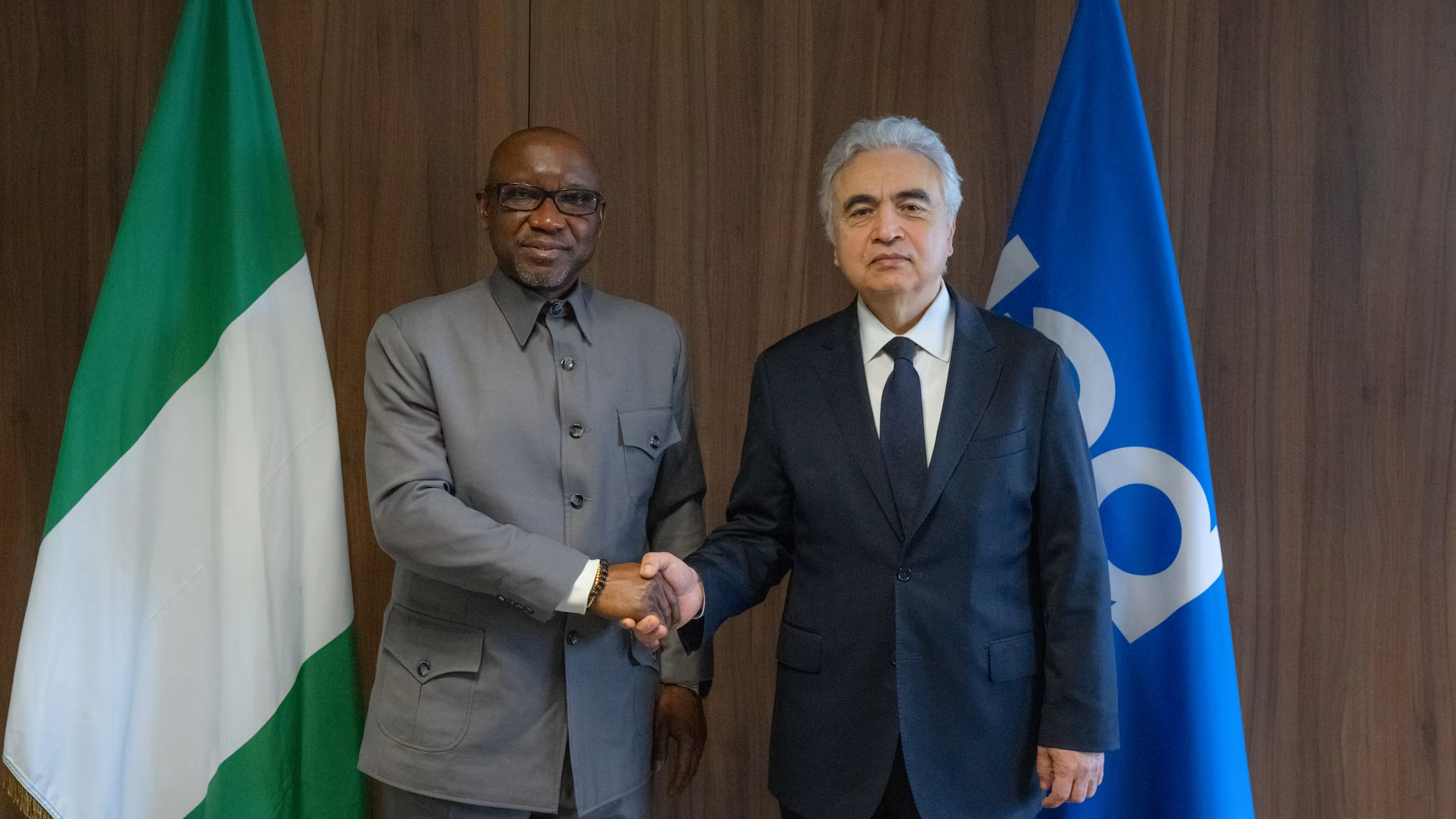
Nigeria’s formal admission as an Association Country with the International Energy Agency (IEA) is a significant milestone, marking a pivotal shift in the country’s position within global energy markets.
Vice President Kashim Shettima highlighted this during the recent signing of an agreement between Nigeria and the IEA for a Joint Work Programme to strengthen strategic partnership in the development of data for energy policy and investment.
In July 2026, the IEA’s Governing Board unanimously agreed to admit Nigeria as an Association country, bringing Africa’s most populous nation into the IEA Family.
The agency currently has 32 Member countries, 14 Association countries, and six countries undergoing accession to membership. Nigeria became the first OPEC member to join the IEA as an associate country, marking a notable shift in its global energy diplomacy.
The minister of state for Petroleum Resources (Gas), Rt. Hon. Ekperikpe Ekpo, described the move as a boost for the country’s quest to expand energy access and accelerate industrialisation.
Analysts say the development is significant not simply because of the prestige attached to membership of an international energy body, but because of what Nigeria can potentially gain from closer access to global energy data, policy expertise, emergency-response planning, investment networks and technical capacity.
Yet the real question is whether Nigeria can convert that international recognition into tangible improvements at home.
As Africa’s most populous nation and a major oil and natural gas producer, Nigeria, however, still grapples with some challenges, including high cost of energy, unreliable electricity supply, and inadequate clean cooking access, among others.
More than an international badge
Nigeria’s entry into the IEA Family comes at a critical point for the country’s energy sector. The country has been pushing to increase crude oil production, expand gas production and utilisation, develop domestic refining, reform its electricity market, attract investment and accelerate renewable-energy deployment, while it is dealing with energy poverty and the economic consequences of volatile global energy markets.
In a press statement released shortly after the country’s membership was approved in July, IEA, while noting that Nigeria is a major oil and gas producer with a dynamic renewable-energy market, highlighted the country’s continuing challenges in expanding reliable and affordable electricity and clean cooking access.
The Association status gives Nigeria considerably deeper engagement with the agency, including participation in selected meetings, cooperation on energy security, data and statistics, policy analysis, training and capacity building.
“As an Association country, Nigeria and the IEA will work more closely across a wide range of energy issues, including on the Agency’s engagement in sub-Saharan Africa,” IEA had stated.
It said the IEA Association programme, which was created in 2015, “allows the Agency to deepen ties with its partner countries, bringing together major energy-producing and consuming countries from around the world.”
It said the membership expansion has consequently increased the IEA Family’s share of global energy demand from 40 per cent in 2015 to over 80 per cent today.
Nigeria’s Influence within Africa
There is also a geopolitical dimension to the development.
Nigeria is not entering the IEA conversation merely as another energy consumer. As one of Africa’s largest oil and gas producers and the continent’s most populous nation, analysts believe that its participation gives African energy concerns greater visibility within the IEA.
Nigeria joins South Africa, Kenya and Senegal among the Agency’s Association countries in sub-Saharan Africa.
The IEA says Nigeria’s inclusion strengthens African representation in its activities and expands its engagement with energy systems across the continent.
Energy policy analyst Dr Adeola Yusuf said Nigeria’s joining the IEA is significant in many ways.
Speaking on a programme on News Central TV, Dr Yusuf said IEA membership would deepen Nigeria’s voice in the global oil and gas space and strengthen the country’s leadership standing in international oil politics.
“When we talk of issues affecting crude oil producers, Nigeria would have a voice; when you have issues relating to oil consumers, Nigeria will also have a voice,” Yusuf stated.
He observed that Nigeria is both a major oil producer and consumer in the whole of sub-Saharan Africa, adding that it makes its membership of the organisation more strategic.
Analyst and senior associate at AO2 Law, Chukwuemeka Ozuzu said Nigeria’s admission into the IEA puts it in a position to play dual roles in global energy policy, as it is also a member of OPEC. While OPEC represents the interests of oil-exporting countries, the IEA aligns with petroleum-importing countries and large energy consumers.
On the question of whether IEA membership could affect Nigeria’s standing within OPEC, Ozuzu, who spoke in an interview with CNBC Africa, argued that the relationship with both organisations would be complementary in nature. He maintained that by being involved in policy conversations of both organisations, Nigeria could act as a bridge between producer and consumer interests, advocating better policies that address concerns of countries on both sides.
READ ALSO:
- Middle East War Hits Nigerian Kitchens as Cooking Gas Price Rises to ₦1,500/kg
- Imported Petrol Cost Rises above Dangote Refinery Fuel
- Oil Surge Offers Nigeria Windfall as Global Markets Reel – Analyst
- Domestic Refineries Record 33.4 Million Barrels Crude Supply Shortfall in Q1
- Middle East Crisis Sends Crude Above $100, Fuel Price Hike Looms
Impact on Energy Security
Analysts have noted that the biggest opportunity of the membership could be in advancing Nigeria’s energy security agenda.
Global crises in recent years—from the Russia-Ukraine war to the Middle East conflict, which disrupted energy supplies — have demonstrated how quickly geopolitical events can translate into higher crude prices, fuel shortages, inflation and pressure on national economies.
In all of these, Nigeria has experienced its own share of vulnerabilities.
Despite being a major crude producer, the country had historically depended heavily on imported refined petroleum products. That exposure became particularly painful when foreign exchange shortages, crude-price movements and domestic supply disruptions combined to push up fuel prices.
The emergence of large-scale domestic refining capacity (such as Dangote Refinery) is beginning to change that equation, but refinery development alone cannot guarantee energy security.
Industry stakeholders have continued to emphasise that Nigeria needs strategic crude supply arrangements, functioning pipelines, adequate petroleum-product reserves, reliable infrastructure and an emergency-response framework capable of absorbing major disruptions.
The IEA Association framework specifically encourages cooperation on emergency response systems, reserves and preparedness exercises.
For Nigeria, this could help shift energy security from a largely reactive exercise into a structured national strategy.
IEA executive director Fatih Birol said Nigeria could leverage the agency’s global network of governments, energy companies and investors to boost investments in the energy sector, including oil, gas, power and solar projects.
Standardizing Energy Data and Policy Analytics
Another potentially transformative benefit is access to better energy data.
Nigeria’s energy debate is frequently clouded by uncertainty over production, consumption, losses, demand growth, electricity supply, fuel consumption and the scale of energy poverty.
The IEA places considerable emphasis on consistent, coherent and timely energy statistics among Association countries.
Through the IEA-Nigeria Joint Work Programme, Nigeria gains direct technical support to modernize its data collection systems. Transparent, reliable metrics eliminate historical data gaps—such as discrepancies in crude production and domestic power consumption—enabling policymakers and investors to make data-driven decisions.
For instance, accurate demand projections are essential for determining how much electricity generation capacity Nigeria needs, where transmission infrastructure should be expanded and which areas are best suited for decentralised renewable systems.
During his visit to Nigeria recently, Birol confirmed that the joint work programme will also cover energy data development, enabling Nigeria to work with the IEA to strengthen its energy data collection and reporting systems.
Can it Unlock Energy Investments?
But membership will not automatically bring billions of dollars into Nigeria.
Investors will still demand regulatory certainty, transparent pricing, commercially viable tariffs, contract enforcement, foreign-exchange stability and predictable government policy.
Analysts state that while the IEA platform can provide knowledge and credibility, Nigeria must provide the investment environment.
The clean-energy dilemma
Nigeria’s IEA relationship also arrives as the global energy system undergoes a profound transformation.
For Nigeria, however, the energy transition cannot simply mean abandoning hydrocarbons.
Yusuf said Nigeria will find a balance between addressing its energy needs through strategic hydrocarbon exploration and supporting the global energy transition agenda.
Oil and gas remain central to government revenues, exports, industrial activity and energy supply. At the same time, the country faces enormous electricity and clean-cooking deficits.
The more realistic challenge is therefore how to use Nigeria’s oil and gas resources more efficiently while simultaneously expanding renewable energy, improving efficiency and reducing emissions.
Nigeria’s off-grid renewable-energy sector is already among the country’s fastest-growing energy markets, according to the IEA.
Analysts believe that the IEA relationship could help Nigeria navigate this complicated transition without sacrificing energy access or economic growth.
With Nigeria having abundant gas reserves, this natural resource has been identified as one that will also feature prominently in the country’s energy future.
However, inadequate infrastructure and investment have historically prevented it from fully exploiting it for power generation, industry and domestic consumption.
A stronger international partnership could help Nigeria develop a more coherent gas strategy—one that balances domestic power needs, industrialisation, LNG exports and emerging global emissions requirements.
Birol said that the partnership would support Nigeria’s priorities, including strengthening energy security, realising its energy potential and expanding access to electricity and clean cooking.
That promise places responsibility on both sides—especially Nigeria.
READ ALSO:
- Crude Swap: Can NUPRC’s Plan Fix Domestic Refinery Supply Shortages?
- Tariff Subsidies, Commercial Losses Dominate Nigeria’s ₦3.39trn Power Shortfalls in 2025
- Power Reforms: Can Nigeria End Electricity Subsidies Without Hurting Consumers?
- Clean Energy Drive Threatened as High Cost of Cooking Gas Forces Households to Seek Alternatives
Birol said the country needs to address domestic challenges that have in the past discouraged access to capital for long-term investments in the energy sector.
According to him, Nigeria needs to maintain transparent, predictable policies and a stable investment system to attract foreign capital and investors.
“I think we should continue to show the predictability of the Nigerian energy sector,” he said in an interview with Business Day.
“The more predictability, the more transparency there is, the better it is for the companies to come,” he added.
A new opportunity, not a magic wand
Nigeria’s admission into the IEA Family is a significant diplomatic and energy-policy milestone as the country now has closer access to one of the world’s leading sources of energy analysis, policy expertise and international cooperation.
But analysts say membership itself will not fix Nigeria’s refineries, revive the electricity grid, eliminate fuel-price volatility or attract investment.
They maintain that those outcomes will depend on what Nigerian institutions do with the opportunity.

Victor Ezeja is a Nigerian journalist skilled in producing insightful news analyses, feature stories, and interviews that simplify complex issues and drive informed public discourse. His work combines rigorous research, balanced reporting, and compelling storytelling to highlight developments shaping industries and society. Victor, who holds a Master's Degree in Mass Communication, specializes in energy, aviation, business, and economic reporting. He can be reached via @VICTOREZEJA on X