

The Federal Government has reduced import tariffs on vehicles, cutting duties on used vehicles from 15 per cent to five per cent and on brand-new vehicles from 20 per cent to 10 per cent, in a move to ease costs for Nigerians while reshaping the country’s fiscal policy.
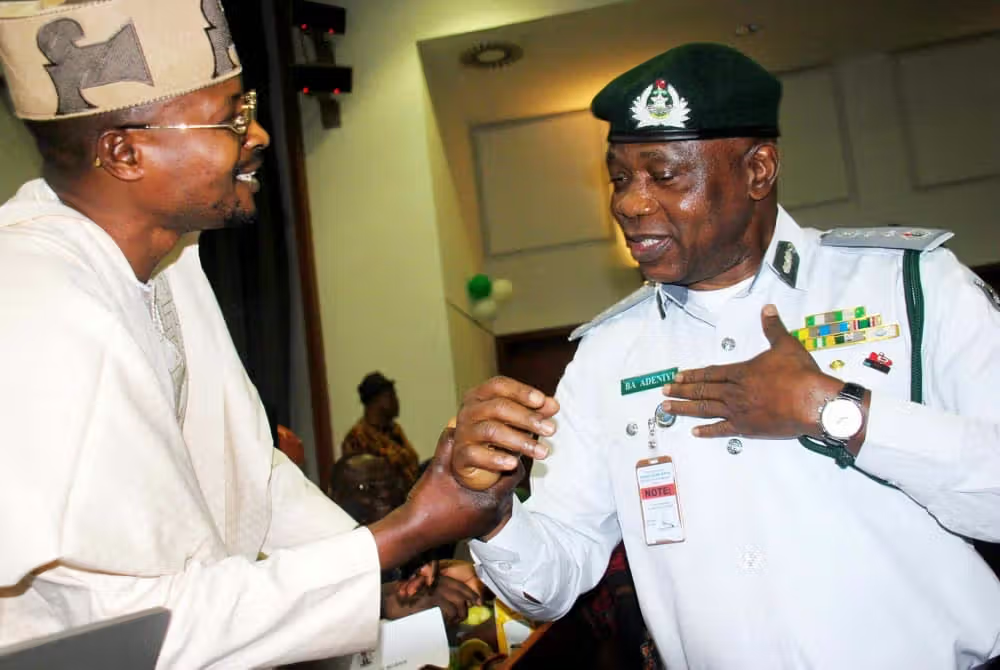
The Comptroller-General of the Nigeria Customs Service (NCS), Adewale Adeniyi, disclosed this on Monday while defending the agency’s 2026 budget proposal before the House of Representatives Committee on Customs and Excise.
According to Adeniyi, the revised tariffs form part of the Federal Government’s 2026 Fiscal Policy Measures (FPM), adding that while the policy is expected to encourage trade and support consumers, it could reduce customs revenue from vehicle imports.
“We have the new excise tariff provided in the 2026 fiscal policy. These measures will increase our overall revenue collection, but tariffs on vehicles have been reduced significantly,” he said.
He explained that duties on used vehicles have been reduced from 15 per cent to five per cent, while tariffs on new vehicles have dropped from 20 per cent to 10 per cent.
During the session, a member of the committee, Alex Mascot, questioned whether the tariff reduction would be sufficient to discourage importers from routing cargo through neighbouring ports, particularly Cotonou in the Republic of Benin.
Mascot argued that many importers have continued to avoid Nigerian ports because of previously high import charges despite recent reductions.
Responding, Adeniyi said implementation of the revised tariff regime commenced in May and expressed optimism that the new policy would improve Nigeria’s competitiveness.
Chairman of the committee, Leke Abejide, described the decision as a welcome relief for Nigerians, saying it reflected the Federal Government’s commitment to responding to public concerns.
He commended President Bola Tinubu’s administration for approving the tariff review, noting that Nigerians had long demanded lower import duties on vehicles.
Customs Surpasses 2025 Revenue Target
Adeniyi also disclosed that the Nigeria Customs Service generated N7.258 trillion between January and December 2025, exceeding its approved revenue target by N1.153 trillion, representing an 18.89 per cent positive variance.
He attributed the strong performance to improved operational efficiency despite several policy decisions that reduced potential revenue.
According to him, revenue generation was affected by the continued suspension of excise duty on telecommunications services, the suspension of the proposed green tax introduced in 2023, and fiscal incentives designed to promote local production of healthcare products, which lowered import duty and VAT collections on medical imports.
He also cited the Presidential initiative promoting compressed natural gas (CNG) vehicles and electric vehicles, as well as the high volume of import duty exemptions granted under Import Duty Exemption Certificates (IDEC), VAT orders and Schedule II of the Common External Tariff (CET).
The Customs boss revealed that imports valued at N34.538 trillion benefited from revenue concessions in 2025. Of the total, 56.40 per cent comprised petroleum products, 40.52 per cent military imports, while 3.08 per cent covered IDEC beneficiaries and other exempted goods.
He further noted that global trade disruptions caused by the Russia-Ukraine war also affected import volumes, particularly wheat shipments into Nigeria.
N11.07trn Revenue Goal for 2026
Looking ahead, Adeniyi said the Nigeria Customs Service has been assigned a N11.074 trillion revenue target for the 2026 fiscal year.
The target includes N5.542 trillion for the Federation Account, N1.491 trillion in non-federation revenue, N2.773 trillion from import Value Added Tax (VAT), and N1.266 trillion from Free-on-Board (FOB) collections.
To achieve the ambitious target, he said the Service will fully deploy the Unified Customs Information System (UCIS), popularly known as B’Odogwu, to automate customs operations and improve revenue collection.
Other strategies include strengthening post-clearance and real-time systems audits to boost compliance, expanding the Authorised Economic Operator (AEO) and Advance Rulings programmes to facilitate legitimate trade, deploying geospatial technology alongside joint border patrols to combat smuggling, and enhancing collaboration with stakeholders.
Adeniyi added that the new excise tariff regime under the 2026 Fiscal Policy Measures, the planned reintroduction of the green tax, and other fiscal reforms are expected to strengthen revenue generation despite uncertainties in global trade arising from geopolitical tensions involving the United States, Israel and Iran.
READ ALSO:
- FG, Dangote Hold Emergency Talks to Cut Petrol Prices
- FG, UNDP Bring Solar Power to 50,000 Rural Nigerians
- Customs, Afreximbank Deepen Partnership to Boost Intra-African Trade
- Nigeria Customs Honours Female Officers, Reaffirms Commitment to Gender Inclusion
The Customs Comptroller-General also presented a proposed N1.235 trillion expenditure budget for the 2026 fiscal year.
He explained that the budget would be financed through N949.86 billion from the four per cent FOB allocation, N55.47 billion from the Service’s two per cent VAT share, and N230.04 billion earmarked for ongoing capital projects.
The proposed expenditure includes N421.70 billion for personnel costs, N307.77 billion for overheads and N565.93 billion for capital projects aimed at strengthening customs operations and modernising border management.

Esther Ososanya is an investigative journalist with Pinnacle Daily, reporting across health, business, environment, metro, Fct and crime. Known for her bold, empathetic storytelling, she uncovers hidden truths, challenges broken systems, and gives voice to overlooked Nigerians. Her work drives national conversations and demands accountability one powerful story at a time.