

Dangote Refinery Absorbs 52.6 Million Barrels representing 78% of what was offered by crude producers.
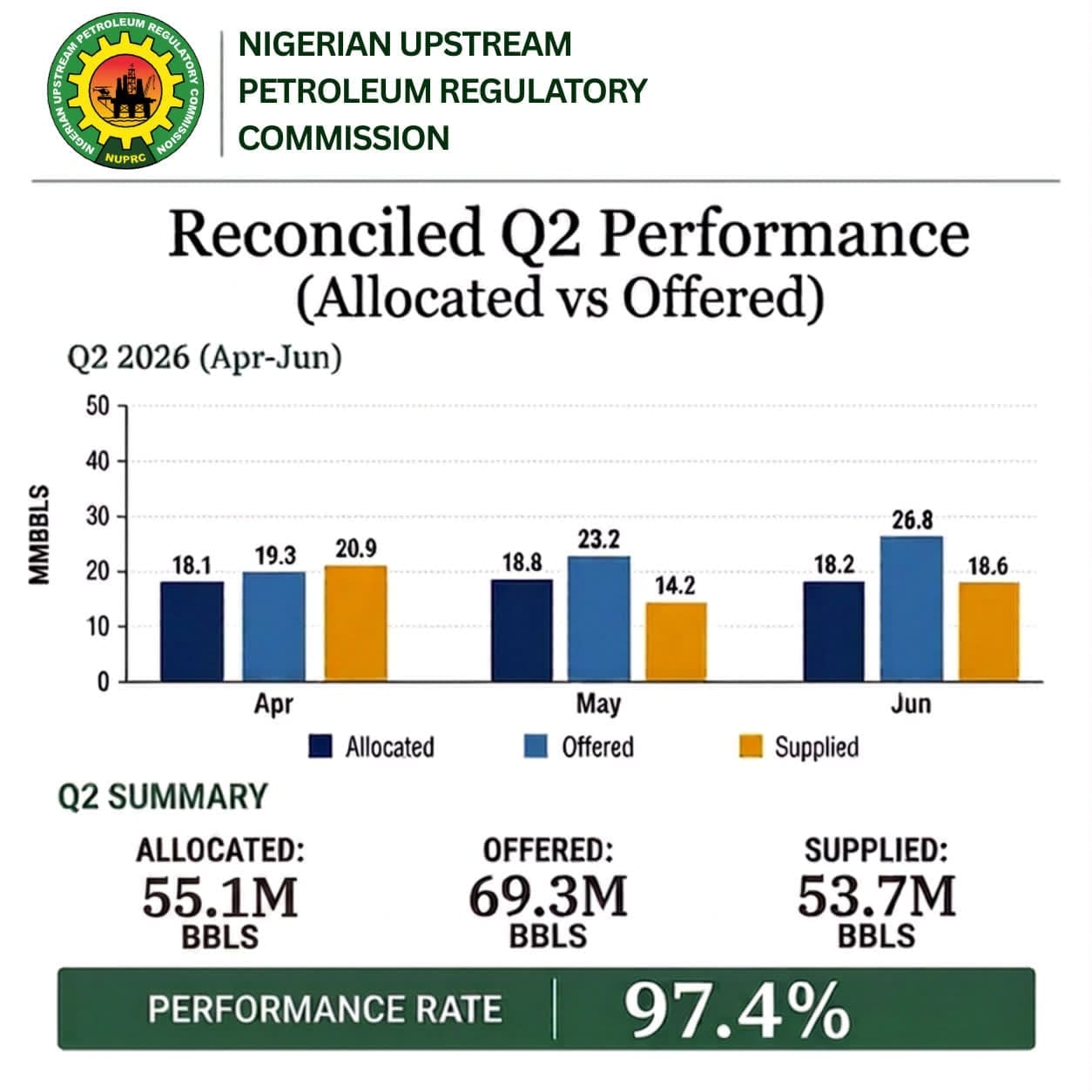
The Nigerian Upstream Petroleum Regulatory Commission (NUPRC) has released its second-quarter (Q2) 2026 report on the enforcement of the Domestic Crude Supply Obligation (DCSO), revealing an impressive 97.4% overall compliance rate as local refineries received 53.7 million barrels of crude oil and condensate between April and June.
The performance highlights the active enforcement of Section 109 of the Petroleum Industry Act (PIA) 2021, which mandates upstream producers to allocate a portion of their crude production to meet domestic refining needs.
According to the Commission, the operational framework relies on regular monthly coordination meetings between the NUPRC, crude oil producers, and licensed domestic refiners. During these meetings, specific crude and condensate volumes are allocated to producers to offer to local refineries. However, in strict adherence to the PIA, the transactions operate on a commercial “willing buyer, willing seller” basis, allowing market dynamics to dictate final deliveries.
Monthly Supply & Compliance Performance
According to the NUPRC report, the Q2 performance showed varying compliance levels across the three-month period, with producers consistently exceeding allocated volumes in their offers to refiners.
Following stakeholder consultations in April, producers were allocated 18,127,638 barrels. However, they exceeded expectations by offering 19,312,476 barrels to refiners. Actual supplies reached 20,879,381 barrels, representing an outstanding 114.9% performance against the allocation.
In May, the Commission allocated 18,778,392 barrels to producers, who again surpassed expectations with offers of 23,187,893 barrels. However, actual supply stood at 14,228,865 barrels, translating to 75.8% compliance—the lowest performance for the quarter.
In June, NUPRC allocated 18,172,638 barrels, while producers offered 26,835,119 barrels to refiners. Actual supply reached 18,606,026 barrels, representing a strong 102.4% performance.
Driving Factors Behind Improved Compliance
The Commission observed that the improvement in DCSO performance coincided with two critical developments: an increase in local oil production and the signing of long-term crude supply agreements supported by bankable Sales and Purchase Agreements between producers and domestic refiners.
READ ALSO:
Domestic Refineries Record 33.4 Million Barrels Crude Supply Shortfall in Q1
Nigeria’s Crude Oil Output Rises in January but Misses OPEC Quota
Nigeria’s Footprint in U.S. Energy Market Shrinks as Crude Export Plunges 47%
Nigeria’s Daily Diesel Supply Rises 84.3% as Import Crashes
According to the NUPRC, the framework operates on a “willing buyer, willing seller” basis as stipulated in the PIA, which shapes the eventual outcomes of the supply negotiations.
Dangote Refinery Dominates Supply Volume
The report underscores the central role of the Dangote Petroleum Refinery in driving national crude demand.
The emerged as the dominant off-taker, requiring 63 million barrels in Q2. Producers offered significantly higher volumes of 68.1 million barrels to the refinery, representing 98% of all offered volumes across all refiners.
Interestingly, the Dangote Refinery finally accepted 52.6 million barrels, which means it only took 78% of what was offered—suggesting that supply availability was not the primary constraint in the domestic crude supply chain during the period under review.
Commission Reaffirms Commitment
The NUPRC reaffirmed its commitment to achieving the government’s objective of energy sufficiency, leveraging the framework of the PIA 2021.
“The Commission aims to sustain recent gains in crude oil production while continuously enforcing the DCSO,” the agency stated.
The Q2 statistics underscore the NUPRC’s determination to ensure that domestic refiners have adequate access to crude oil, a critical component of Nigeria’s strategy to reduce reliance on imported petroleum products and strengthen energy security.
The Commission continues to hold monthly stakeholder meetings with crude oil producers and local licensed refineries to allocate specific crude volumes, ensuring transparency and accountability in the domestic supply chain.

Victor Ezeja is a Nigerian journalist skilled in producing insightful news analyses, feature stories, and interviews that simplify complex issues and drive informed public discourse. His work combines rigorous research, balanced reporting, and compelling storytelling to highlight developments shaping industries and society. Victor, who holds a Master's Degree in Mass Communication, specializes in energy, aviation, business, and economic reporting. He can be reached via @VICTOREZEJA on X