

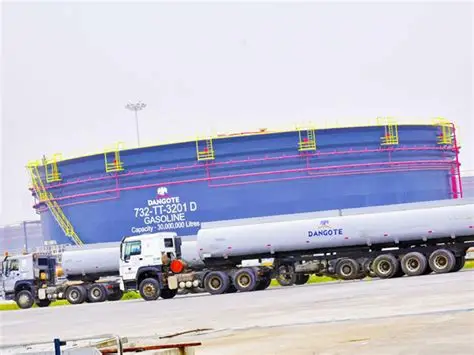
Nigeria’s downstream petroleum sector has again come into the spotlight following the legal action instituted by Dangote Petroleum Refinery against the issuance of fuel import licences and the mixed reactions it has generated among marketers.
The development has sparked intense debate across the energy sector, with stakeholders sharply divided over its implications for competition, local refining, and national energy security.
At the heart of the controversy is Dangote Refinery’s argument that the continued issuance of licences for the importation of petroleum products undermines local refining efforts and contradicts some provisions of the Petroleum Industry Act (PIA).
In a suit (FHC/L/CS/857/2026) filed at the Federal High Court in Lagos, the refinery contends that import permits should only be granted where there is proven insufficiency in domestic supply.
The Nigerian Midstream and Downstream Petroleum Regulatory Authority (NMDPRA) recently issued licences to some Nigerian oil marketers for the importation of over 600,000 metric tonnes of petrol into the country.
The refinery had filed a similar suit against NMDPRA, NNPC and several fuel importers in the past but withdrew it in July 2025.
In the fresh suit, the $20 billion facility wants the court to void import licences issued by the NMDPRA to marketers. The company asserts that its 650,000-barrel-per-day plant now supplies over 90 per cent of Nigeria’s daily petrol consumption, making imports economically wasteful and a threat to local investment in the energy sector.
The move has generated mixed reactions among industry operators, many of whom fear that limiting fuel imports could expose the country to supply disruptions and create a dominant market position for a single supplier.
Fears Over Monopoly and Supply Vulnerability
Several marketers and industry associations have expressed concern that restricting import licences may reduce competition within the downstream sector, potentially leading to higher prices and supply instability.
In court filings, the NNPC reportedly warned that ceding market control to a single entity could lead to supply disruptions and price instability, trading one form of energy insecurity for another.
It argued that the PIA permits imports to ensure supply security and noted that Dangote has yet to provide independent proof that it can fully meet the nation’s total fuel demand. NNPC specifically stated that the PIA allows import licences to companies with local refining licences or a proven record in international crude and petroleum products trading, adding that there was no mandatory ban on import.
The court has scheduled a hearing on the matter in the coming weeks.
Experts have argued that Nigeria’s fuel supply landscape has historically relied on multiple channels of sourcing products, particularly during periods of refinery shutdowns, logistics bottlenecks, or fluctuations in local production capacity.
Industry stakeholders warned that depending heavily on one refinery — regardless of its scale — may present strategic risks in the event of operational challenges, maintenance shutdowns, or distribution constraints.
The Independent Petroleum Marketers Association of Nigeria (IPMAN), the Petroleum Products Retail Outlet Owners Association of Nigeria (PETROAN), and the Depot and Petroleum Products Marketers Association of Nigeria (DAPPMAN) have all kicked against the move, emphasising the importance of maintaining an open and competitive market structure.
DAPPMAN Threatens Legal Action Against Dangote Refinery
In a statement released on Sunday, May 17, DAPPMAN argued that the licences being challenged by Dangote Refinery were not “administrative courtesies” but “legal instruments” issued under the PIA to guarantee fuel supply stability in the country.
It said approving the licences was within the statutory powers of the NMDPRA.
The group said its members have invested billions of naira in storage facilities, marine logistics, distribution networks, and depot operations that are tied to fuel importation activities.
It expressed concern that such a legal action designed to void import licences would not only affect individual businesses but also pose a threat to jobs across the entire downstream value chain and ultimately affect Nigeria’s economy.

For many operators, the issue goes beyond commercial interests and touches directly on national energy security.
While acknowledging the right of the Dangote Petroleum Refinery to pursue legal remedies, DAPPMAN rejected what it described as the underlying argument that a private refinery’s commercial interests should supersede the statutory mandate of the regulator.
“The PIA is clear: import licences may be issued where the regulator determines it necessary. That determination has been made. It has been defended in court before; it should be defended again,” DAPPMAN stated.
It warned against any attempt to turn Nigeria’s petroleum market into a monopoly, noting that it has evolved over the years into a market that allows many players.
“Nigeria’s fuel market is not a monopoly waiting to happen. It is a competitive, multi-participant market that has taken years to build and that serves millions of Nigerians every day.”
The association said it would engage legal experts to challenge Dangote Refinery in court over the move.
PETROAN Supports Fuel Imports to Create Competitive Market
On his part, National President of PETROAN, Dr Billy Gillis-Harry, said that while every business has a right to defend and protect itself, in this case, national interest should override individual corporate interest.
Speaking on News Central TV, Dr Gillis-Harry said the Dangote Refinery has every right to protect its business, but there is a need to ensure that what is in Nigeria’s best interest is done.
He emphasised the need for Nigeria to have multiple sources of petroleum product supply to the country, rather than relying on a single source.
“Dangote Refinery has every right to protect its business, but we must look out for what is in the best interest of Nigerians, and that’s why it is important not to allow one company to be in charge of all the supply sources,” Gillis-Harry stated.
“We advise that all of us should focus on how we can have multiple sources of petroleum products, and if temporary import licences are granted, that should not be a challenge to anybody,” the PETROAN national president added.
He stated that in other, more industrialised countries, refineries exist, yet imports are allowed.
He said Dangote Refinery is exporting products to the United States and other parts of the world, where there are refineries, and wondered why it is kicking against importation in Nigeria. “Even countries with strong domestic refining capacities still maintain strategic import flexibility to cushion unforeseen disruptions,” he stated.
He added that PETROAN supports what Dangote Refinery is doing in terms of domestic refining but does not subscribe to Nigeria relying on only one source for the supply of petroleum products.
READ ALSO:
-
Dangote Refinery Drags Nigerian Govt to Court over Fuel Import Licences
-
Fuel Sufficiency Boost as Dangote Refinery Finally Hits 650,000bpd Capacity
-
Dangote Refinery Slashes Aviation Fuel Price
-
How Nigeria can Ensure Fair Fuel Pricing, Steady Supply – Marketers
-
Nigerian Airlines Raise Airfares amid High Cost of Aviation Fuel
Some industry analysts noted that energy security cannot be achieved by dependence on a single channel but through diversification of supply sources.
Energy expert Nick Agule kicked against Dangote’s move to stop fuel importation, saying that the company is currently a monopoly, allowing it to continue dominating supply, which kills competition, which helps in market stability.
He pointed out that imported products seem to be cheaper than those of Dangote Refinery.
“In the petroleum refining sector, Dangote is a monopoly, so he needs some measure of competition. If imported products are landing in Nigeria cheaper than Dangote, which is refining right there in Lekki in Lagos, then Dangote has some questions to answer,” Agule stated in an interview with Nigerian Info FM.
According to him, it is expected that since the products are refined locally, they should be cheaper than imported ones.
A recent Energy Bulletin released by the Major Energies Marketers Association of Nigeria (MEMAN) Competency Centre showed that the landing cost of imported PMS is N1,230.34 on a 30-day average, suggesting it is N45 cheaper than the N1,275 per litre gantry price at Dangote Refinery.
Agule maintained that as the state-owned refineries are down, the only way the Dangote Refinery can face competition is through importation to give Nigerians fair prices.
Chairman of the Board of Trustees of the Community Development Committees of Niger Delta Oil and Gas Producing Areas (CDC), Joseph Ambakederimo, called on the downstream regulator to ensure competition in the market by encouraging supply from multiple sources instead of relying on a single source for energy supply. He stressed that instead of banning or restricting fuel imports, the focus should be on ensuring that the quality of imported products meets international standards.
Dangote’s Position on Local Refining
Supporters of Dangote Refinery, however, insist that continued large-scale fuel importation discourages investment in domestic refining and perpetuates Nigeria’s long-standing dependence on foreign petroleum products despite being a major crude oil producer.
The 650,000-barrels-per-day Dangote Refinery, widely regarded as Africa’s largest single-train refinery, was conceived partly as a solution to Nigeria’s decades-old refining crisis. Proponents argue that allowing unrestricted imports after such massive private-sector investment sends the wrong signal to potential investors.
Tank Farm Owners Back Dangote Refinery’s Move
Amid the ongoing controversy, a group of petroleum marketers backed Dangote Refinery’s action.
Members of the Jetties and Petroleum Tank Farm Owners of Nigeria (JETFON) kicked against the move by DAPPMAN to institute a legal action against Dangote Refinery.
In a communique signed by its Executive Secretary, Olayiwola Temitope, JETFON said the current trend shows that local refining output can satisfy domestic demand, hence the need to suspend imports.
Citing the factsheet released recently by the NMDPRA for April 2026, JEFTON said Nigeria’s daily consumption of PMS surged to 51.1 million litres per day in April 2026, a notable increase from the 47.3 million litres per day recorded in March.
At the same time, fuel imports dropped by 37.3 per cent from 5.9 million litres per day recorded in March to 3.7 million litres per day in April.
PMS daily supply rose from 40.1 million litres per day in March to 44.4 million litres in April. Out of this, domestic refiners’ supply to the local market (led by Dangote Refinery) was 40.7 million litres daily, while imports covered only 3.7 million litres daily.

The Tank Farm owners maintained that local refining should enjoy regulatory protection capable of enabling sustainable growth and reducing capital flight associated with fuel imports.
“Relying on foreign refined products leaves the local economy vulnerable to external supply chain shocks, international logistics disruptions, and continuous foreign exchange pressures that weaken the Naira,” the group stated.
“By prioritising local refineries, Nigeria can build a self-sustaining and secure domestic fuel supply ecosystem.”
Those backing the refinery also point to the pressure imports place on foreign exchange reserves, arguing that domestic refining can help stabilise the naira by reducing dollar demand for imported petroleum products.
“Beyond forex stability, a thriving local refining sector serves as a massive catalyst for economic growth, generating direct and indirect employment for thousands of skilled Nigerian youths, stimulating industries, and ensuring that wealth generated from natural resources remains within the domestic economy,” JEFTON added.
It called on the federal government to cancel all import licences and continue backing local refineries to drastically reduce pressure on the naira due to heavy foreign exchange demands.
Also, the Centre for the Promotion of Private Enterprise (CPPE) warned about the implications of approving the importation of petroleum products into the country on the economy.
The CPPE CEO, Dr Muda Yusuf, said the move could undermine efforts towards boosting domestic production.
Yusuf warned that no nation has ever achieved significant success in industrialisation by allowing “unbridled importation”.
“Prosperous economies are built on production, refining, manufacturing, value addition and the strengthening of domestic productive capacity,” he added.
He stated that previously, Nigeria was spending over $10 billion yearly on fuel imports, warning that returning to such a regime could weaken the economy.
Since commencing operations, Dangote Refinery has gradually increased production of diesel, aviation fuel, and petrol supplies in the Nigerian market. Company officials have repeatedly stated that the refinery possesses the capacity to satisfy domestic fuel demand while also exporting surplus products to regional markets.
The Energy Security Debate
The legal dispute has reopened broader conversations around how Nigeria defines energy security in a deregulated market environment.
For decades, Nigeria remained heavily dependent on imported refined petroleum products due to the poor performance of state-owned refineries. This dependence often exposed the country to international price volatility, foreign exchange shortages, shipping disruptions, and subsidy-related fiscal pressures.
The emergence of Dangote Refinery was widely celebrated as a strategic breakthrough capable of reducing those vulnerabilities. Yet experts say energy security involves not only domestic production capacity but also market resilience, infrastructure redundancy, and competitive supply mechanisms.
“There is a delicate balance between protecting local investment and ensuring market flexibility,” said an energy economist, Cletus Ideh. “A resilient fuel market usually combines domestic refining with strategic import options.”
Some observers believe the dispute also reflects the growing pains associated with Nigeria’s transition into a fully deregulated downstream petroleum sector following the removal of fuel subsidies.
Under deregulation, market competition is expected to determine pricing and supply efficiency. However, questions remain over the extent to which government policy should support indigenous refining investments without stifling competition.
For the federal government and regulators, the challenge lies in balancing multiple interests: encouraging local refining, maintaining competitive pricing, preserving investor confidence, and safeguarding uninterrupted fuel supply nationwide.
The NMDPRA has defended its authority to issue import licences, maintaining that such approvals remain necessary to guarantee supply sufficiency and market stability.
As the case proceeds through the courts, industry watchers believe its outcome could shape the future structure of Nigeria’s petroleum market for years to come.

Victor Ezeja is a Nigerian journalist skilled in producing insightful news analyses, feature stories, and interviews that simplify complex issues and drive informed public discourse. His work combines rigorous research, balanced reporting, and compelling storytelling to highlight developments shaping industries and society. Victor, who holds a Master's Degree in Mass Communication, specializes in energy, aviation, business, and economic reporting. He can be reached via @VICTOREZEJA on X