

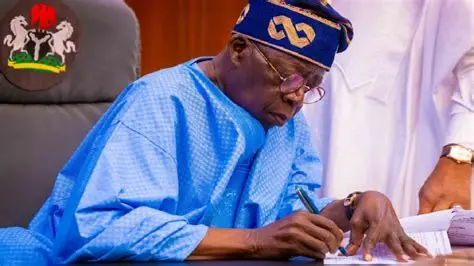
In a major move aimed at restarting Nigeria’s deepwater energy sector, President Bola Tinubu has approved a reform package expected to unlock up to $50 billion in new deep offshore oil and gas investments.
The reform, codified under the Deep Offshore Oil and Gas Projects Incentives (Tax Remission) Order, 2026, fundamentally shifts Nigeria’s approach to major energy ventures.
According to a statement signed by the President Special Adviser to Tinubu on Information and Media, Bayo Onanuga, the new system replaces protracted, project-by-project government negotiations with a clear, rules-based framework designed to enhance Nigeria’s competitiveness for globally mobile capital.
The statement said the first major beneficiary of this new reform system is expected to be Shell’s long-delayed Bonga South West project, an offshore development estimated at $10 billion.
The Presidency noted that the initiative stems directly from discussions between President Tinubu and Shell plc CEO Wael Sawan, during which the President ordered a broader strategy rather than piecemeal fixes.
It explained that under the new directive, NNPC Limited is authorized to amend eligible Production Sharing Contracts (PSCs) to align with the new regulatory standards.
Beyond attracting capital, the administration emphasized that local capacity and job creation remain central to the reform. Qualifying projects will be required to maximize local fabrication, engineering, marine logistics, and project management to reinforce Nigeria’s position as Africa’s premier deep offshore hub.
READ ALSO:
- Nigeria Targets $50bn Investment from 22 Offshore Oil & Gas Projects
- NUPRC Approves Major Offshore Exploration License to Boost Nigeria’s Oil Reserves
- Dangote Advances Olokola Deep Seaport Project Following Host Community Approval
- NUPRC Hails ExxonMobil’s $1bn Investment in Nigerian Deepwater Project as Drilling Resumes After Decade Hiatus
- ExxonMobil’s Force Majeure Declaration on 200,000 bpd Erha Oil Field Threatens Nigeria’s Output
“Given effect through the Deep Offshore Oil and Gas Projects Incentives (Tax Remission) Order, 2026, the framework replaces project-by-project negotiations with transparent eligibility criteria, clear implementation processes and a durable investment architecture that provides greater certainty for investors while safeguarding long-term national value,” the Presidency stated.
“The approval also enables NNPC Limited, as the government’s nominated counterparty under the Production Sharing Contracts, to proceed with the necessary amendments to eligible Production Sharing Contracts required to implement the framework.”
Other highlights of the new offshore reform include:
Industrial & Local Content Mandates: The directive qualifies operators to maximize execution within Nigeria—boosting domestic engineering, fabrication, marine logistics, and project management.
Inter-Agency Alignment: Developed through an inter-agency collaboration involving the Ministries of Justice, Finance, and Petroleum Resources, alongside the Nigeria Revenue Service (NRS), NUPRC, and NCDMB.
Boosting Domestic Capacity and Global Competitiveness
Highlighting the economic focus of the reform, Olu Arowolo-Verheijen, Special Adviser to the President on Oil and Gas, emphasized that the framework prioritizes Nigerian industrial growth
According to her, “Projects qualifying under the framework will maximize execution within Nigeria wherever commercially and technically feasible, strengthening domestic engineering, fabrication, marine logistics, technical services, and project management.”
“The objective is not only to increase investment and production but also to create skilled jobs, deepen local supply chains, and position Nigeria as Africa’s regional hub for deep offshore project execution.”
Stressing the strategic imperative of regulatory certainty in global capital markets, President Tinubu stated, “The countries that attract long-term investment are not necessarily those with the greatest natural resources. They are the ones that provide the greatest certainty.”
Continuing, he said, “This reform reflects our determination to build an investment environment defined by clear rules, strong institutions, and enduring partnerships. We are creating the conditions for capital to flow, for Nigerian businesses to grow, for our people to prosper and for our natural resources to deliver lasting national value.”

Victor Ezeja is a Nigerian journalist skilled in producing insightful news analyses, feature stories, and interviews that simplify complex issues and drive informed public discourse. His work combines rigorous research, balanced reporting, and compelling storytelling to highlight developments shaping industries and society. Victor, who holds a Master's Degree in Mass Communication, specializes in energy, aviation, business, and economic reporting. He can be reached via @VICTOREZEJA on X