

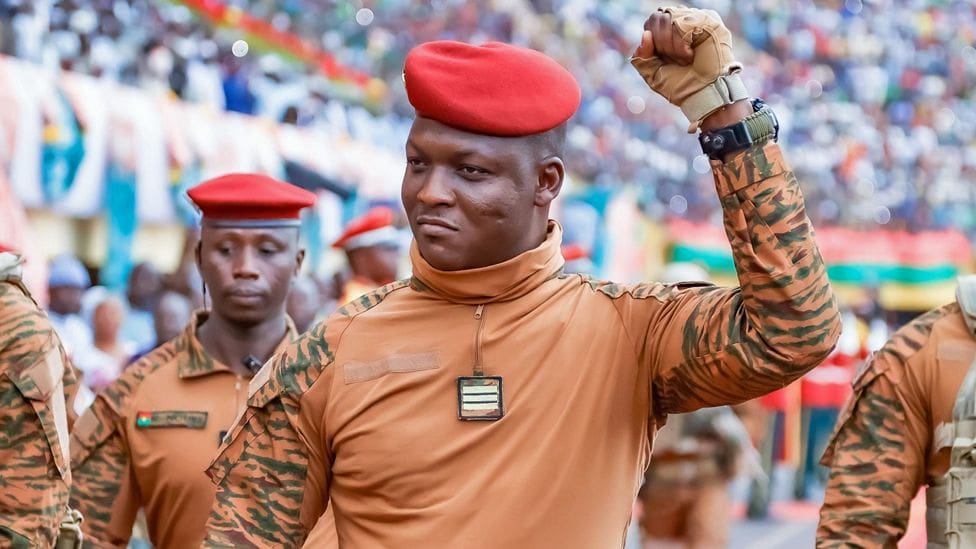
Burkina Faso’s military-led government has dissolved all political parties and movements and repealed the laws governing their activities.
The decision was announced on Thursday in a statement issued by the presidency’s communications directorate following a meeting of the council of ministers presided over by Ibrahim Traore, head of the ruling junta.
Émile Zerbo, minister of territorial administration and mobility, said the move marked a “great and important decision” within the framework of what he described as the re-founding of the state.
According to the presidency, the proliferation of political parties had contributed to political drift, encouraged divisions among citizens and weakened the country’s social fabric.
READ ALSO: Museveni Takes Strong Early Lead in Uganda Election Count
The statement said the dissolution was intended to preserve national unity, strengthen coherence in government action and create space for reforms in political governance.
Under the decree adopted by the Council of Ministers, the assets of the dissolved political parties are to be transferred to the state.
Zerbo said draft legislation related to the decision would be forwarded to the Transitional Legislative Assembly “as soon as possible.”
READ ALSO: Tanzania Halts Independence Day Celebrations Amid Protest Calls
Before the September 2022 coup that brought Traore to power, Burkina Faso had more than 100 registered political parties, with 15 represented in parliament following the 2020 general election. Political parties were ordered to suspend their activities after the military takeover.
At the same meeting, the council of ministers also approved a national development roadmap known as the “Reliance Plan.” The programme, estimated at FCFA 36 trillion (about $65 billion), is expected to run from 2026 to 2030.

Rafiyat Sadiq is a political, justice, and human rights reporter with Pinnacle Daily, known for fearless reporting and impactful storytelling. At Pinnacle Daily, she brings clarity and depth to issues shaping governance, democracy, and the protection of citizens’ rights.