

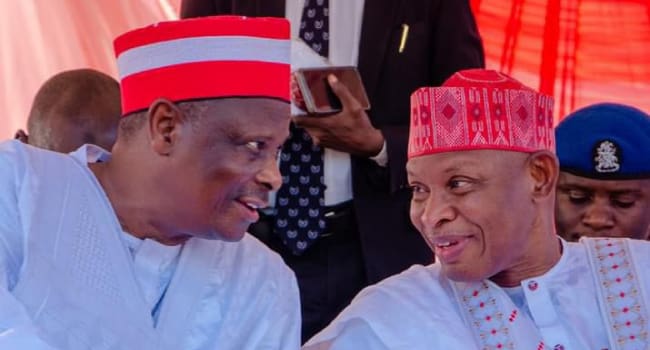
When former Kano State governor and leader of the Kwankwasiyya Movement, Senator Rabiu Musa Kwankwaso, formally registered with the African Democratic Congress (ADC) on Monday at Gidan Kwankwasiyya, Miller Road, Bompai, Kano, the scene appeared to many as just another political defection.
But behind the crowded ceremony lies a complex web of political calculations, personal grievances, and strategic repositioning.
Kwankwaso officially joined the ADC on March 30, 2026, marking a complete break from the New Nigeria People’s Party (NNPP) following a major fallout with his former protégé and current Kano State governor, Abba Kabir Yusuf.

Explaining his decision, Kwankwaso cited what he described as the “current trajectory of the nation’s political landscape, which calls for strategic realignment”.
A day before joining the ADC, he resigned as the national leader of the NNPP and shortly after, the Kwankwasiyya Movement directed its members nationwide to register with the ADC.
His defection had long been anticipated but not without speculation on which party would eventually win his trust.
The signs became clearer when the Labour Party’s 2023 presidential candidate, Peter Obi, who is now aligned with the ADC visited him in Kano, where he received a rousing welcome from Kwankwasiyya supporters.

Collapse of a Political Alliance
At the centre of the crisis is the breakdown of the once formidable alliance between Kwankwaso and Governor Yusuf.
What was once a strong political bond has degenerated into a public feud, fuelled by accusations of betrayal and power struggles.
Kwankwaso did not hide his displeasure when Yusuf indicated plans to defect to the ruling All Progressives Congress (APC), a party dominated in Kano by his long-time rival, Abdullahi Ganduje.

From feelings of betrayal by his political protégé to what is perceived as abandonment by his own party, Kwankwaso’s frustration deepened.
In 2023, the Kwankwasiyya Movement was a dominant political force in Kano, with its red cap symbol representing a symbol of political identity, loyalty, and ideology
Kwankwaso was instrumental in Yusuf’s emergence as governor, mobilising his political structure to defeat Ganduje’s influence in the state, who was then a sitting governor seeking re-election.
Roots of the Rift
The crisis reportedly began over Kwankwaso’s strong influence on the Yusuf administration, including key appointments and governance decisions, as well as the controversial removal of the state’s anti-corruption agency head.
Despite Kwankwaso’s objections, Yusuf proceeded to defect to the APC on January 26, 2026, after resigning from the NNPP three days earlier.
Wave of Defections Reshapes Kano Politics
Yusuf’s defection triggered a sweeping political realignment in Kano, with 21 out of 27 NNPP lawmakers in the state assembly, including principal officers, defecting to the APC.
Eight members of the House of Representatives also joined the ruling party, alongside all 44 local government chairmen, their deputies, and ward executives.
The mass movement significantly altered the state’s political balance.
Following the governor’s exit, several political appointees loyal to Kwankwaso, including the deputy governor, resigned rather than follow Yusuf to the APC.
Kwankwaso’s Reaction: ‘Betrayal’ and Defiance
Kwankwaso described Yusuf’s defection as shocking and difficult to comprehend, insisting that those who left the NNPP would eventually regret their decision.
He went further to label the move a “cold betrayal of a sacred trust”, even declaring January 23 as “World Betrayal Day”.
Maintaining his stance, Kwankwaso said he remains “priceless” in politics and not driven by financial inducement.
RELATED NEWS:
- Kwankwaso Officially Joins ADC After Resigning from NNPP
- Kwankwaso: Gov Yusuf will Regret Leaving NNPP
- Fresh Political Crisis Looms in Kano as Yusuf and Kwankwaso Differ on Defection
- 2027: Kwankwaso Rules Out Defection, Open To Discussion
Speaking to supporters in Kano, he stressed that his decisions are guided by principles, not money, despite widespread belief that politicians can be influenced financially.
Earlier Openness to Alliances
Interestingly, before the fallout, Kwankwaso had openly denied the intention to leave NNPP but also expressed conditional openness to alliances, including with the APC.
He insisted that any alliance must protect the interests of the NNPP and the Kwankwasiyya Movement, warning against being used and discarded.
He also recalled his role in forming the APC and the sacrifices made by his supporters, including alleged persecution before the party came to power.
“We have our party, we are comfortable here, and we are happy. We are not in a hurry. NNPP members and leadership believe we have something to offer this country at the highest level of leadership, and we want to do it the right way. We are ready to engage anyone, but if there is any negotiation, it will be done collectively.”
NNPP Crisis and Internal Divisions
Even before his exit, Kwankwaso faced opposition from a rival faction within the NNPP.
The faction linked to the party’s founder, Boniface Aniebonam, repeatedly challenged his authority, at times claiming he had been expelled over alleged anti-party activities.
The group also asked the Independent National Electoral Commission (INEC) to disregard congresses organised by the Kwankwasiyya faction, insisting they were unconstitutional.
Following Yusuf’s defection, the NNPP’s national leadership dissolved its Kano executive structure and appointed a caretaker arrangement to manage party affairs.
Analyst Weighs in
Public affairs analyst Hon. Nonso Okeke told Pinnacle Daily that Kwankwaso’s move reflects the fluid and interest-driven nature of Nigerian politics.
He said the development raises questions about consistency, noting that Kwankwaso criticised Yusuf for leaving the NNPP, only to exit the same party shortly after.
According to Okeke, political actors often prioritise survival and strategic advantage over loyalty, citing past coalition failures driven by competing interests.
He described Kwankwaso’s move to the ADC as a strategic repositioning but questioned the party’s national strength compared to Kwankwaso’s influence, which is largely concentrated in Kano and parts of the North.
Okeke also pointed to emerging internal tensions within the ADC, warning that early factional disputes could shape the party’s stability ahead of future elections.
Kwankwaso’s Defection to ADC Justifies Yusuf’s Defection
APC chieftain Mohammed Jamo said Kwankwaso’s defection from the NNPP has vindicated Governor Abba Yusuf’s earlier decision to leave the party.
Speaking on Politics Today, Jamo argued that the NNPP is no longer a viable political platform and that current shifts in Kano politics support Yusuf’s move.
He noted that Yusuf and his allies were initially criticised when they exited the NNPP, especially by members of the Kwankwasiyya Movement, but said recent defections show the decision was justified.
Conclusion: Strategy or contradiction?
Kwankwaso’s defection to the ADC raises critical questions about the true motive behind his earlier outrage over Yusuf’s exit from the NNPP.
While he framed Yusuf’s move as betrayal, his own departure suggests a broader pattern of political recalibration.
Whether driven by loss of political control in Kano or a calculated move ahead of 2027, his actions point less to party loyalty and more to strategic survival.
As he himself put it, the decision aligns with “the current trajectory of the nation’s political landscape”.
The question remains: was it truly about betrayal, or simply a struggle for dominance over Kano’s political structure?

Rafiyat Sadiq is a political, justice, and human rights reporter with Pinnacle Daily, known for fearless reporting and impactful storytelling. At Pinnacle Daily, she brings clarity and depth to issues shaping governance, democracy, and the protection of citizens’ rights.