

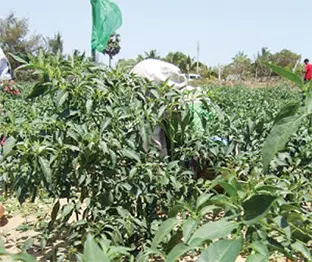
Nigeria’s agricultural exports plunged by 31.2 per cent in the first quarter of 2026, Q1’26, as prolonged port delays, excessive pesticide use, outdated chemical preservatives, poor post-harvest handling and failure to obtain mandatory phytosanitary certification continued to undermine the country’s access to international markets.
Latest data from the National Bureau of Statistics (NBS), showed that agricultural exports fell to N1.172 trillion in Q1’26, from N1.704 trillion recorded in the corresponding period of 2025.
The figure also represented an 11.39 per cent decline from the N1.323 trillion recorded in the fourth quarter of 2025, Q4’25.
Agricultural value chain experts warned that the development, compounded by weak quality assurance systems and inefficient border logistics, is rapidly eroding the competitiveness of the ‘Made-in-Nigeria’ agro brand and exposing exporters to mounting economic losses.
The decline has intensified calls for an urgent overhaul of farming practices, post-harvest handling, chemical regulation, certification systems and port operations to stem the growing wave of export rejections.
Cocoa, Sesame Dominate Export Earnings
According to the NBS data, Superior Quality Cocoa Beans remained Nigeria’s leading agricultural export in Q1’26, valued at N596.90 billion.
This was followed by Sesame Seeds valued at N153.78 billion; Soya Beans, excluding seeds, at N129.27 billion; Cashew Nuts in Shell at N119.76 billion; and Flours and Meals of Soya Beans valued at N53.20 billion.
Asia remained Nigeria’s largest destination for agricultural exports, accounting for N529.45 billion, followed by Europe with N500.34 billion.
The Netherlands, Belgium, India and Canada also ranked among the major destinations for Nigerian agricultural commodities.
The domestic decline comes amid a broader global push for stricter compliance with international food safety standards.
Speaking at the opening of the 49th Session of the Codex Alimentarius Commission in Geneva on July 6, 2026, Director-General of the Food and Agriculture Organisation (FAO), Qu Dongyu, announced an additional $500,000 allocation to strengthen digital infrastructure and capacity building for developing countries implementing international food safety standards.
Qu warned that confidence in global food trade depends largely on the effective implementation of food safety standards.
“Impact depends on implementation without implementation these standards cannot achieve their intended benefits,” he said.
He added that international food standards go beyond food safety, helping countries build trust, reduce waste and create more competitive and equitable markets as they transform agrifood systems to become more efficient, inclusive, resilient and sustainable.
Agriculture Ministry moves to investigate rejections
Confirming the seriousness of the challenge, Minister of Agriculture and Food Security, Abubakar Kyari, last month inaugurated a Technical Working Group to investigate the recurring rejection of Nigeria’s agricultural exports and submit its findings within two months.
Kyari said Nigeria had recorded several cases of export rejection over the years due to non-compliance with Maximum Residue Limits, MRLs, as well as other sanitary and phytosanitary requirements.
He noted that the repeated rejections had resulted in significant economic losses for stakeholders across the agricultural value chain.
15 containers of zobo rejected at Mexican border
One of the most striking cases emerged during the 2026 SheExport Conference, where the Founder of Women in Agribusiness, Trade and Export, WATEX, Dr. Queen Okpa, revealed that a shipment of 15 containers of hibiscus flowers, popularly known as zobo, was rejected at the Mexican border after laboratory tests detected residues of outdated chemical preservatives.
According to Okpa, the shipment was returned after failing quality control tests.
She said the incident highlighted deep-rooted weaknesses in sourcing and traceability across Nigeria’s agricultural value chain.
“The preservatives used on that hibiscus were chemicals that have been banned for years in other countries,” she said.
Okpa warned that countries with strict food safety standards reject or return agricultural products when they exceed the maximum allowable limits for certain chemical residues.
She added that Nigerian beans and rice had also faced similar restrictions.
Beyond chemical contamination, she identified poor post-harvest handling as another major threat, particularly because of high levels of toxins found in some local commodities.
According to her, the European Union allows a maximum aflatoxin level of four per cent, compared with the 20 per cent ECOWAS standard, while recent tests on commodities in local markets showed contamination levels between 65 and 95 per cent.
Okpa said the situation could be significantly reduced through improved post-harvest handling and investment in basic infrastructure.
“We can reduce this by 70 to 80 per cent simply through better post-harvest handling,” she said, calling for the provision of infrastructure such as solar-powered dehydrators in farming communities.
She said such facilities would enable farmers to dry produce hygienically instead of exposing them to contamination on open ground or bags.
Port delays shorten shelf life
For Managing Consultant at Bdelium Limited, Dr. Adelaja Adesina, port inefficiency is another major threat to the shelf life and competitiveness of Nigeria’s agricultural exports.
Speaking on a radio programme on agribusiness, Adesina said cargo processing that could be completed within 48 hours at ports in Benin Republic and Ghana often takes between two and three weeks at Nigerian ports.
He warned that the delays leave many perishable commodities unable to meet buyers’ quality requirements by the time they reach their destinations.
“There are so many reasons that produce gets rejected. Number one has to do with quality. If you don’t meet their quality, you will be rejected,” he said.
Adesina added that the time required to move agricultural commodities through Nigerian ports was a major challenge, particularly for products with limited shelf lives.
He said the country must urgently address the delays if it hopes to compete effectively with neighbouring countries in the regional export market.
Pesticide abuse threatens Nigeria’s export market
Programme Director of the Health of Mother Earth Foundation, HOMEF, Joyce Brown, also raised concerns over the indiscriminate use of chemicals by Nigerian farmers.
Speaking during a national programme, Brown said pesticide abuse was directly responsible for a significant proportion of Nigeria’s agricultural export rejections.
Citing research by the Amalgamated Agric Practitioners of Nigeria, AAPN, she disclosed that 65 per cent of active ingredients in chemicals used by Nigerian farmers were classified as highly hazardous pesticides, while more than 80 per cent of farmers applied such substances to their crops.
Brown said the situation posed a serious threat to public health and Nigeria’s international trade.
She also cited a 2024 statement by the National Agency for Food and Drug Administration and Control, NAFDAC, that more than 60 per cent of Nigeria’s food exports, particularly those destined for the European Union, were rejected over excessive pesticide residues.
Molecular biologist, Ifeanyi Casmir, attributed the continued presence of banned pesticides in Nigeria’s agricultural value chain to weak enforcement.
He said chemicals that had been officially banned for years remained readily available in local markets and online.
Casmir said the continued circulation of such substances undermined international trade regulations and exposed Nigerian agricultural exports to rejection.
“The reality is that chemicals and pesticides that have been officially banned for years are still heavily circulated in our local markets,” he said.
He cited Dichlorvos, commonly known as Sniper, as an example of a highly hazardous chemical that remains accessible despite regulatory restrictions.
According to him, the continued use of heavy chemical treatments also contributes to soil degradation and the accumulation of dangerous pesticide residues in crops.
Certification Gaps Undermine Competitiveness
National President of the Cocoa and Coffee Farmers Alliance, Comrade Adeola Adegoke, identified the failure of exporters and farmers to meet required certification standards as another major challenge.
He cited contamination from excessive pesticide use, particularly Dichlorvos, as well as aflatoxins and salmonella, among the key risks facing Nigeria’s agricultural exports.
Adegoke also identified the failure to obtain the required national quarantine certification and poor compliance with Good Agricultural Practices, GAPs, as critical systemic gaps.
He stressed that compliance with phytosanitary and sanitary requirements through the Nigeria Agricultural Quarantine Service was essential to maintaining access to international markets.
“The maximum residue limit must be adhered to strictly, especially at the US and EU borders,” he said.
READ ALSO:
- Diversifying Nigeria’s Economy Starts with Agriculture – Prof Utomi
- Banks Funnel Cheap Credit to Oil and Gas, Squeeze Agriculture, Manufacturing
- Nigeria, UAE Agreement Will Strengthen Ties in Renewable Energy, Aviation, Agriculture, Others – Tinubu
- Banks Funnel Cheap Credit to Oil and Gas, Squeeze Agriculture, Manufacturing
Trade Representative of the Federal Republic of Uganda to Nigeria and Ghana, Ani Charles Bassey-Eyo, warned that the recurring rejection of Nigerian agricultural exports was no longer merely a trade issue but a growing threat to the country’s global reputation.
He said repeated rejections weakened confidence in the ‘Made-in-Nigeria’ brand, reduced the country’s ability to command premium prices and restricted access to high-value international markets.
“The recurring rejection of Nigerian agricultural exports should be viewed as more than a trade issue; it is fundamentally a competitiveness and reputation issue,” he said.
Bassey-Eyo urged the Federal Government to move beyond committee-level interventions and implement end-to-end reforms covering traceability systems, grassroots compliance awareness, quality assurance infrastructure and standardised inspection processes.
He also called for a more inclusive approach to the Technical Working Group investigating the export rejections.
According to him, the team should engage farmers, exporters, commodity associations, logistics providers, processors and quality assurance professionals alongside government agencies.
“The most effective solutions will come from those directly involved in the value chain,” he said.

Esther Ososanya is an investigative journalist with Pinnacle Daily, reporting across health, business, environment, metro, Fct and crime. Known for her bold, empathetic storytelling, she uncovers hidden truths, challenges broken systems, and gives voice to overlooked Nigerians. Her work drives national conversations and demands accountability one powerful story at a time.