

Nigeria’s inflation rate may be slowing, but the latest figures show that households and businesses in the country’s major commercial centres are facing very different levels of price pressure.
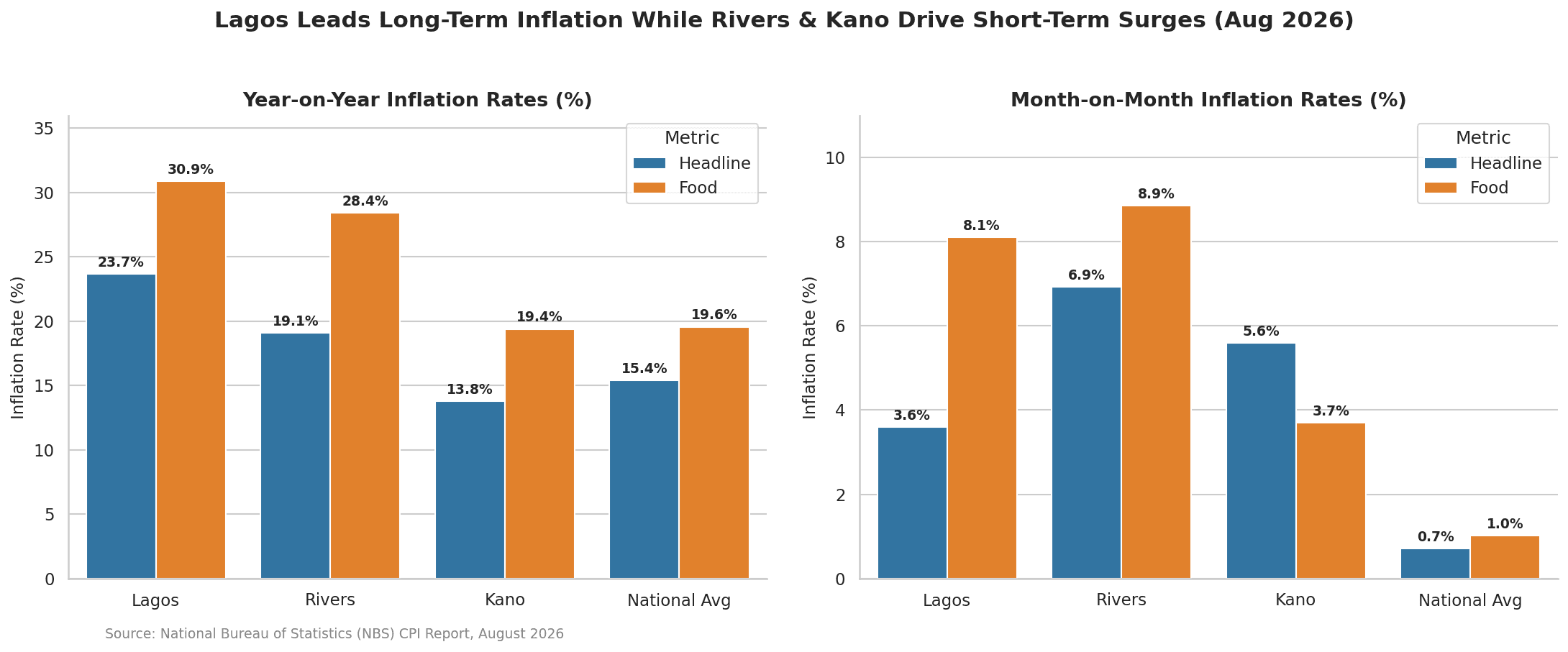
While Lagos records the highest yearly inflation, Rivers posts the fastest monthly price increase, and Kano shows the lowest yearly rate among the three despite a sharp rise in prices in August.
The differences show that inflation is not affecting businesses and households across the country in the same way. While Lagos is dealing with the biggest accumulated increase in prices over the past year, Rivers is experiencing the most rapid jump in prices from one month to the next, while Kano has recorded a lower overall inflation rate but significant recent pressure.
Lagos has the Highest yearly Inflation
According to NBS, Lagos recorded a headline inflation rate of 23.68 per cent in August, the highest among the three states and above the national rate of 15.39 per cent.
Headline inflation measures the overall change in the prices of goods and services commonly bought by households. The yearly figure compares prices in August 2026 with prices in August 2025.
The Lagos Consumer Price Index (CPI), which measures changes in the cost of goods and services, rose to 152.2 in August from 146.9 in July and 123.0 a year earlier.
Food remains a major source of pressure in Lagos. Food inflation stood at 30.9 per cent year-on-year, while monthly food inflation rose sharply to 8.1 per cent.
READ ALSO:
- NERC Orders DisCos to Refund Customers ₦20.33bn for Meter Payments
- Foreign Investors Retreat as Domestic Capital Powers NGX Rally
- Risks, Opportunities US-Iran War Poses for Nigeria
- JPMorgan Return Could Cut Nigeria’s ₦16trn Debt Costs
This means Lagos households were paying significantly more for food than they did a year earlier, while food prices also recorded a strong increase between July and August.
Rivers has the fastest price increase
Its yearly headline inflation was lower than Lagos at 19.1 per cent, but its monthly inflation rate was the highest among the three states at 6.92 per cent.
Monthly inflation measures how much prices changed between one month and the next. A high monthly rate therefore points to a rapid and immediate increase in prices.
Food prices were also a major concern in Rivers. Food inflation stood at 28.4 per cent year-on-year, while monthly food inflation reached 8.86 per cent, the second-highest rate nationally.
The data suggest that while Lagos has experienced greater price pressure over the past year, Rivers is currently seeing prices rise at a much faster pace.
Kano has lower yearly inflation but rising pressure
Kano recorded the lowest yearly headline inflation among the three states at 13.8 per cent, below the national rate of 15.39 per cent.
However, its monthly inflation rate was 5.59 per cent, making it the third-highest monthly rate nationally.
Food inflation in Kano was 19.4 per cent year-on-year, close to the national food inflation rate of 19.57 per cent. Its monthly food inflation stood at 3.7 per cent.
This suggests that Kano has not experienced the same level of accumulated price increases as Lagos and Rivers, but prices have risen considerably in recent months.

Food remains a major pressure point
The differences become clearer when the components of inflation are examined.
Farm produce prices rose by 11.3 per cent in Rivers in August, compared with 10.5 per cent in Lagos and 5.6 per cent in Kano.
Energy prices also moved differently across the three states. They fell by 12.1 per cent in Lagos and 5.8 per cent in Kano but increased by 11.8 per cent in Rivers.
Services recorded their biggest monthly increase in Kano at 10.2 per cent, compared with 5.1 per cent in Rivers and 2.7 per cent in Lagos.
Goods prices increased by 5.7 per cent in Rivers, 4.7 per cent in Lagos and 3.9 per cent in Kano.
The figures show why looking only at the overall inflation rate can hide important differences in what is driving price increases in each state.
What the three states tell businesses
For businesses, the different inflation patterns matter because they affect operating costs, consumer spending and pricing decisions in different ways.
Businesses in Lagos face the burden of the highest yearly inflation, meaning they have had to deal with a larger increase in the cost of goods and services over the past year.
Businesses in Rivers are facing a more immediate challenge because prices are rising rapidly from month to month. This could make it harder for companies to predict costs and set prices.
In Kano, the lower yearly inflation rate provides some relief compared with Lagos and Rivers, but the strong monthly increase suggests that businesses cannot ignore the possibility of further price pressure.
State inflation figures need caution
The NBS cautions that state inflation figures should not be compared as if households in every state buy exactly the same things in the same proportions.
Each state’s inflation calculation uses spending patterns specific to households in that state. This means a higher inflation rate does not necessarily mean every product is more expensive in that state.
This means the particular basket of goods and services that households in that state typically buy has increased in price at a faster rate.

Alex is a business journalist cum data enthusiast with the Pinnacle Daily. He can be reached via ealex@thepinnacleng.com, @ehime_alex on X