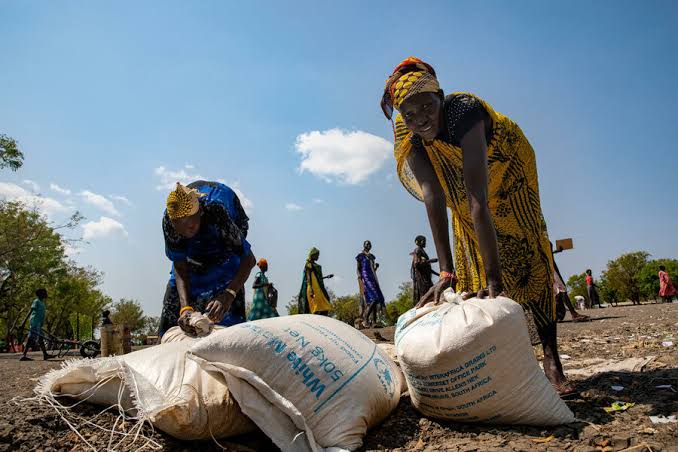
Extreme hunger is expected to worsen in 13 global hotspots over the coming months, with five countries at immediate risk of famine, according to United Nations report.
The report released by the United Nations Food and Agriculture Organization (FAO) and the World Food Programme (WFP) on Monday titled “Hunger Hotspots” warns that the spread of conflict, particularly in the Middle East – coupled with climate and economic stressors – is pushing millions of people to the brink.
The report highlights a deepening hunger crisis, in the Zamzam camp in North Darfur and warning of a growing famine risk in other parts of Sudan. It also points to the ongoing threat of famine in the Gaza Strip, while describing acute food insecurity in Haiti, Mali, and South Sudan as catastrophic.
Five Countries at Immediate Risk
South Sudan citizen, Nyal Chol Liech Muon preparing the meal after collecting food at WFP’s distribution point in Bilkey Payam Photo: [WFP/Theresa Piorr]
The report forecasts severe food insecurity in multiple regions over the next five months, urging international donors and organizations to step up funding and logistical support. It highlights that ongoing conflict and limited resources are obstructing the delivery of life-saving assistance to vulnerable populations.
“The people living in the five worst-hit countries face extreme hunger and risk of starvation and death in the coming months unless there is urgent humanitarian action,” UN agencies warned.
Sudan is facing what the United Nations calls the world’s largest hunger crisis. According to the World Food Programme (WFP) and UNICEF, over 24.6 million people, more than half the population are experiencing high levels of acute food insecurity as of mid-2025. Famine has been officially confirmed in multiple areas, including Zamzam camp in North Darfur, and is expected to spread to other regions unless urgent humanitarian access is granted.
South Sudan, affected by recurrent flooding and political instability, could see as many as 7.7 million people in crisis conditions. The report estimates that 63,000 individuals are already facing famine-like circumstances.
Gaza: Total Population Experiencing Food Insecurity
In Palestine, the ongoing military operations and blockade in Gaza have devastated the food supply. The report states that the entire population of 2.1 million is suffering from acute food shortages, with nearly 500,000 people at risk of famine by the end of September.
Aid convoys have been severely limited, and humanitarian supplies are frequently delayed or looted, impeding sustained food distribution.
Haiti: Hunger Crisis Escalates Amid Gang Violence
In Haiti, widespread gang violence has forced the displacement of over 1.3 million people, many of whom are now living in overcrowded shelters with little access to food, water, or sanitation. According to a joint report from the World Food Programme (WFP) and Agriculture Organization (FAO) at least 8,400 people are currently facing catastrophic hunger.
Mali: Starvation Risk Due to Conflict and Market Disruptions
In Mali, conflict, internal displacement, and high grain prices have created a dire food security situation. According to a joint report from the United Nations Food and Agriculture Organization (FAO) and Reuters, 2,600 people are projected to be at risk of starvation by the end of August 2025, especially in conflict-affected northern regions.
Access and Funding Shortfalls Undermining Aid
Women Receives Food Aid From WFP [Photo Credit:WFP]
The FAO and WFP stressed that humanitarian efforts are being severely undermined by insecurity and funding gaps. Both agencies called for immediate international support to prevent further deterioration.
“This report makes it very clear: hunger today is not a distant threat – it is a daily emergency for millions,” said FAO Director-General Qu Dongyu. “We must act now, and act together, to save lives and safeguard livelihoods.”
“This report is a red alert. We know where hunger is rising and we know who is at risk,” said WFP Executive Director Cindy McCain. “Without funding and access, we cannot save lives.”
Additional Countries of High Concern
Beyond the five worst-affected countries, the report highlights ongoing and worsening food insecurity in Yemen, the Democratic Republic of the Congo, Myanmar, and Nigeria. It also flags Burkina Faso, Chad, Somalia, and Syria as critical hotspots.
To officially declare a famine, the UN requires that at least 20 percent of a population experiences extreme food shortages, 30 percent of children suffer from acute malnutrition, and two people per 10,000 die each day from hunger or hunger-related disease.
Urging Early Action
The report strongly emphasizes the importance of proactive measures to mitigate the impacts of food insecurity. “Preemptive interventions save lives, reduce food gaps, and protect assets and livelihoods,” it stated.
Signs of Progress in Some Countries
Despite the alarming trends, the UN agencies also reported improvements in several countries. Ethiopia, Kenya, Lebanon, Lesotho, Malawi, Mozambique, Namibia, Niger, Zambia, and Zimbabwe have been removed from the hotspots list due to better food security conditions.
Rafiyat Sadiq is a political, justice, and human rights reporter with Pinnacle Daily, known for fearless reporting and impactful storytelling. At Pinnacle Daily, she brings clarity and depth to issues shaping governance, democracy, and the protection of citizens’ rights.