

Nigeria’s latest inflation data for May 2026 present a complex and politically sensitive economic picture. The headline inflation is rising, monthly price pressure is slowing, food costs remain structurally high, and regional disparities are widening in ways that are quietly reshaping household survival patterns across the country.
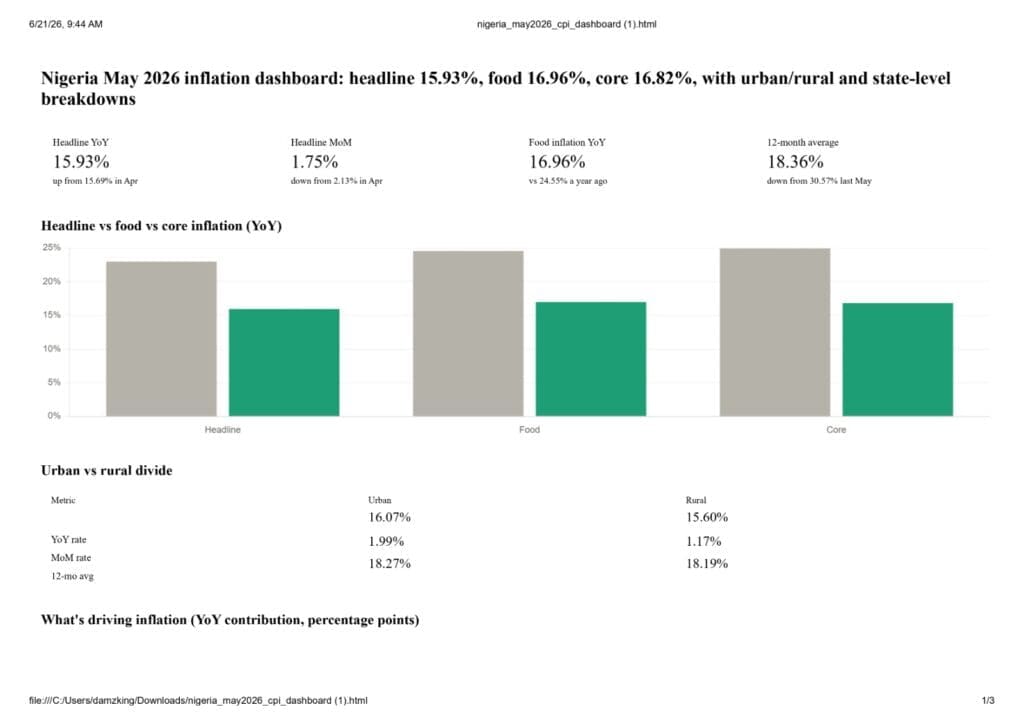
According to the Consumer Price Index (CPI) released by the National Bureau of Statistics (NBS), the headline inflation rate rose to 15.93% year-on-year in May 2026, up from 15.69% in April 2026, marking a continued upward drift in annual price levels despite easing short-term momentum.
At the centre of the data is a paradox: inflation is rising on paper but slowing in motion.
The CPI itself increased to 140.7 index points, reflecting a 2.4-point rise from April (138.3). Yet, the pace of monthly inflation slowed to 1.75%, down from 2.13% in April, signalling that while prices are still rising, they are doing so at a reduced speed compared to the previous month.
This divergence between annual acceleration and monthly deceleration is becoming the defining structure of Nigeria’s current inflation cycle.
A Disinflation Signal That Is Not Yet Felt in Markets
On a year-on-year basis, the inflation trajectory shows a modest upward movement of 0.24 percentage points, rising from 15.69% to 15.93%. However, compared to May 2025, when inflation stood at 26.06%, the broader picture still reflects a significant structural slowdown in inflation over a 12-month horizon.
The twelve-month average inflation rate also eased to 18.36%, a sharp decline from 30.57% recorded in May 2025, indicating that longer-term price pressures are cooling even as short-term volatility persists.
Economists describe this pattern as a “two-speed inflation regime” where structural disinflation coexists with intermittent price shocks driven by food supply constraints, energy adjustments, and transport costs.
Food Inflation: The Persistent Pressure Point
Food continues to stand at the centre of Nigeria’s inflation dynamics, acting as the most persistent and powerful driver of household cost pressures across the economy.
In May 2026, food inflation was recorded at 16.96% year-on-year. While this represents a notable decline from the 24.55% recorded in May 2025, it remains sufficiently elevated to significantly weaken household purchasing power and compress real incomes across income groups.
On a monthly basis, food inflation eased to 2.98%, down from 3.63% in April 2026, indicating a slight slowdown in the pace at which food prices are rising. However, this moderation does not translate into price relief for consumers, as food costs continue to accumulate at a steady and sustained rate.
The inflationary pressure is being driven by a set of staple commodities that sit at the core of Nigerian diets and daily consumption patterns. These include fresh onions, maize grains, yam and cassava products, egusi (melon), fresh tomatoes and pepper, ginger, cowpea, and plantain. Together, these items form the backbone of the national food basket, meaning that even marginal price movements in them have an outsized impact on household budgets.
Because these commodities are consumed widely and frequently, their price behaviour effectively defines the inflation experience for most households more than headline figures do. As a result, food inflation operates less as an abstract macroeconomic indicator and more as a direct transmission channel of economic stress into everyday living conditions.
In practical terms, food inflation functions as a consumption shock rather than just a statistical measure. It directly determines the affordability of calories, shapes dietary choices, and ultimately influences food security outcomes across both urban and rural households in Nigeria.
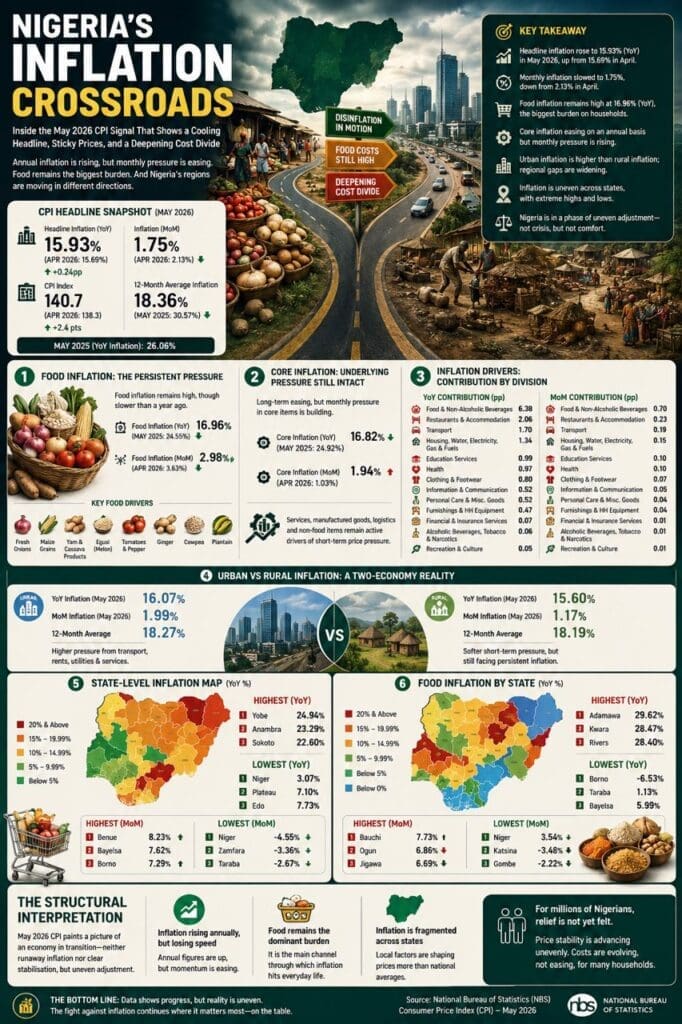
The “all items less farm produce and energy” index core inflation rose to 16.82% year-on-year, down from 24.92% in May 2025, showing a significant structural moderation.
However, the monthly core inflation rate tells a different story, rising to 1.94%, up from 1.03% in April.
This suggests that while long-term inflation is easing, short-term price pressures in services, manufactured goods, logistics, and non-food consumption remain active.
The implication is clear: disinflation is not uniform; it is uneven, segmented, and highly sensitive to monthly shocks.
What Is Driving Inflation: A Divisional Breakdown of Pressure Points
The structure of Nigeria’s Consumer Price Index reveals that inflationary pressure is not evenly distributed across the economy but instead is driven by a relatively narrow cluster of essential spending categories, rather than a broad-based surge in prices.
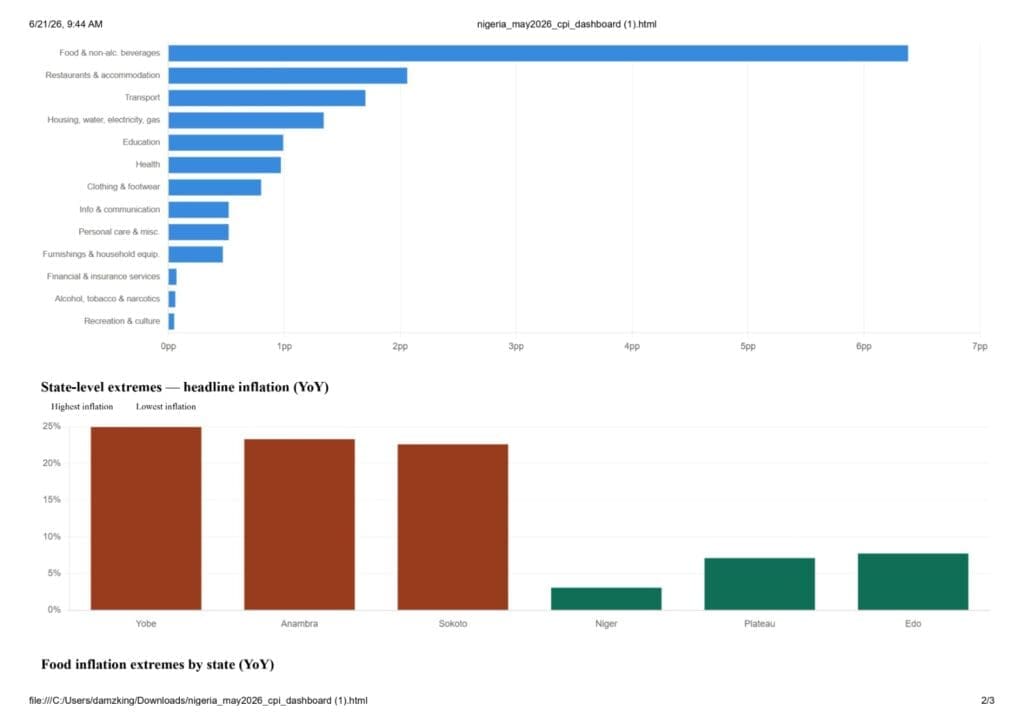
On a year-on-year contribution basis, food and non-alcoholic beverages remain the most dominant driver of inflation, contributing 6.38 percentage points to the headline index. This is followed at a significant distance by restaurants and accommodation services at 2.06 percentage points and transport at 1.70 percentage points, both of which reflect the compounding effect of food consumption outside the home and rising mobility costs.
Housing-related costs covering water, electricity, gas, and other fuels contributed 1.34 percentage points, underscoring the persistent pressure from energy and utility expenses. Education services followed at 0.99 percentage points, while health contributed 0.97 percentage points, indicating that essential human capital services continue to experience steady price adjustments.
Other notable contributions include clothing and footwear at 0.80 percentage points, information and communication at 0.52, personal care and miscellaneous goods also at 0.52, and furnishings and household equipment at 0.47. At the lower end of the spectrum, financial and insurance services contributed 0.07 percentage points, alcoholic beverages, tobacco and narcotics 0.06, and recreation and culture just 0.05 percentage points.
Taken together, this distribution highlights a structurally important pattern: inflation in Nigeria is being disproportionately shaped by survival-linked consumption categories, food, transport, and housing rather than discretionary or luxury spending segments. This reinforces the reality that current price pressures are being transmitted most aggressively through basic cost-of-living channels.
On a monthly basis, the same hierarchy persists, with food contributing the most at 0.70 percentage points. It is followed by restaurants and accommodation services at 0.23, transport at 0.19, and housing, water, electricity, gas, and fuels at 0.15. This consistent pattern indicates that short-term inflation dynamics remain anchored in essential consumption categories, with limited contribution from non-essential spending.
nigeria_may2026_cpi_dashboard (1).html
Urban vs Rural Inflation: A Two-Economy Reality
The Consumer Price Index data continues to highlight a widening structural gap between Nigeria’s urban and rural inflation experiences, reinforcing the emergence of a two-speed cost-of-living environment across the country.
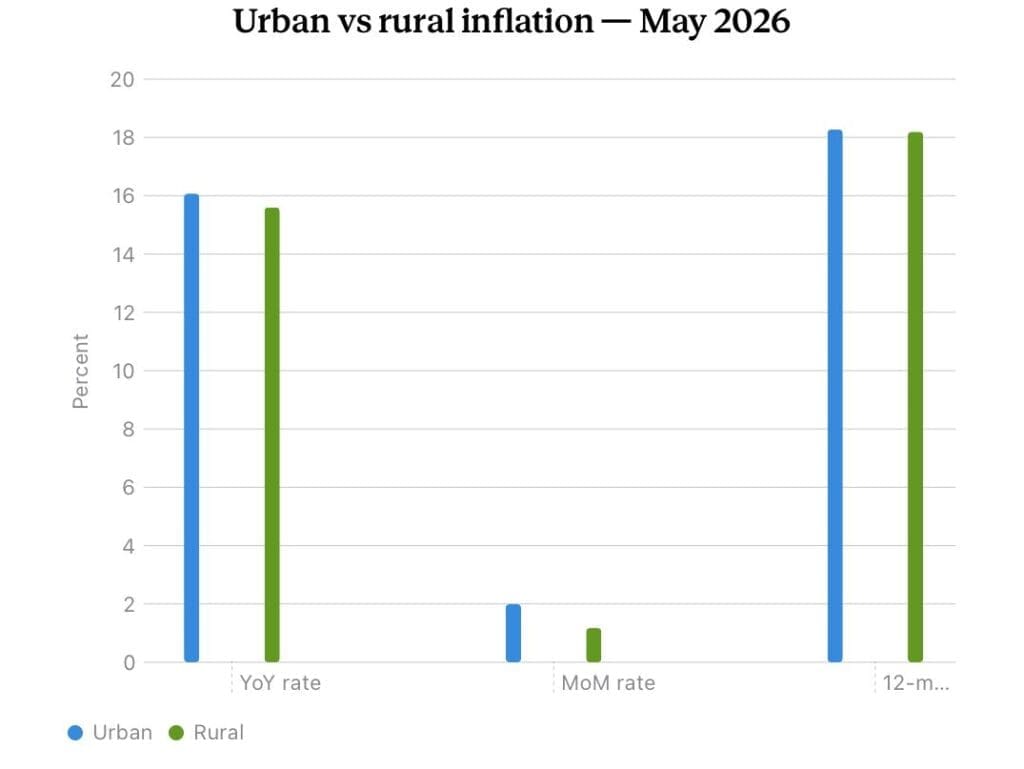
In urban areas, inflation stood at 16.07% year-on-year in May 2026, with a month-on-month rate of 1.99%. The twelve-month average inflation rate for urban centres was recorded at 18.27%, reflecting sustained pressure on city-based consumers who face higher exposure to transport costs, housing rents, utility bills, and service-related pricing.
By contrast, rural inflation was slightly lower at 15.60% year-on-year, with a significantly softer month-on-month rate of 1.17%. The twelve-month average for rural inflation stood at 18.19%, marginally below the urban benchmark, indicating a broadly similar long-term trajectory but different short-term dynamics.
The data suggests that inflationary pressure is more intense in urban centres, where cost structures are heavily influenced by transport logistics, accommodation expenses, and service-sector pricing. These factors amplify the impact of broader inflation trends on city households, where consumption baskets are more monetised and market-dependent.
Rural areas, however, appear to be experiencing a relatively short-term easing in price momentum, particularly on a month-on-month basis. This reflects temporary stabilisation in localised food supply chains and subsistence-linked consumption patterns, which tend to soften immediate price transmission effects compared to urban markets.
Overall, the divergence underscores a growing spatial inequality in inflation exposure, where urban households bear a sharper and more immediate cost burden, while rural communities experience milder but still persistent inflationary pressures over time.
State-Level Inflation Map: Nigeria’s Uneven Price Geography
The Consumer Price Index further exposes a pronounced subnational fragmentation of inflationary pressures across Nigeria, underscoring the reality that inflation is no longer a uniform national experience but a highly uneven economic condition shaped by localised factors.
The year-on-year inflation was highest in Yobe at 24.94%, followed by Anambra at 23.29% and Sokoto at 22.60%. These figures indicate sustained and elevated price pressures in these states, reflecting stronger transmission of cost increases into local markets.
In contrast, the lowest year-on-year inflation rates were recorded in Niger at 3.07%, Plateau at 7.10%, and Edo at 7.73%, suggesting significantly milder inflationary conditions in these regions relative to national averages.
Monthly data reveals even sharper volatility at the state level. The most severe monthly inflation increases were observed in Benue (8.23%), Bayelsa (7.62%), and Borno (7.29%), indicating rapid short-term price increases in these areas.
However, several states also recorded notable monthly price declines, including Niger at -4.55%, Zamfara at -3.36%, and Taraba at -2.67%, indicating temporary deflationary movements or short-term easing of price pressures in selected markets.
This stark divergence across states reflects the growing influence of localised economic conditions on inflation outcomes. Factors such as supply chain disruptions, security constraints, variations in agricultural output, and transport bottlenecks are increasingly shaping price behaviour at the subnational level. As a result, inflation in Nigeria is becoming less of a centralised macroeconomic trend and more of a patchwork of regional economic realities.
Speaking exclusively to Pinnacle Daily Economist, an investment banker, Sidiku Olayinka Oscars, said the widening gap between urban and rural inflation reflects deeper structural differences in how both populations consume, produce, and access goods and services.
According to him, urban centres are significantly more exposed to transported goods, imported inputs, and formal market systems, making city residents more vulnerable to fuel price fluctuations, logistics costs, and external economic shocks.
“The reasons are not far-fetched. Urban areas depend more on transported goods, imported inputs, and formal markets, making them vulnerable to fuel price shocks, poor road infrastructure, and rising logistics costs. Rural communities often have more direct access to subsistence farming and locally produced food, which provides some buffer against inflationary pressures, even though they face challenges of insecurity and rising agricultural input costs,” he told Pinnacle Daily.
He noted that urban households also spend a larger share of their income on housing, transportation, utilities, and services, sectors that are highly sensitive to energy prices, exchange rate movements, and global economic disruptions.
By contrast, rural consumption patterns remain more closely tied to self-produced or locally sourced food, reducing immediate exposure to some of the inflationary forces affecting urban markets.
Oscars warned that the growing divergence between urban and rural inflation could have broader socioeconomic consequences if left unaddressed.
“In my opinion, these structural differences risk widening urban-rural inequality, increasing social tensions, and reducing the effectiveness of national economic policies. It could complicate fiscal planning, deepen regional disparities, and ultimately slow inclusive economic growth,” he said.
He added that while headline inflation stood at 15.93 per cent in May 2026, with food inflation at 16.96 per cent and core inflation at 16.82 per cent, urban households remain under intense pressure as rising living costs continue to erode purchasing power despite the country’s inflation moderation narrative.

Food Inflation by State: A More Volatile Map
Food inflation across Nigeria presents an even more fragmented and volatile pattern than headline inflation, revealing deep structural inconsistencies in how food prices are transmitted across different states.
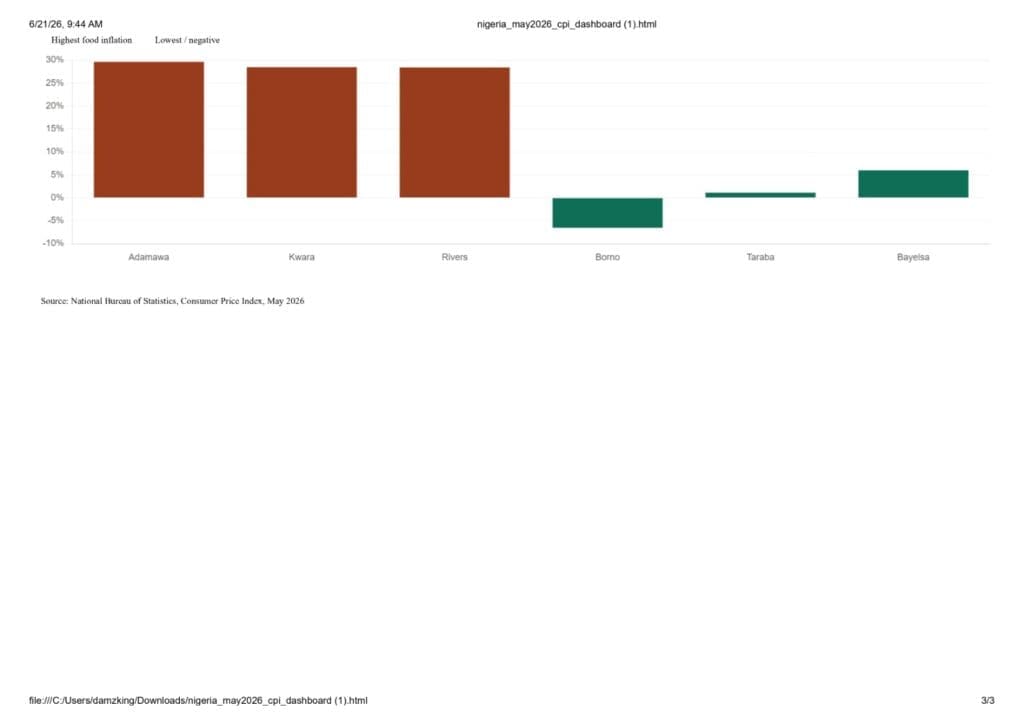
At the upper end of the spectrum, the highest food inflation rates were recorded in Adamawa at 29.62%, Kwara at 28.47%, and Rivers at 28.40%. These figures point to intense upward pressure on food prices in these states, where household food baskets are being significantly strained by persistent cost increases.
In sharp contrast, some states recorded unusually low or even negative food inflation. Borno registered -6.53%, indicating a deflationary movement in food prices, while Taraba recorded 1.13% and Bayelsa 5.99%, all of which suggest relatively subdued food price pressures compared to national averages.
Monthly movements further reinforce this volatility. Food inflation was highest on a month-on-month basis in Bauchi at 7.73%, Ogun at 6.86%, and Jigawa at 6.69%, reflecting sharp short-term price surges in these locations.
On the lower end, Niger recorded 3.54%, while Katsina posted -3.48% and Gombe -2.22%, indicating declining food price levels in those states over the month.
The presence of negative food inflation in several states is particularly significant, as it points to highly uneven agricultural supply conditions, seasonal distortions, and localised market corrections. It underscores the extent to which Nigeria’s food inflation dynamics are no longer uniform but instead driven by highly variable and often unpredictable regional supply chain realities.
The Structural Interpretation: A Fragile Balance
Nigeria’s inflation data for May 2026 presents a layered and somewhat contradictory economic reality, defined by three simultaneous forces that are reshaping how price pressures are understood and experienced across the country.
First, inflation continues to rise on an annual basis, even though the speed of that increase is gradually weakening. The data suggests a system that is still under upward price pressure, but with diminishing momentum compared to previous periods.
Second, food prices remain the dominant transmission channel through which inflation is felt in everyday life. More than any other category, food continues to determine how households adjust consumption, manage income constraints, and absorb economic shocks, making it the most sensitive and socially impactful component of the inflation basket.
Third, inflation in Nigeria is no longer a uniform national phenomenon. Instead, it is increasingly fragmented at the state level, with significant divergence in price behaviour across regions. This makes subnational inflation dynamics as important as headline national figures in understanding the true cost-of-living landscape.
Taken together, these patterns point to an economy in transition. Nigeria appears to be in a phase that is neither characterised by runaway inflation nor by clear stabilisation but rather by uneven adjustment—where price pressures are easing in some segments while persisting stubbornly in others.

Providing further insight into the disconnect between official inflation figures and household realities, Oscars argued that many Nigerians are yet to experience meaningful relief despite the apparent moderation in the inflation rate.
According to him, while headline inflation has declined significantly from the elevated levels recorded in 2024, the impact of earlier price shocks remains deeply embedded in everyday living costs.
“What many Nigerians are experiencing is a pronounced gap between official statistics and actual purchasing power. Wages have not kept pace with rising expenses, while low-income households continue to spend a disproportionate share of their income on food items whose prices remain highly volatile,” he said.
He explained that the recent rebasing of the Consumer Price Index may have contributed to sharper year-on-year declines in inflation figures without necessarily translating into noticeable price relief for consumers.
“The CPI rebasing updated the consumption basket and reduced the weight assigned to food. While this may improve statistical accuracy, it can also produce steeper declines in annual inflation figures without matching what households experience in real markets,” he noted.
The economist further stressed that the current phase represents disinflation rather than deflation.
“Disinflation simply means prices are rising more slowly; it does not mean prices are falling. The cost of staples such as rice, transportation, and other essentials remains significantly higher than pre-2023 levels following the removal of fuel subsidies and exchange-rate reforms. These increases are already embedded in household budgets.”
He added that persistent supply-side constraints, including insecurity, inadequate infrastructure, and import-related challenges, continue to keep food prices highly sensitive to shocks despite broader macroeconomic improvements.
For many households, particularly wage earners and low-income families, he said the result is a continued squeeze on living standards, where official inflation moderation has yet to translate into meaningful improvements in daily economic conditions.
In that sense, the May 2026 CPI does not necessarily signal an outright inflation crisis. Instead, it reflects an ongoing recalibration of price dynamics across the economy.
However, beneath the surface of moderating monthly indicators lies a more complex reality. Statistical improvements in inflation metrics are not yet fully translating into tangible relief for households. The experience of price stability is advancing unevenly, and in many cases, more slowly than the data suggest.
For millions of Nigerians, particularly in states where food inflation remains elevated, analysts say the cost of living is not necessarily declining. Rather, it is evolving, shifting in composition, intensity, and distribution, but not yet easing in a way that is consistently felt at the household level.

Esther Ososanya is an investigative journalist with Pinnacle Daily, reporting across health, business, environment, metro, Fct and crime. Known for her bold, empathetic storytelling, she uncovers hidden truths, challenges broken systems, and gives voice to overlooked Nigerians. Her work drives national conversations and demands accountability one powerful story at a time.