

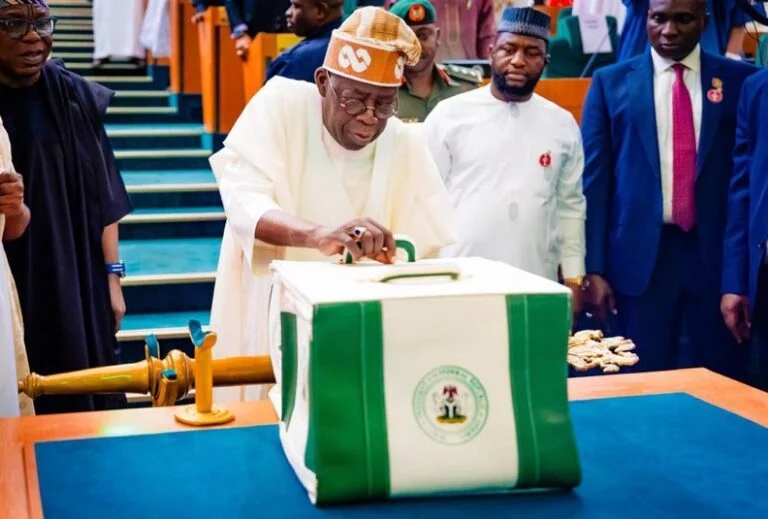
On Friday, December 19, 2025, Nigeria’s President Bola Tinubu presented a proposed 2026 budget size of N58.18 trillion to a joint session of the National Assembly.
Christened ‘Budget of Consolidation, Renewed Resilience and Shared Prosperity’, it aims to consolidate economic reforms and boost growth.
It was read for the first time on the same day, and as of Tuesday, December 23, it has passed the second reading in the Senate.
This was after the lawmakers debated its general principles, unwittingly drawing concern over the eagerness to speed up the process barely five days after its presentation.
Leading the debate, the Senate Leader, Opeyemi Bamidele (APC Ekiti Central), said the proposed budget reflects the President’s commitment to restoring economic stability, correcting distortions, and strengthening public finance.
He noted the budget is anchored on four pillars which are consolidating macroeconomic stability, improving the business and investment environment, promoting job-rich growth and poverty reduction, and strengthening human capital while protecting vulnerable citizens.
He believes the budget proposal emphasises purposeful spending, disciplined debt management, and pursues growth that is broad-based and sustainable.
Diket Plang (Plateau Central) corroborated that the budget prioritises macroeconomic stability and infrastructure development, adding that effective implementation would boost productivity.
Aminu Abbas (Adamawa Central) described the proposal as the best budget presented so far in Nigeria’s democratic history, urging lawmakers to ensure it delivers tangible benefits to citizens.
READ ALSO:
- Seplat Energy Aligns Operated Onshore Assets with PIA
- 2026 Electoral Act: Presidential Campaign Spending Limit Doubled to ₦10bn, Governorship Cap Tripled to ₦3bn
Asuquo Ekpenyong (APC, Cross River South) commended the administration for the substantial allocation to security and infrastructure but stressed the need for full implementation.
A former Senate President, Ahmed Lawan, also called on the federal government to ensure full implementation of the budget once approved, to avoid the practice of operating multiple budgets within a single fiscal year.
A breakdown of the figure
President Tinubu projected an expected total expenditure of ₦58.18 trillion, total revenue of ₦34.33 trillion, debt servicing of ₦15.52 trillion, recurrent (non‑debt) expenditure of ₦15.25 trillion, capital expenditure of ₦26.08 trillion, and budget deficit of ₦23.85 trillion, representing 4.28 per cent of gross domestic product (GDP).
According to the him, these numbers are not just accounting lines, they are a statement of national priorities.
“We remain firmly committed to fiscal sustainability, debt transparency, and value‑for‑money spending,” Tinubu pledged.
Pinnacle Daily reports that the 2026–2028 Medium‑Term Expenditure Framework and Fiscal Strategy Paper has set the parameters for this 2026 budget.
In the paper, the President has projected a conservative crude oil benchmark of $64.85 per barrel, crude oil production of 1.84 million barrels per day, and an exchange rate of ₦1,400 to a dollar for the 2026 fiscal year.
“We will continue to reduce waste, strengthen controls, and ensure that every naira borrowed or spent delivers measurable public value — especially in infrastructure, human capital, and security,” Tinubu also assured.
He is optimistic that 2026 will be a year of stronger discipline in budget execution.
“I have issued directives to the Honourable Minister of Finance and Coordinating Minister of the Economy, the Honourable Minister of Budget and Economic Planning, the Accountant‑General of the Federation, and the Director‑General of the Budget Office of the Federation to ensure that the 2026 Budget is implemented strictly in line with the appropriated details and timelines,” the President declared.
He expects that there will be improved revenue performance through the new National Tax Acts (NTA) 2025, and the ongoing reforms in the oil and gas sector, which he said are designed not merely to raise revenue, but to drive transparency, efficiency, fairness, and long‑term value in our fiscal architecture.
Key sectoral provisions
The President also projected ₦5.41 trillion for defence and security, ₦3.56 trillion for infrastructure, ₦3.52 trillion for education, and ₦2.48 trillion for health.
Lingering socio-economic developmental issues face in Nigeria
Nigeria is faced with several deep-rooted and interconnected challenges hindering inclusive growth and sustainable development.
READ ALSO: New NMDPRA CEO Saidu Mohammed Withdraws from Seplat Energy Board
Many Nigerians believe that the lingering issues primarily revolve around governance and corruption, widespread insecurity, economic instability, mass poverty, and severe infrastructure deficits.
For instance, reports show that frequent power outages and a fragile electricity sector force businesses and households to rely on expensive generators, increasing operational costs.
Inadequate road and rail networks have led to logistical bottlenecks, high transport costs, and an increased risk of accidents.
The removal of fuel subsidies and naira devaluation heightened the tension as inflation soared incrementally making necessities and food less affordable for the average citizen
Although inflation has begun to moderate, its impact has yet to be significantly felt by households and businesses.
Over 46 per cent of Nigerians are said to live below the national poverty line, with extreme poverty concentrated disproportionately in the northern regions.
Multiple budgets, debt servicing, poor implementation, budgetary cycle are among the concerns
As the country is still trapped in a generator-driven economy, heavy dependence on oil revenues, rising debt obligations and a persistent failure to translate plans into results.
Analysts say the salient matters in the 2026 proposed budget include rising cost of debt servicing, growing fiscal threat, and lack of resources to fund the budget, which will lead to poor implementation.
Sharing his thoughts with ARISE TV on Monday, a professor of economics and public policy at the University of Uyo, Akpan Ekpo, believes that the 2026 budget’s assumptions expose long-standing weaknesses in Nigeria’s economic management.
He criticised the practice of running overlapping budgets, noting that the 2024 budget has split into 2025 and is expected to roll into 2026.
“Running two or three budgets in one year doesn’t make any sense,” Ekpo said.
While the President intends to harmonise the budgets into a single framework by March, the economist cautioned that the benefits would depend entirely on implementation.
READ ALSO: Tinubu Presents ₦58.18trn 2026 Budget Proposal to National Assembly
“It’s good to have a single window, but it must be done,” Ekpo urged.
While budgets are often well-written almost yearly, poor execution obviously hinders the implementation
This has remained Nigeria’s weakest link, Ekpo said, “We don’t take it seriously.”
He asserted, for instance, that as at the third quarter of 2025, only about 17 per cent of the capital budget had been released and that projections are that 44 per cent of capital allocations would be released in 2026.
“It’s quite ambitious. It is a tall order,” Ekpo said.
He believes the allocation of roughly 44 per cent of the total budget to capital spending was a positive signal, if implemented.
“If we can stick to that and implement that, it will help the economy,” Ekpo maintained.
He was critical about Nigeria’s over-reliance on oil revenues, which are exposed to the whims and caprices of global forces beyond the country’s control.
“You don’t control the price, you don’t control the output,” he noted.
He noted the budgetary provisions are about 9.3 per cent for security, 6.1 per cent for infrastructure, 6.2 per cent for education and 4.2 per cent for health as insufficient.
“Security is very, very crucial,” he said. “But look at the percentages.”
He further questioned the transparency of official budget figures, pointing to inconsistencies between revenue projections and actual releases.
For him, budget numbers remain estimates that require rigorous public scrutiny.
“It’s for Nigerians and relevant stakeholders to interrogate them and make sure they make sense,” Ekpo added.
In looking at the numbers relative to the 2025 budget, the Managing Director/Chief Business Officer of Optimus by Afrinvest, Ayodeji Ebo, expressed that the expenditure looks unrealistic.
READ ALSO: Nigeria Leads Africa’s $2trn Instant Payments Boom — Report
He spoke on Channels TV on Saturday, December 20. He said most times the focus has always been on the actual budget but that focus should be on implementation.
He noted that based on the 2025 budget performance, the government was only able to achieve 60 per cent as of the third quarter.
To annualise the budget, Ebo explained, “When you look at revenue at about N18 trillion as at Q3, when you annulise that, it will be about N24 trillion if you [the government] continue at that rate till the end of 2025.
“You look at the expenditure too, you also end at about N34 trillion at the end of 2025.
“So, you will see that it is a far cry. Based on projected revenue of about N34 trillion, and projected actual revenue in 2025 is about N24 trillion, it means you are trying to increase revenue by N10 trillion, which shows that there will likely be a gap.”
He explained further that if the expenditure is about N58 trillion, projected revenue is about N34 trillion, then there is about N24 trillion gap.
“So, I tried to look at total bonds and treasury bills issued this year, it is about N20 trillion – N15 trillion for treasury bills and N5 trillion for bonds.
“This also shows that the rate will be higher next year because the government will need to fill that gap,” Ebo explained.
According to him, his concern has been on the actual budget, stressing that with his analysis, it means there will be a gap of N30 trillion by next year.
Also instructive is that the government is projecting about N26 trillion for capital expenditure, and based on the numbers the President revealed, N2.4 trillion was released for 2024, and N3.1 trillion for 2025.
This means that the government is saying it will to do five times in 2026, which shows that in reality, government dont have funding
“We dont have the resources to fund capital expenditure,” he added.
On his part, an economist, Segun Sopitan, also at the Channels TV programme on Saturday, sees the national budget as critical to the country’s development.
He explained that in looking at economic management, being intentional about driving economic outcomes for the country in a particular direction makes the budget the most critical policy documents.
There has been a lack of reporting and accountability on Nigeria’s budget, he said.
According to Sopitan, “In management consultants, we say that what you don’t measure you cannot improve.”
“So, if you [government] have not looked at what you’ve done with the budget of the last year, on what basis are you budgeting for the new year, because you’re supposed to look at the gaps?” Sopitan queried.
He expressed concern that there has been no report as at the moment of the 2025 budget performance.
He said for a lot of analysts, the plans for 2026 are in high gear, and must have been concluded and already be looking at implementation.
“Yet, the government has not laid before Nigerians what they’re going to be doing next year,” Sopitan lamented.
He also noted the confusion the government has created in running a number of budgets at the same time.
“We’re running the 2024 budget, believe it or not. The 2025 budget has been shifted. The execution of almost 70% of the capital expenditure in the 2025 budget has been shifted into next year,” Sopitan said.
He expressed concern that the capital spending, which drives development, 70 per cent of it has been shifted into next year, and now the government is talking about a 2026 budget.
He pointed out that embedded in the 2025 budget is the actual budget of about N47 trillion and a supplementary budget of another N16 trillion, which brought it to about N54 trillion.
“The real concern for me is that there has to be more intentionality about cleaning up the budget process.
“One of the things that President Buhari did to his credit for those of us in the economic space was that he cleaned up the budget every year. Every year by the first of January, you are sure you have a budget for that year already signed and ascended into law, and you know what happened with the previous year,” Sopitan added.

Alex is a business journalist cum data enthusiast with the Pinnacle Daily. He can be reached via ealex@thepinnacleng.com, @ehime_alex on X