Anambra State’s current debt figures show a difference between the original value of loans signed between 2007 and 2013 and the amount recorded as outstanding when former Governor Peter Obi left office in March 2014. The Debt Management Office (DMO) recorded Anambra’s external debt at $30.32 million as of December 31, 2013, while domestic debt …
Anambra State’s current debt figures show a difference between the original value of loans signed between 2007 and 2013 and the amount recorded as outstanding when former Governor Peter Obi left office in March 2014.
The Debt Management Office (DMO) recorded Anambra’s external debt at $30.32 million as of December 31, 2013, while domestic debt stood at ₦3.03 billion.
The Anambra State Government, in a September 16, 2026 statement, listed eight multilateral loans signed between 2007 and 2013 with original commitments totalling $123.77 million.
It said $92.35 million remained outstanding on the eight facilities as of June 30, 2026, equivalent to ₦127.37 billion at the exchange rate used in its statement.
The $123.77 million figure represents the original commitments of the eight facilities, whilst the DMO’s $30.32 million figure represents Anambra’s total external debt stock at December 31, 2013.
The two figures therefore represent different points in the borrowing cycle, pointing out that loan commitments can differ from actual disbursements, while repayments reduce outstanding balances over time.
Analysts expect that a loan-by-loan record of approvals, disbursements, repayments and balances would therefore be required to establish the amount outstanding on each facility when Obi left office.
The financial position contained in Obi’s March 17, 2014 handover report also listed ₦27 billion in local investments, ₦26.5 billion in foreign-currency investments, ₦28.17 billion in certified balances belonging to ministries, departments and agencies, and a ₦10 billion Federal Government refund due to the state.
READ ALSO:
- CPPE to FG: Cut Living Costs, Wages Alone Won’t Save Workers
- NCAA Suspends ‘No Pay, No Service’ Action Against 11 Airlines Over Debt
- CPPE to FG: Cut Living Costs, Wages Alone Won’t Save Workers
- FG, CBN Sign MoU to Align Fiscal, Monetary Policies
After deducting an estimated ₦5 billion for March salaries, pensions, gratuities and certified obligations on completed projects, the report put the net balance at ₦86.67 billion.
The figures show the state’s reported financial assets and liabilities at the point of handover, while the DMO debt record provides the contemporaneous public debt position.
Eight loans remain on the debt record
The eight multilateral facilities listed by the Anambra government covered malaria control, agriculture, healthcare, education, community development, erosion control and agricultural value chains.
Two projects account for most of the original commitments and the outstanding balances reported in 2026.
The State Education Programme Investment Project had an original commitment of $48.33 million, while the Nigeria Erosion and Watershed Management Project, known as NEWMAP, had an original commitment of $37.89 million.
Together, they accounted for about 70 per cent of the $123.77 million original portfolio.
As of June 30, 2026, the state government reported $37.34 million outstanding on the education project and $34.86 million on NEWMAP. At the exchange rate used by the state, those balances were valued at about ₦51.50 billion and ₦48.08 billion respectively.
The two facilities therefore accounted for about ₦99.59 billion of the ₦127.37 billion outstanding balance attributed by the state to the eight loans.
The state government said the facilities continue to require debt-service payments.
“So far, this government pays hundreds of millions of Naira every month to service these debts, and we are not complaining. It is good for Anambra once we can show the impacts,” it stated.
The project records provide the basis for examining how the outstanding debt relates to the facilities financed.
For the education programme, the relevant records include the schools and infrastructure covered by the project, expenditure and disbursement records, beneficiaries and the assets remaining in use.
For NEWMAP, the corresponding records include erosion-control projects completed, locations covered, project expenditure and the infrastructure and communities affected.
The same records can be examined for the health, agriculture, malaria-control and community-development facilities.
Total debt rose to ₦187.88bn
Anambra’s overall public debt has also increased since 2015.
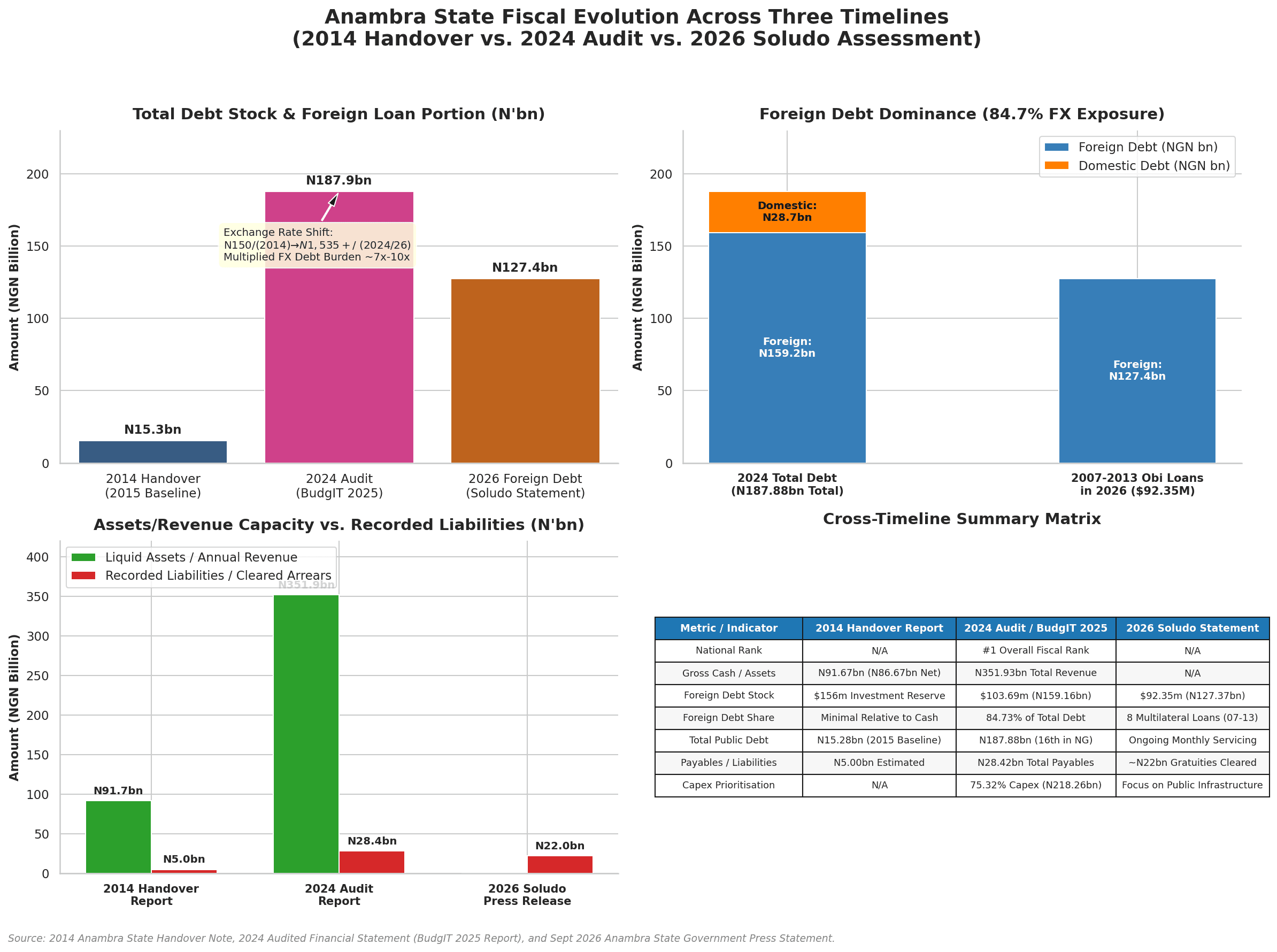
An analysis of BudgIT’s State of States Report 2025, based on 2024 data, put the state’s total public debt at ₦187.88 billion as of December 31, 2024, compared with ₦15.28 billion in 2015.
Foreign debt accounted for ₦159.16 billion, or 84.73 per cent, while domestic debt stood at ₦28.68 billion.
According to analysts, the high share of foreign debt means movements in the naira-dollar exchange rate affect the naira value of the state’s obligations.
A dollar-denominated balance can decline while its naira equivalent rises when the naira depreciates.
Put simply, the eight loans provide an example. Their original commitments totalled $123.77 million, while the state reported $92.35 million outstanding in June 2026. The dollar balance was therefore below the original commitment, while the naira value depended on the exchange rate used at each reporting date.
The DMO recorded Anambra’s external debt at $102.58 million as of December 31, 2025, entirely classified as multilateral debt. This figure is from a different reporting date and debt measure from the $92.35 million balance reported by the state for the eight specific facilities in June 2026.
The ₦15.28 billion recorded for 2015 and the ₦187.88 billion recorded for 2024 therefore represent the state’s overall debt stock at those dates rather than borrowing attributable to one administration.
Revenue and other liabilities
Anambra’s revenue increased alongside its debt stock. BudgIT recorded total revenue of ₦351.93 billion in 2024, up from ₦173.29 billion in 2023. Internally generated revenue rose from ₦36.20 billion to ₦42.97 billion.
Federal allocations accounted for ₦308.96 billion, or 87.79 per cent of recurrent revenue, while internally generated revenue accounted for 12.21 per cent.
The state’s 2024 debt-service payment was ₦2.66 billion, according to BudgIT. That represented 6.19 per cent of internally generated revenue and 0.76 per cent of total revenue.
Beyond formal debt, BudgIT recorded ₦28.42 billion in other liabilities. These included ₦23.84 billion in contractor obligations, ₦479.53 million in pension and gratuity arrears and ₦4.10 billion in judgment debts and other liabilities.
Anambra also recorded ₦218.26 billion in capital expenditure in 2024, representing 75.32 per cent of total expenditure, according to the report.
These figures place formal debt alongside other government obligations, revenue and capital expenditure in the state’s overall fiscal position.
Salary and pension liabilities remain separate
The records on salaries, pensions and gratuities constitute a separate category from formal public debt.
Obi’s March 17, 2014 handover report estimated ₦5 billion for March salaries, pensions, gratuities and certificates for completed projects.
The current administration has reported additional inherited liabilities and payments made against them.
“Our administration has cleared about N22 billion in inherited gratuity arrears of retired state and local government employees and teachers. However, there are still legacy arrears which have lingered since the time of HE Peter Obi.”
On the defunct Water Corporation, the government stated, “First, there are the arrears of salaries to staff of defunct Water Corporation, which lingered throughout HE Peter Obi’s tenure, culminating in court processes and judgments. It is this administration that has negotiated a settlement and already paid the first two instalments of the agreed three installment payments.”
On primary-school teachers, it added, “Second, there are arrears of salaries, pensions and gratuities owed to primary school teachers under the local government system during the Gov Mbadinuju’s tenure…
“We have been informed that the government of HE Peter Obi verified and certified the debt of 16 months of salary arrears and agreed to pay in tranches. It has only paid five months and no more until today. This administration has set up a committee headed by the Head of Service to finalise a new verification for us to pay.”

Alex is a business journalist cum data enthusiast with the Pinnacle Daily. He can be reached via ealex@thepinnacleng.com, @ehime_alex on X