

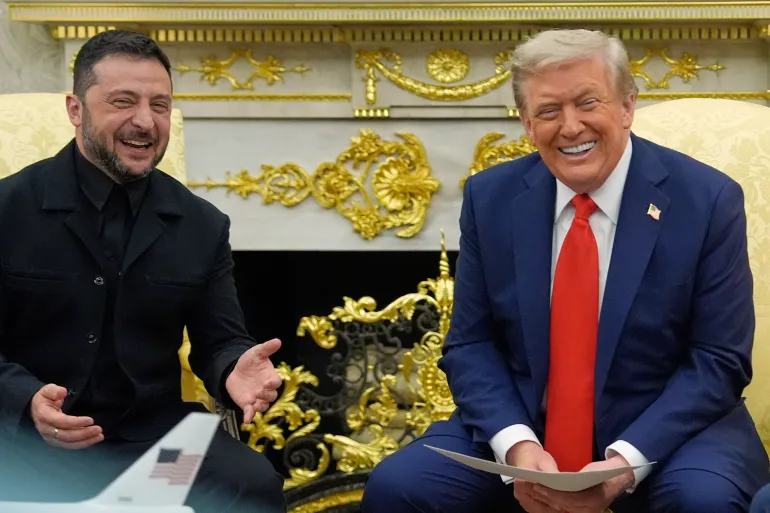
US president pushes for direct talks, says security guarantees for Kyiv will involve Europe with Washington’s coordination
By Rafiyat Sadiq
United States President Donald Trump has unveiled plans to convene a summit between Russian President Vladimir Putin and Ukrainian President Volodymyr Zelenskyy as part of renewed efforts to end the war in Ukraine.
The proposal was announced on Monday during high-level talks at the White House, where Trump hosted Zelenskyy alongside European leaders, including French President Emmanuel Macron and UK Prime Minister Keir Starmer. The discussions centred on security guarantees for Kyiv and possible terms for halting the conflict, which began with Russia’s full-scale invasion in February 2022.
Trump said he had already spoken with Putin by phone and “begun arrangements” for the summit. He disclosed that the meeting would begin with bilateral talks between Putin and Zelenskyy before a trilateral session including the US.
“Again, this was a very good, early step for a war that has been going on for almost four years,” Trump posted on Truth Social. He added that Vice President JD Vance, Secretary of State Marco Rubio, and special envoy Steve Witkoff were coordinating with both Moscow and Kyiv.
German Chancellor Friedrich Merz and NATO Secretary-General Mark Rutte confirmed that Putin had agreed to a bilateral meeting with Zelenskyy, though no date or venue was announced. Zelenskyy described his White House talks with Trump as “a very good conversation” and said he was prepared to meet the Russian leader one-on-one.
Russia has not formally confirmed its agreement to the summit, but the state-run TASS news agency quoted Kremlin aide Yuri Ushakov as saying Putin and Trump supported the continuation of direct talks between Moscow and Kyiv.
READ ALSO:Trump, Putin Set to Meet Amid Looming White House Deadline on Ukraine
The planned summit would mark the first face-to-face meeting between Putin and Zelenskyy since the invasion.
Security Guarantees Take Centre Stage
The discussions in Washington focused heavily on potential security guarantees for Ukraine. Trump ruled out NATO membership but suggested that European countries would provide the “first line of defence,” with the US playing a coordinating role.
“We’re going to help them out also, we’re going to be involved,” Trump told reporters. Later, he said on Truth Social that European partners would formalise guarantees for Ukraine “with coordination by the US.”
Zelenskyy noted that the guarantees would be finalised within seven to ten days.
Special envoy Witkoff said Putin appeared open to a security arrangement similar to NATO’s collective defence mandate under Article 5. Speaking after the White House talks, NATO chief Rutte called the US willingness to engage in security guarantees a “breakthrough,” though he clarified there was no discussion about deploying US or European troops in Ukraine.
Konstantin Sonin, a Russian exile and professor at the University of Chicago, said real guarantees would require European troops on the ground something he argued Putin would reject.
Disputed Territories Remain an Obstacle
The question of territory remains unresolved. Before Monday’s meeting, Trump warned that Crimea would not return to Ukraine in any settlement, and indicated that “swapping, changes in land” would likely form part of a peace deal.
Secretary of State Rubio echoed this view, telling Fox News that both sides would need to make concessions, including over borders.
“Obviously, land or where you draw those lines , where the war stops is going to be part of that conversation,” Rubio said.
Zelenskyy, however, ruled out concessions on territory, telling reporters: “We will leave the issue of territories between me and Putin.”
Ukraine currently controls no Russian territory but last year seized part of Russia’s Kursk region during a surprise counteroffensive. Russia, meanwhile, maintains control of about one-fifth of Ukrainian land.
Mixed Reactions from Analysts
Yurii Poita of the Kyiv-based Center for Army, Conversion and Disarmament Studies said the White House meeting could cautiously be called a success, citing the positive tone and Trump’s willingness to address Kyiv’s demand for security guarantees.
Still, Poita warned that unresolved issues remain. “If the Russian leadership does not feel significant pressure, primarily economic and sanctions-related, Russia will ignore calls for peace or set unacceptable conditions,” he said.
Iryna Skubii, a Ukrainian studies fellow at the University of Melbourne, said peace talks would fail if Russia continued to pursue maximalist aims. “If Russia continues to treat Ukraine through an imperial lens and maximalist demands, seeking to seize territory and dictate political control, then no agreement will be possible, as it would mean Ukraine surrendering its sovereignty,” she said.
The proposed summit adds new momentum to diplomatic efforts but leaves the most difficult questions “territory”, “sovereignty”, and “long-term security” still unresolved.
SOURCE: ALJAZEERA

Rafiyat Sadiq is a political, justice, and human rights reporter with Pinnacle Daily, known for fearless reporting and impactful storytelling. At Pinnacle Daily, she brings clarity and depth to issues shaping governance, democracy, and the protection of citizens’ rights.