

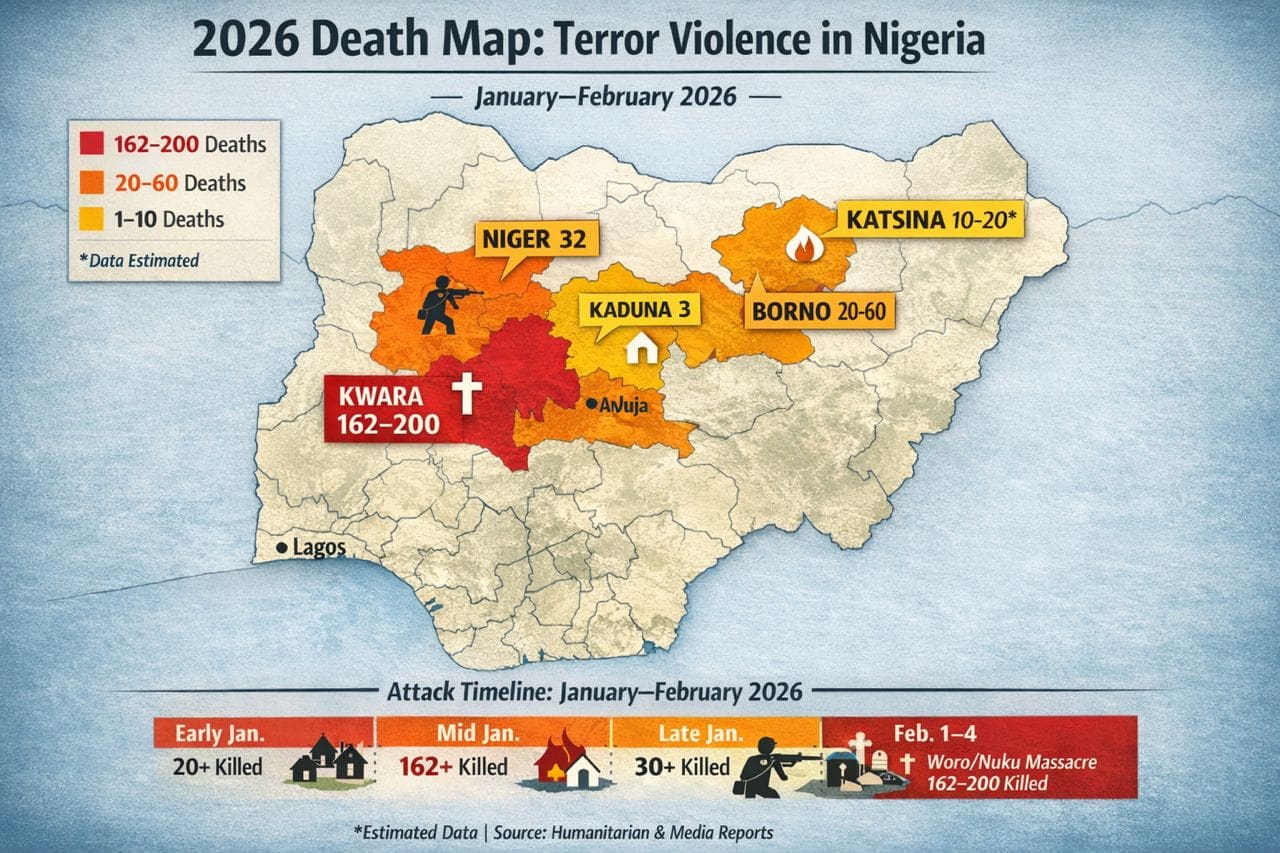
On 3–4 February 2026, heavily armed gunmen swept through Woro and Nuku villages in Kwara State. Residents initially believed the violence would be brief, another raid, another night of fear. By dawn, 162 bodies lay on the ground, with subsequent reports suggesting the toll could exceed 200 fatalities.
Entire households were wiped out. Farmlands became mass graves. Survivors fled into neighboring towns, and Nigeria woke up to a chilling reality: a state long considered relatively safe had become the country’s newest terror frontline.
Borno State — The Ongoing Insurgency
For more than a decade, terror in Nigeria was concentrated in the Northeast, particularly Borno State. In Sabon Gari and surrounding areas, Boko Haram and ISWAP-linked attacks continued into January 2026, leaving 20–60 dead.
These assaults targeted civilians and security-linked facilities, compounding trauma in a region already ravaged by years of displacement. The geography of terror, once predictable, was shifting.
Niger and Kaduna States — New Frontlines
Gunmen raids in Niger State’s Borgu area, including Tunga-Makeri, Konkoso, and Pissa villages, killed approximately 32 residents. In Kaduna State, militants attacked Kauru village, leaving three dead.
These incidents demonstrate a dangerous expansion of terror into previously less affected states, signaling that no rural community is truly safe.
On Wednesday, February 19, 2026, a terrorist group, Lakurawa, attacked nine communities in the Arewa Local Government Area of Kebbi State, killing no fewer than 34 people during the morning attack.
An indigene, Umar Mai Gishiri, said they attacked Masama, Mamunu, Kamzo, Awashaka, Tungar Bature, Dan Mai Rago, Tungar Tsoho and Gorin Dena in the local government.
He added that many of the residents and families of those killed during the attack had fled due to the fear of further attack.
He said when the attackers invaded his community, they went from house to house killing people.
“It was terrifying. I was lucky to escape into a nearby bush,” he stated in a media interview.
Cumulative Death Toll
With the Kebbi killings, verified reports from local officials, humanitarian agencies and international media now place conservative estimates of terror-related deaths in early 2026 between 239 and 334 people.
Breakdown of fatalities so far:
-
Kwara (Woro and Nuku communities): 162–200
-
Borno (Sabon Gari and surrounding attacks): 20–60
-
Niger (Borgu area): 32
-
Kaduna (Kauru): 3
-
Kebbi (Arewa LGA – Lakurawa attack): 34
Total: 239–334+ deaths
This accounts for confirmed deaths and probable underreported fatalities, as many rural communities lack formal record-keeping.
From Insurgency to Entrenchment
Rather than openly holding territory, terror groups now move fluidly, striking, withdrawing, and returning. This strategy allows them to expand influence without sustained military retaliation, deepening insecurity in previously peaceful areas.
In an exclusive interview with Pinnacle Daily, Joshua Uloko, a criminologist and General Secretary of the Crime Report Association of Nigeria, explained the security gaps,
“The government is not sensitive enough. Traditional rulers know the geography, the people, and the local threats, yet they are excluded from intelligence operations. Engaging them is key to prevention.”
READ ALSO:
- Terrorism: ISWAP Leader Sentenced to 20 Years in Prison
- FG Withdraws VIP Police Escorts, Deploys Officers to Terror-Hit Kwara Communities
- FG to Name Terrorism Financiers Soon — Presidential Aide
- How Money Laundering Empires Feed Violence in Nigeria
Uloko emphasised community policing, intelligence gathering, and local accountability, noting that many attacks exploit porous borders and ungoverned spaces.
“When the state does not count its dead, it becomes easier for the violence to repeat itself,” he added.
A striking feature of the 2026 attacks is their focus on remote, agrarian settlements:
- Limited surveillance
- Slow military reinforcement
- Minimal media presence
Extremist groups exploit these conditions, achieving devastating efficiency. Kwara, Borno, and Katsina communities all faced delayed responses, leaving residents vulnerable to systematic attacks.
Intelligence Failures and Security Gaps: Ben Okezie Weighs In
Security consultant and columnist Ben Okezie described the expansion of terror violence as a direct consequence of intelligence failures and systemic neglect of community policing:
“It’s intelligence. Failure of intelligence. If community policing and state police systems were functioning, local security would know the strangers, their movements, and intentions. Instead, the attackers strike when communities are disorganized.”
Okezie also highlighted poor welfare and training of police officers, lack of accountability, and absence of punishment for negligence. He emphasised state police and empowered community policing as crucial solutions.
Political Analysis — Jide Ojo
Political analyst Jide Ojo stressed that Nigeria’s insecurity is exacerbated by poverty, unemployment, and weak governance:
“Many youths join criminal gangs because they have no education, no job, no home. Security solutions must be non-kinetic; welfare, employment, and education are as important as military response.”
He also highlighted the need for foreign assistance, improved cyber and border security, and stronger governance.
Beyond the statistics lies a devastating human cost: entire family lineages have been wiped out in Kwara; displaced children are left uncertain of their next meal; farms stand abandoned as fear drives families from their land; and communities in Borno and Katsina are once again gripped by renewed trauma. These are not abstract losses, but unrecorded lives, erased futures, and deeply destabilized communities.
Government Response: Familiar Words, Rising Graves
Federal and state authorities have condemned the attacks and pledged to restore peace. Yet residents report security often arrives after the violence, not before.
Experts like Okezie and Uloko stress that traditional rulers, community leaders, and intelligence networks must be involved to identify perpetrators and prevent attacks.
Efforts such as police recruitment, state police discussions, agro-rangers, and increased military presence will take time to yield results. Meanwhile, communities continue to bear the brunt of attacks.
A Nation at a Crossroads
The opening weeks of 2026 deliver a stark message: terror violence is no longer geographically predictable. Without coordinated intelligence, rural security, and community involvement, the death map will expand silently and steadily, at enormous human cost.
For now, verified figures confirm over three hundred (300) Nigerians killed in just weeks, and the unanswered question remains: how many more must die before counting the dead becomes as urgent as burying them?

Esther Ososanya is an investigative journalist with Pinnacle Daily, reporting across health, business, environment, metro, Fct and crime. Known for her bold, empathetic storytelling, she uncovers hidden truths, challenges broken systems, and gives voice to overlooked Nigerians. Her work drives national conversations and demands accountability one powerful story at a time.