

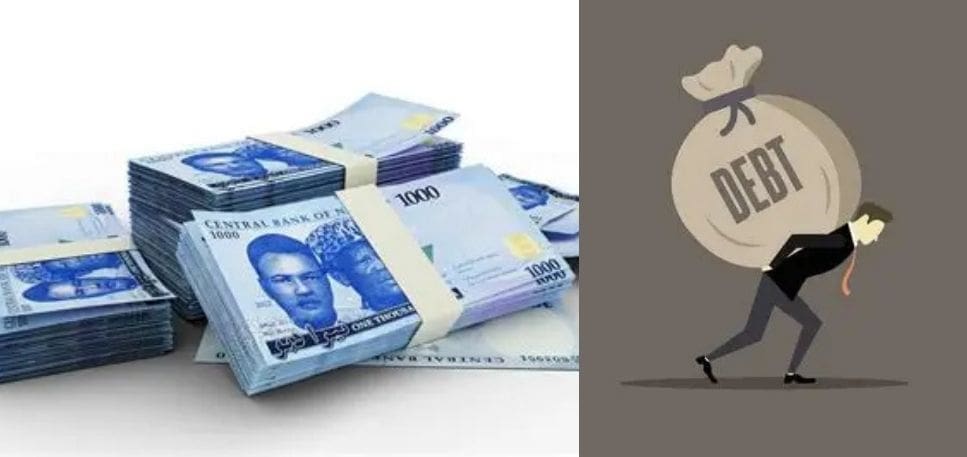
Nigeria’s total public debt is projected to rise to ₦155.1 trillion following the Senate’s approval of a fresh $6 billion loan request by President Bola Ahmed Tinubu.
The approval, granted within hours, adds about ₦8.4 trillion at an exchange rate of ₦1,400 per dollar to the country’s debt stock, which stood at ₦146.69 trillion as of the end of 2025.
The Senate, led by Godswill Akpabio, approved the request barely three and a half hours after reading the President’s letter. The lawmakers completed the first, second, and third readings and passed the request on the same day.
The decision followed the presentation of a report by Senator Aliyu Wamakko, Chairman of the Senate Committee on Local and Foreign Debts.
Breakdown of Tinubu’s Loan Request
President Tinubu conveyed the request in two separate letters to the Senate. He sought approval for a $5 billion structured Total Return Swap (TRS) external financing programme with First Abu Dhabi Bank of the United Arab Emirates, alongside a $1 billion export finance facility from the United Kingdom arranged by Citibank’s London branch.
According to the President, the TRS facility will be drawn in tranches and used for budget implementation, infrastructure development, and refinancing of expensive domestic and external debts. He added that it would also help the government meet urgent financial obligations.
Tinubu stated that Nigeria’s total public debt stood at $110.3 billion, about ₦159.2 trillion, as of December 31, 2025. He noted that phased drawdowns would reduce pressure on debt servicing.
The President also requested approval to issue naira-denominated Federal Government securities as collateral and to meet margin obligations in U.S. dollars.
Ports Rehabilitation Plan
He explained that the $1 billion UK-backed loan would fund the reconstruction and rehabilitation of Lagos Port Complex and Tin Can Island Port through the Nigerian Ports Authority. The project aims to fix critical infrastructure failures, improve efficiency, enhance safety, and align Nigeria’s ports with global standards.
Following the request, Akpabio referred the matter to the Senate Committee on Local and Foreign Debts for immediate review. The committee quickly returned with its report, paving the way for approval.
In his presentation, Wammakko said the TRS facility is a derivative-based instrument governed by International Swaps and Derivatives Association rules. He explained that it allows access to up to $5 billion, with flexible drawdowns to reduce immediate fiscal pressure.
He noted that the loan is backed by naira-denominated Federal Government securities at 133.3 per cent collateralisation, with monthly mark-to-market valuation and margin calls in U.S. dollars if needed.
The facility has a six-year tenor, with a three-year break clause and annual rollover options. Pricing is set at SOFR plus 3.95 per cent for the first tranche and 4 per cent for subsequent tranches, with a 1.5 per cent arranger fee per tranche.
Debt Sustainability Concerns
The committee said the funds would support budget implementation, infrastructure projects, refinancing of costly debt, and urgent fiscal needs. It added that 40 per cent of the funds would finance capital projects in the 2025 and 2026 budgets.
On debt sustainability, the committee noted that Nigeria’s debt-to-GDP ratio stood at 36.92 per cent, within the 60 per cent threshold approved by the Federal Executive Council and the 80 per cent benchmark advised by international financial institutions.
However, it warned that the debt service-to-revenue ratio, estimated at about 60 per cent, remains a concern and requires improved revenue mobilisation.
The committee highlighted the benefits of the TRS structure, including access to foreign currency without issuing Eurobonds, flexible drawdowns, stronger bilateral financial ties, and potential refinancing of expensive debt. It also cited built-in safeguards for dispute resolution and valuation.
It, however, flagged risks such as exchange rate volatility, which could trigger margin calls in U.S. dollars, and market fluctuations affecting the value of collateral.
Experts Raise Red Flags
Experts raised fresh concerns over the borrowing plan. Tunde Abidoye of Quest Merchant Bank warned that the structure exposes Nigeria to significant foreign exchange risk.
He explained that if the naira depreciates, the government would have to cover the gap between the loan value and the naira-denominated collateral, while dollar-based interest payments would further increase debt servicing costs.
David Adonri of High Cap Securities said the growing reliance on external debt could mortgage the country’s future. He argued that borrowing in foreign currency is risky due to unstable foreign income and advised greater reliance on domestic debt.
READ ALSO:
- FG Cuts Debt Service Spending by 38% to $405.3m as Domestic Borrowing Strategy Shifts
- Nigeria Must Cut Debt Dependence, Build Stronger Revenue Base – Finance Minister
- How ₦59bn Debt Load Reshapes Champion Breweries’ Operations
- Power Sector: Debt to GenCos Now at ₦6.5trn – APGC CEO Insists
Clifford Egbomeade also warned that the new loans would raise Nigeria’s external debt exposure within a 2026 budget framework of N58.18 trillion, with projected revenue of N34.33 trillion and a deficit of N23.85 trillion.
He noted that while the $1 billion port rehabilitation loan has clear economic benefits, including improved efficiency and higher customs revenue, concerns remain about debt sustainability and execution risks.
Simon Tumba, a Lagos-based business executive, called for transparency in the government’s borrowing plans. He questioned overlapping funding arrangements for port rehabilitation and warned that poor debt management could push Nigeria toward long-term financial distress.
Meanwhile, former Vice President Atiku Abubakar criticised the swift approval of the loan. In a statement by his aide, Phrank Shaibu, he described the process as a failure of legislative oversight.
Atiku questioned the lack of debate and scrutiny, warning that continued borrowing to fund deficits and service existing debt reflects weak fiscal discipline.
He cautioned that Nigeria’s future was being jeopardised and urged greater transparency and accountability, stressing that both the executive and legislature would be judged for their decisions.

Esther Ososanya is an investigative journalist with Pinnacle Daily, reporting across health, business, environment, metro, Fct and crime. Known for her bold, empathetic storytelling, she uncovers hidden truths, challenges broken systems, and gives voice to overlooked Nigerians. Her work drives national conversations and demands accountability one powerful story at a time.