

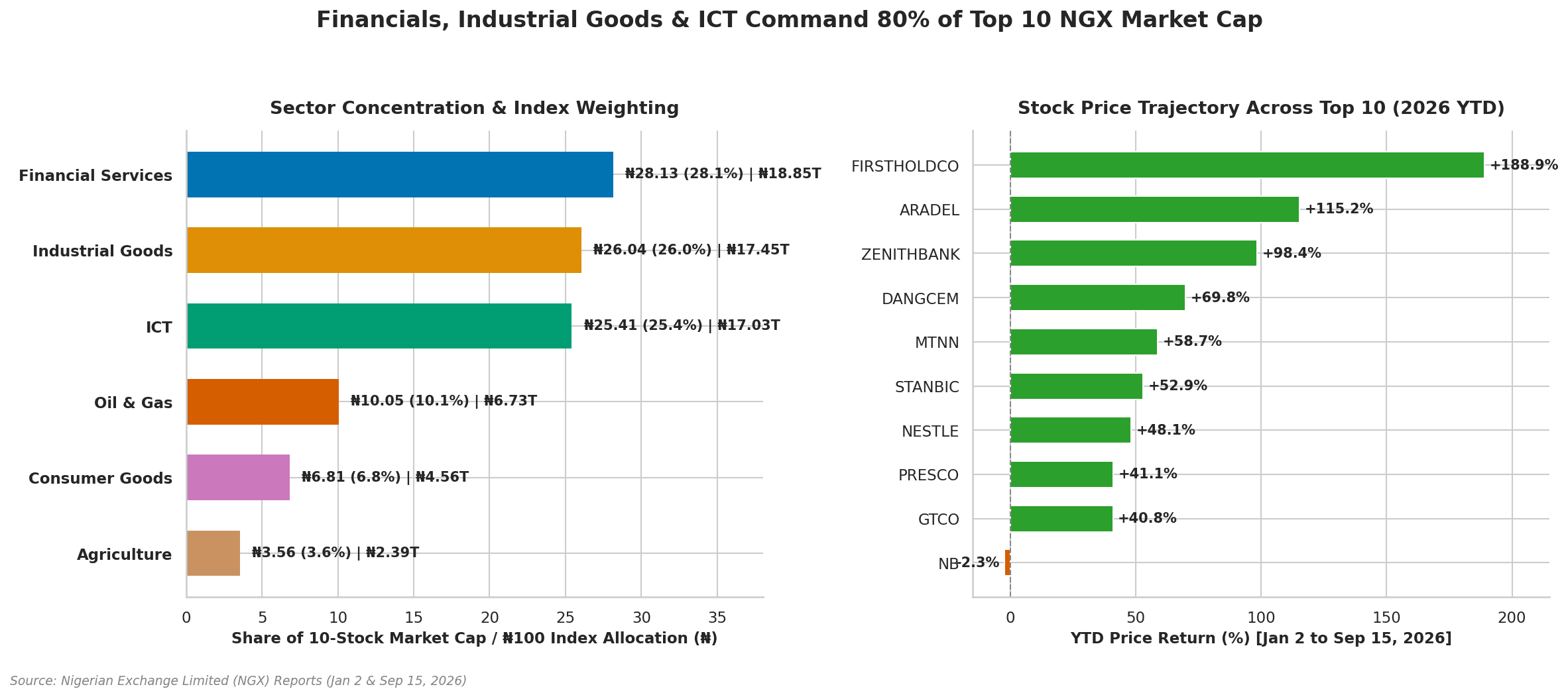
Dangote Cement, MTN Nigeria and Aradel account for 61.5 per cent of the ₦67.01 trillion market value represented by FTSE Russell’s 10 Nigerian large-cap stocks, exposing the concentration behind the country’s return to the global frontier market.
Nigeria’s return to FTSE Russell’s Frontier Market universe will give global investors access to 10 of the country’s largest listed companies, but the composition of the basket shows that their exposure to Nigerian equities will be heavily concentrated in just three stocks.
Dangote Cement, MTN Nigeria and Aradel Holdings have a combined market capitalisation of about ₦41.21 trillion, representing 61.5 per cent of the ₦67.01 trillion combined value of the 10 Nigerian stocks included in the FTSE Frontier Index Series.
That means that for every hypothetical ₦100 invested across the 10 stocks based on their market values, about ₦61.50 would be concentrated in the three companies.
The remaining seven stocks account for only 38.5 per cent of the basket, highlighting the extent to which Nigeria’s new global equity exposure is driven by a small group of large companies.
The 10 stocks are Aradel Holdings, Dangote Cement, First HoldCo, Guaranty Trust Holding Company, MTN Nigeria Communications, Nestlé Nigeria, Nigerian Breweries, Presco, Stanbic IBTC Holdings and Zenith Bank.

Three companies dominate Nigeria’s global equity window
Dangote Cement has the largest market capitalisation in the group at ₦17.45 trillion, giving it a 26.04 per cent share of the basket. MTN Nigeria follows with ₦17.03 trillion and a 25.41 per cent share, while Aradel Holdings has ₦6.73 trillion, representing 10.05 per cent.
Together, the three companies therefore account for more than three-fifths of the market value represented by the 10 stocks.
The concentration becomes even clearer when the financial-services companies are added, with First HoldCo having a market capitalisation of ₦6.41 trillion, Zenith Bank ₦5.26 trillion, GTCO ₦4.75 trillion and Stanbic IBTC Holdings ₦2.43 trillion.
The four financial-services stocks have a combined value of ₦18.85 trillion, accounting for 28.13 per cent of the 10-stock basket.
In practical terms, an investor using market capitalisation as a guide to Nigeria’s FTSE exposure would have about ₦28.13 out of every ₦100 in financial services, ₦26.04 in Dangote Cement and ₦25.41 in MTN Nigeria.
Oil and gas, represented solely by Aradel, takes 10.05 per cent, while consumer goods, represented by Nestlé Nigeria and Nigerian Breweries, accounts for 6.81 per cent. Presco’s agriculture exposure represents 3.56 per cent.
This means financial services, Dangote Cement and MTN Nigeria alone account for 79.58 per cent of the basket.
Babatunde Obaniyi, GCEO of Griffin Capital Group, said the dominance of banks in the FTSE selection reflects the importance of liquidity to international investors, noting that four of the 10 companies are banks or financial institutions.
“If you look at the 10 companies that were added… four of them are banks. It tells you where the capital is going towards,” Obaniyi said.
He added that foreign investors have historically shown strong interest in Nigerian banking stocks because of their liquidity and ability to accommodate large transactions.
Ambrose Omordion, Chief Research Officer at InvestData Consulting, similarly stressed that the selection should not be interpreted as a judgment on companies that were left out.
“The ones that are not there does not mean that those companies in Nigeria are not doing well,” Omordion said, explaining that index providers apply specific criteria to determine eligible stocks.
For international investors, he said, market capitalisation, earnings performance, corporate governance and, particularly, free float are important.
Free float refers to the proportion of a company’s shares that are actually available for public trading. A large free float makes it easier for institutional investors to buy and sell significant amounts of shares without their transactions causing sharp price movements.
“They want a stock that has enough free float,” Omordion said. “That liquidity is very, very important.”
READ ALSO:
- Aradel Modular Refinery to Begin Petrol Production in 2027
- Ecobank Nigeria Slips into Loss as Group Battles $541m Tax Exposure
- MTN, Dangote, 24 Firms Control Over 90% of NGX Value
- Hidden Risks Behind Aradel’s 252% Profit Surge
- Explainer: 10 Things to Know Before Buying Dangote IPO
FTSE’s Nigeria is not the whole Nigerian economy
The composition also shows the sectors that global investors will not directly access through these 10 large-cap stocks.
The six represented sectors are financial services, industrial goods, ICT, oil and gas, consumer goods and agriculture.
Seven other sectors in the NGX’s classification structure have no representation in the basket. They include conglomerates, construction and real estate, healthcare, investment, natural resources, services and utilities.
That means major businesses in areas such as power, hotels, transport, pharmaceuticals, construction and diversified conglomerates do not form part of this particular 10-stock large-cap exposure.
The absence of these sectors, however, does not necessarily indicate poor performance or weak companies. As Omordion explained, index membership changes according to the provider’s rules and periodic reviews.
“No stock remains in an index forever,” he said. “When it is reviewed, another stock can come in.”
The current stock performances also show why the basket has become so valuable. Between January 2 and September 15, Aradel’s share price rose from ₦720.30 to ₦1,550, while Dangote Cement climbed from ₦609 to ₦1,034. First HoldCo increased from ₦48.80 to ₦141, and MTN Nigeria rose from ₦511 to ₦811.10.
Nestlé Nigeria also rose from ₦1,958 to ₦2,900, while Presco increased from ₦1,450 to ₦2,045.30. Zenith Bank gained from ₦64.50 to ₦128 and Stanbic IBTC from ₦100 to ₦152.90. Nigerian Breweries was the exception among the 10, declining from ₦74.80 to ₦73.10.
New global exposure meets a market dominated by local capital
The FTSE inclusion comes as the Nigerian market seeks to broaden its investor base after years of limited foreign participation.
Obaniyi said about 85 per cent of market liquidity up to July came from local institutional investors, including pension funds and insurance companies.
He said the return to the FTSE index could complement that domestic liquidity by bringing foreign portfolio capital back into Nigerian equities.
“Having that back now brings that liquidity back to the market,” Obaniyi said.
He also described the reclassification as a boost to Nigeria’s visibility among global frontier markets and said it could deepen the pool of assets available to international and domestic investors.
For Omordion, however, the ability of the selected companies to absorb large foreign investments will depend heavily on liquidity and free float.
That distinction is important because a company can have a very large market capitalisation but still offer limited shares for public trading.
The FTSE basket therefore presents a concentrated gateway into Nigerian equities: three companies carry more than 60 per cent of its market value, four financial institutions account for more than a quarter, and seven major NGX sectors have no representation.

Alex is a business journalist cum data enthusiast with the Pinnacle Daily. He can be reached via ealex@thepinnacleng.com, @ehime_alex on X