


Nigeria’s cocoa sector recorded a remarkable 62.25 per cent increase in export earnings during the first three quarters of 2025, underscoring the crop’s pivotal role in the nation’s agricultural trade and highlighting its resilience amid evolving global market conditions.
A review by Pinnacle Daily of the National Bureau of Statistics’ ‘Foreign Trade in Goods Statistics’ shows that cocoa exports in 2025 built on the record surges of 2024, with notable changes in product mix, market destinations, and trade dynamics shaping the sector’s performance.
In 2024, Nigeria’s cocoa exports delivered approximately ₦1.51 trillion in the first nine months. Superior quality cocoa beans dominated, particularly in the third quarter, generating ₦375.49 billion.
Standard-quality beans and processed cocoa products, including natural cocoa butter, also contributed significantly to overall earnings.
Malaysia and the Netherlands were the leading destinations, while Germany and countries within the ECOWAS region added to the totals, reflecting cocoa’s wide global reach.
In contrast, the first three quarters of 2025 saw cocoa exports climb sharply to ₦2.45 trillion.
The surge was led by standard-quality cocoa beans, which reached ₦719.91 billion in the first quarter, overtaking superior beans as the highest contributor.
Superior beans remained important, with first-quarter exports at ₦508.27 billion and second-quarter at ₦277.02 billion.
Meanwhile, processed cocoa products gained traction, particularly natural cocoa butter, with Germany emerging as the largest buyer in the third quarter of 2025, importing ₦79.00 billion worth.
What drove the surge
Several key factors explain the strong performance of cocoa exports in 2025 compared with 2024.
The data showed that standard-quality cocoa beans emerged as one of Nigeria’s most exported commodities, generating ₦719.91 billion in Q1 2025 alone, while superior beans also contributed significantly, and the rising prominence of cocoa butter reflected a gradual diversification of export products.
Europe remained the backbone of Nigeria’s cocoa trade, as the Netherlands and Belgium consistently imported large volumes of both standard and superior beans.
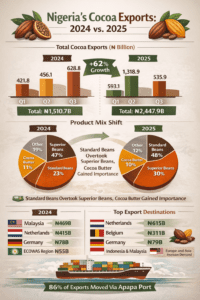
Germany became a major market for cocoa butter, while Indonesia and Malaysia strengthened their roles as buyers of superior beans.
This shift illustrates a structural change in market concentration as cocoa beans became less reliant on a few buyers, while processed cocoa focused on specialised European markets.
Total export value nearly doubled from 2024 to 2025, driven by higher volumes of standard beans and sustained demand for processed products.
Pinnacle Daily’s analysis revealed further that logistics played a critical role, as Apapa Port handled the bulk of exports.
In Q1 2025, it processed 86.12 per cent of the total export value, enabling Nigeria to efficiently move high volumes to global markets as maritime transport remained the key enabler of growth, supporting both bean and processed cocoa shipments.
What changed
Several structural trends were evident in the 2024–2025 comparison, as superior beans led in 2024.
In 2025, standard beans became the backbone of exports. Cocoa butter grew in importance, particularly in Germany, while overall market diversification increased as Europe and Asia remained core markets, complemented by emerging buyers like Germany and Indonesia.
The NBS data show that export earnings became more evenly spread across product categories, reducing reliance on superior beans alone.
Even though the third quarter of 2025 exports were slightly lower than the corresponding period in 2024 due to a smaller contribution from superior beans, the total nine-month export value rose, reflecting broader structural strengthening and market diversification.
Nigeria ranks among the top 3, as West Africa maintains global supremacy
West Africa remains the powerhouse of global cocoa production, with the Ivory Coast and Ghana supplying the bulk of world output, followed by Nigeria, Cameroon, and Uganda.
Records showed that in 2023, the Ivory Coast led the continent’s cocoa production with over 2 million tonnes, while Ghana produced approximately 750,000 tonnes.
Nigeria produced around 300,000 tonnes, Cameroon 290,000 tonnes, and Uganda 30,000 tonnes, underscoring the region’s critical role in sustaining the world’s cocoa supply chain.
Nigeria’s non-oil exports milestone
Pinnacle Daily reported on Tuesday that Nigeria’s broader non-oil export sector achieved a historic milestone in 2025, reaching a record $6.1 billion.
This was disclosed by the Executive Director and Chief Executive Officer of NEPC, Nonye Ayeni, during the council’s annual success report and 2026 non-oil export outlook briefing in Abuja.
According to Ayeni, the data were obtained from pre-shipment inspection agencies.
“This represents an 11.5 per cent increase from the $5.46 billion recorded in 2024,” she said. “The non-oil export sector rose to approximately $6.1bn, representing a year-on-year growth of about 11.5 per cent over and above the $5.4bn recorded in 2024.
Ayeni added, “This marks the highest non-oil export value achieved in the country for formally documented trade and also from the inception of the council, almost 50 years ago.”

Alex is a business journalist cum data enthusiast with the Pinnacle Daily. He can be reached via ealex@thepinnacleng.com, @ehime_alex on X