

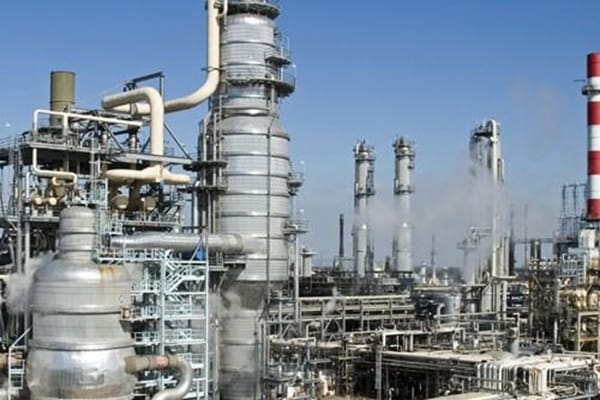
The Minister of State for Petroleum Resources (Oil), Senator Heineken Lokpobiri, has said constructing more modular refineries can help curb the cases of oil theft, pipeline vandalism and illegal refining in Nigeria.
Lokpobiri stated this while inspecting the ongoing construction of a 30,000-barrel-per-day modular refinery project in Koko, Delta State, by Ebenco Global Link Limited.
The minister, who commended the indigenous oil and gas company for embarking on the project, said it is a strong indicator of renewed investor confidence in indigenous energy infrastructure.
The ongoing construction of a 30,000-barrel-per-day modular refinery project in Koko, Delta State, is a strong indicator of renewed investor confidence in indigenous energy infrastructure,” Lokpobiri stated.
“The refinery’s potential role is in a broader strategy to address pipeline vandalism and illegal refining by providing legitimate, scalable alternatives within the value chain.”
READ ALSO: Nigeria Loses $15bn Annually to Oil Theft, Pipeline Vandalism – Experts
He emphasised that President Tinubu’s administration’s reforms are targeted at unlocking private capital and accelerating projects that “advance national energy resilience”.
The Minister stressed that modular refining, when carried out with strong governance and local processing, provides a viable means of closing Nigeria’s supply gaps while accelerating economic growth.
He said that the modular refinery is one of the most significant indigenous refining projects in decades. The refinery, which is being built entirely locally, intends to increase domestic processing capacity, minimise fuel scarcity, and strengthen national energy security.
READ ALSO: Lokpobiri Seeks Investments in Oil & Gas to Reduce Africa’s $120bn Import Cost
Dr Ebenezer Oluwagbemiga, Chief Executive Officer of Ebenco, stated that the refinery would commence operations in stages, beginning with 5,000 barrels per day and gradually increasing to full capacity.
He stressed that once fully operational, the project will create jobs, increase local content, and lessen the economic incentives that drive illegal refining.
Dr Peter Akindeju, a management consultant, commended the refinery’s modular design as a major advancement in indigenous engineering, citing increased production flexibility and shorter delivery deadlines.
He encouraged the government to grant the project pioneer status, citing its national importance in refining expansion, job generation, and energy security.
An Associate Professor at FUPRE, Dr Omonigho, praised the investment as a turning point in Nigeria’s industrial self-reliance, demonstrating the country’s ability to create complex midstream and downstream infrastructure.

Victor Ezeja is a passionate journalist, scholar and analyst of socioeconomic issues in Nigeria and Africa. He is skilled in energy reporting, business and economy, and holds a master's degree in mass communication.