

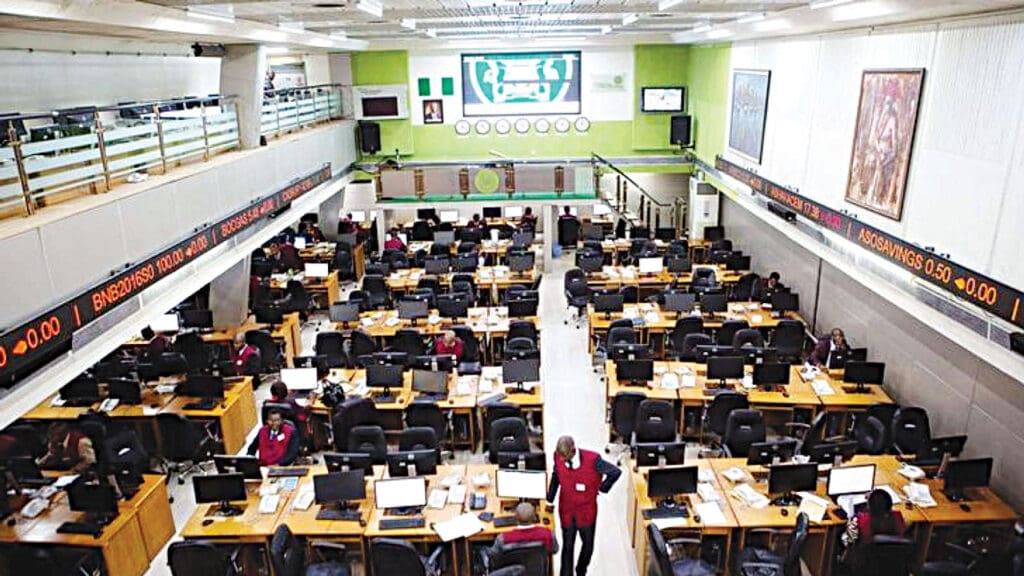
Reaching a 55.88 per cent year-to-date return at the close of trading on Friday, October 31, total stock market capitalisation rose to N97.83 trillion, leaving investors with a N7.25 trillion gain in one month on the Nigerian Exchange Limited (NGX).
This is one of the largest single-month gains in recent times that the stock market has recorded this year, a review of stock statistics by Pinnacle Daily has shown.
The gain represents an 8.0 per cent rise from N90.58 trillion, the market capitalisation that opened on Thursday, October 2, as October 1 was a public holiday, marking Nigeria’s Independence Day celebration.
In July, the stock market gained N12.5 trillion, representing a 14 per cent month-on-month growth as market capitalisation rose from N75.95 trillion at the start of that month to N88.42 trillion at the end of that month.
Pinnacle Daily can report that, since the beginning of the year, the stock market has gained approximately N35.07 trillion, having opened the year’s trading at N62.76 trillion and closing at N97.83 trillion in the review month.
Analysts attribute this remarkable performance largely to ongoing fiscal and monetary reforms.
READ ALSO: Naira Gains as External Reserves Rise to $43.17bn in October
The boom is resulting in strong earnings results for listed companies, increasing foreign portfolio participation, and renewed confidence in the market, further leading to considerable capital gains across all sectors.
Similarly, the All-Share Index (ASI) rose to 154,126.45 basis points at the end of October trading from the 142,710.48 basis points it opened at the start of the month.
Industrial goods led the sectoral indices’ performance
The industrial goods sector of the market, which houses large-cap stocks, notably Dangote Cement and BUA Cement, led the sectoral performance as the index rose by 17.5 per cent to 5,955.84 basis points at the close of October trading from 5,068.68 basis points at the beginning of the month under review.
The oil and gas index was followed by an appreciation of 15.45 per cent to 2,912.80 basis points from 2,523.05 basis points.
READ ALSO: SEC Charges Stockbrokers on Capital Market Sustainability
Commodity trailed the upward movement by 9.7 per cent to 1,230.45 basis points from 1,121.70 basis points.
Closing also in the green, the consumer goods sector index rose by 4.85 per cent to 3,534.32 basis points from 3,370.91 basis points.
The insurance index came at the bottom, increasing slightly by 3.37 per cent to 1,231.19 basis points from 1,191.04 basis points.
However, the banking stocks, one of the notable financial services industries that drives activity in the stock market, closed in the red as the index declined by -3.15 per cent to 1,466.38 basis points from 1,514.11 basis points.
Raising foreign investors’ participation
A recent analysis by Pinnacle Daily hinted at foreign investors’ participation in the market improving significantly, with their transactions on the NGX rising to N387.62 billion and leading a rise in foreign inflows to N325.46 billion, and both records hitting a six-month high in September.
Going by the level of stability in the Nigerian market, Nigeria is seen as open to foreign investor attraction, the Head of Financial Institutions Rating at Agusto & Co, Ayokunle Olubunmi, had told Pinnacle Daily.
Sustaining the boom requires policy consistency
Shareholders are excited about the market boom, the National President of the New Dimension Shareholders Association, Patrick Ajudua, told Pinnacle Daily.
He expressed that because of the boom in the market, most listed companies on the NGX that have been declaring losses have seen a positive turnaround in their financial performances, leading to the restoration of investors’ confidence and declaration of dividends.
READ ALSO: How 10 Most Capitalised Stocks Control over 60% of NGX Market Cap
“In fact, some companies are now declaring interim dividends as a way to compensate their shareholders for the pain they experienced in the last few years of non-declaration of dividends,” Ajudua maintained.
He, however, urged that there should be policy consistency to sustain the boom in the stock market.
“To sustain this boom, there must be policy consistency to ensure that the business environment is made conducive and there is stability of monetary and fiscal policy,” Ajudua added. “We need to check inflationary pressure and foreign rates.”
What to expect in the new month
The market has closed the last week of October in the red, prompting analysts at Cowry Asset Management to anticipate a mixed performance in the new week, cautioning that the market still needs improved macro indicators or stronger-than-expected corporate results to reignite the bullish trend.
“Looking ahead, we expect the market to trade mixed in the near term, with direction to be shaped by investor reaction to the outcome of fixed-income yields, fund rotation,
into safer assets, and the ongoing earnings season.
“In our view, the market currently needs a strong catalyst—possibly in the form of improved macro indicators or
stronger-than-expected corporate results—to reignite a bullish spark and restore positive sentiment on the NGX,” the analysts added.

Alex is a business journalist cum data enthusiast with the Pinnacle Daily. He can be reached via ealex@thepinnacleng.com, @ehime_alex on X