
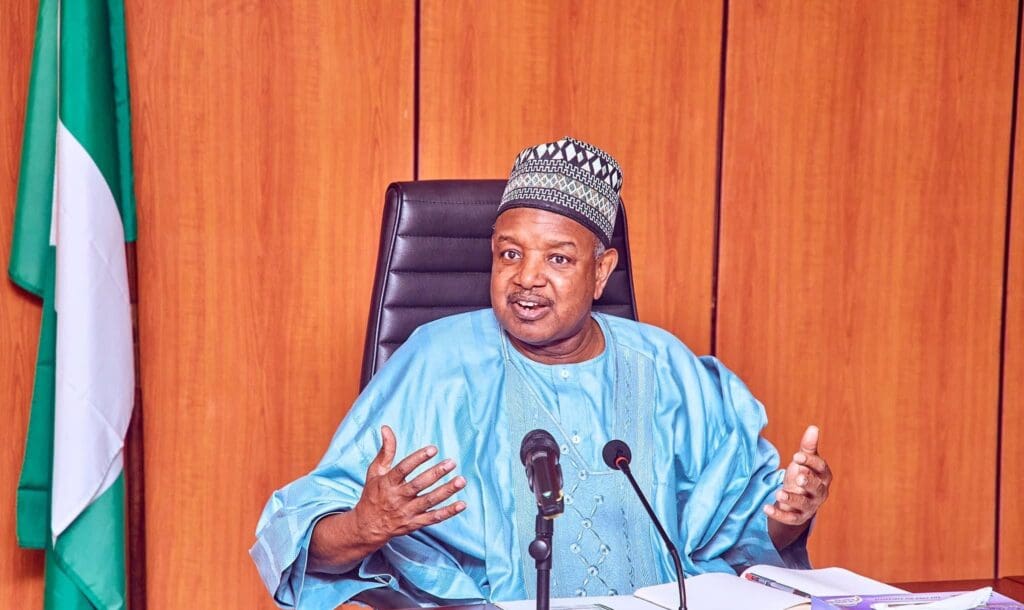
The Minister for Budget and Economic Planning, Senator Abubakar Atiku Bagudu, yesterday at the Multi-Stakeholder Dialogue by Action Aid Nigeria on the theme “Rethinking Poverty Reduction Strategies in Nigeria”, spoke about government effort and the need for partnership with the private sector. Excerpts:
Rethinking Poverty Reduction Strategy
What we have been trying to do as an administration is to really assure partners that there’s nothing like “we and them”. We are thinking through challenges together, and therefore we have to show our respect and ensure that we have a conversation that is not dizzy but more unifying.
Let us understand what these statistics mean and what they can be useful for. I had hoped somebody, particularly from the World Bank, would make it clear. I choose not to talk to the media about it because, at the end of the day, what are you going to do with all these statistics?
You can use it to mobilise the populace, or you can use it to discourage everyone. The choices are ours, and that’s part of the role the media has to play. That’s why President Asiwaju Bola Ahmed Tinubu, in his wisdom, even before he was sworn in, said, “How can we best capture Nigeria’s reality without playing it?” Something that will mobilise everyone.
We’re not where we want to be as a nation, particularly as a band. And it’s not the fault of any one person. We’re not going to blame anyone, but let’s look at it historically. For how many years in our history, maybe since independence, have we been growing higher than the population growth? Maybe very few. So, those numbers—whether the estimate from the World Bank or the 2022 Multidimensional Poverty Index numbers from NBS—are not just numbers that happen. They are consequences of choices that have been taking place in the past.
READ ALSO: Naira-for-crude Deal Will Continue, FG Assures
I think it was even said, How many people reflect on their family sizes versus their income? Especially those of us who are Christians and Muslims, who believe in the scriptures. Marriage itself requires responsibility. Procreation is a responsible activity, not just a bedroom duty.
So, the poverty numbers should be used to galvanise us to act together, not as a criticism of one government or the other.
President Asiwaju Bola Ahmed Tinubu is involved and courageous. Part of his boldness and courage is that he is not going fast above somewhere. When many people cite the 2022 poverty figures as if they are 2025 poverty figures, we would never respond.
What is important to acknowledge is that those numbers are not something Nigeria is proud of at all times. But how we got there was because, historically, we have under-invested in almost everything, and we are now experiencing the consequences of that under-investment.
Thus, in 2023, in his wisdom, consistent with our understanding, President Tinubu said, “What are the necessary choices that we need to take? Bold, corrective steps.”
As a politician, what you would like to be is proactive all the time. But only a responsible politician will say, “I will take this measure even though it may be painful, believing that it is the right choice.”
When we are talking about strategies that can reduce or even eliminate poverty, that should be the starting point of the discourse.
Somebody has even said, “What would have happened without the choices he took?” I was elected governor in 2015 and recall that in Nigeria’s golden moments between 2011 and 2014, oil prices had really been at $147 per barrel. But because of poor choices, 27 states could not pay salaries by the year 2015, even with the highest oil prices.
That is why President Buhari’s administration in 2014 faced a crisis. The federal government should have prepared better, but we didn’t. We were wasting resources through subsidies. With oil prices at those levels, 27 states could not pay salaries.
Now, what we need to live with is that we can do better. The question is, is the strategy put in place, the “Renewed Hope” agenda, the right one? Or can we calibrate it to do better?
In the strategy, we are saying we have to get the macroeconomy predictable and going in the right direction so it can generate revenue and attract investment. It is those additional revenues that can be invested in our people and inclusion.
We’ve been seeing the results of that. We can compare ourselves to some countries that are doing better than us in terms of revenue generation.
READ ALSO: African Economy Must be Built on Private Leadership Not Aid—Elumelu
Take Brazil, for example. With the same population size as Nigeria, Brazil’s federal budget is at least 20 times greater than Nigeria’s. Do we expect to achieve the same outcomes? Not likely. That’s why we have to stay the course of reforms to generate investment and invest more in our people to eliminate poverty. President Tinubu’s determination is that, by 2030, we will eliminate poverty, not reduce it.
Understanding the Multidimensional Poverty Index
However, we must understand that poverty doesn’t have a universal measure. Different countries use different metrics to define poverty. Some use $1.50 per day as a threshold; others use $3.50 per day. It’s important to understand the methodology, especially when comparing the Multidimensional Poverty Index across countries.
In Nigeria, for instance, the sample size used for these indices is relatively small—about 60,000 people out of 250 million. It’s important to consider these nuances when discussing poverty, especially in the media.
We may not be where we want to be, but we are doing better. The reforms of the last two and a half years have helped generate more revenue. Private capital is flowing into the economy again, and we’re putting policies in place to ensure that our plans work.
Most recently, we’ve implemented a World Development Plan targeting 8,809 wards in the country. Each ward will focus on its unique economic opportunities, and we aim to ensure that each economically active Nigerian has access to prosperity.
The challenge is to decentralise these opportunities to create better outcomes at the local level. Poverty’s causes differ from one location to another, and in some places, it’s cultural.
For example, in some villages, people practise open defecation, which is a cultural practice, not necessarily due to lack of resources. This understanding is crucial in tackling poverty effectively.
However, there are opportunities in Nigeria that we must leverage. Many Nigerians are hard-working but lack the resources or knowledge to maximise their potential. For instance, 60% of cassava farmers in Nigeria use the wrong seedlings, which reduces their yield. But when supported with better seeds and training, their yields quadruple.’
READ ALSO: Nigeria at 65: Debt, Poverty Threaten Gains of Reform, Expert Warns
Similarly, in our fishing and livestock communities, simple technology can significantly improve productivity.
The government has a role to play in supporting these individuals, but the private sector and communities also have important roles. We must provide training and ensure that everyone involved in these sectors has the skills to succeed. Additionally, addressing trade distortions and international policies that harm local production is crucial.
Government-Private Sector Partnership
Finally, we must work together. The government cannot solve everything on its own, but with the right policies, collaboration, and support, we can eliminate poverty. This requires a whole-of-society approach, including businesses, the media, and international organisations.
We need to mobilise all stakeholders to ensure that the resources go where they are needed and to ensure that hard-working Nigerians are rewarded for their efforts.
President Tinubu’s economic reforms and the Renewed Hope Agenda are steps in the right direction. However, these efforts require partnerships and collaboration at all levels. We must remain focused on improving our macroeconomic framework and supporting local development to ensure that we eliminate poverty and achieve sustainable economic growth for Nigeria.

Sunday Michael Ogwu is a Nigerian journalist and editor of Pinnacle Daily. He is known for his work in business and economic reporting. He has held editorial roles in prominent Nigerian media outlets, where he has focused on economic policy, financial markets, and developmental issues affecting Nigeria and Africa more broadly.