
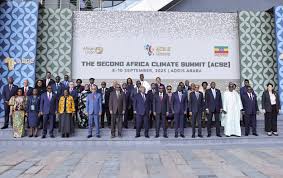
African leaders ended the second Africa Climate Summit on Wednesday with a resounding call for greater investment in renewable energy and stronger financial support to help the continent confront climate change.
The three-day gathering in Ethiopia’s capital produced a joint declaration that emphasized the urgent need to scale up renewable energy projects across Africa. Leaders argued that clean energy is not only key to fighting climate change but also central to creating jobs, boosting industrialization, and ensuring long-term energy security for the continent’s growing population.
A major highlight of the declaration was the proposal to establish a coalition of African critical mineral producers. Officials said the bloc would help African countries secure better terms in the global supply chain for vital resources such as lithium, cobalt, and rare earth elements, minerals that are indispensable for renewable energy technologies like batteries, solar panels, and wind turbines.
READ ALSO: Ethiopia Inaugurates Africa’s Largest Dam
According to the leaders, Africa holds some of the world’s richest mineral deposits, yet continues to lose out because of poor pricing, weak value addition, and foreign-dominated supply chains.
A united front, they argued, would allow the continent to leverage its mineral wealth more strategically in the transition to a green global economy.
Demand for Climate Financing
In addition, the summit strongly pressed the international community to increase climate financing for Africa. Leaders stressed that despite contributing the least to global greenhouse gas emissions, Africa faces the harshest impacts of climate change, including droughts, floods, and food insecurity.
The African Union (AU) used the platform to call for a fairer global climate finance architecture.
The AU argued that existing arrangements often deepen the debt burden of developing countries, forcing them to divert scarce resources away from development needs toward costly loan repayments.
READ ALSO: IATF 2025: Obasanjo’s Comment Sparks Debate on Africa’s IMF, World Bank Dependence
This year’s summit, held under the theme “Financing Africa’s Resilient and Green Development,” attracted a wide spectrum of participants, including heads of state, civil society organizations, researchers, and development partners. Discussions centered on how Africa can present a stronger, collective voice in global climate negotiations.
The leaders agreed that the declaration would serve as Africa’s official position at the COP30 climate talks scheduled for November. By uniting around clear demands for renewable energy investment, climate financing, and mineral resource management—African nations aim to strengthen their bargaining power on the global stage.
Observers say the declaration reflects a shift in Africa’s climate strategy. Instead of being seen as a passive victim of climate change, the continent is increasingly positioning itself as a key player in the global energy transition.
By highlighting its mineral wealth, renewable energy potential, and growing population, Africa hopes to attract the investments needed to build a greener, more resilient future while also pushing back against financial systems that leave developing countries trapped in debt.

Esther Ososanya is an investigative journalist with Pinnacle Daily, reporting across health, business, environment, metro, Fct and crime. Known for her bold, empathetic storytelling, she uncovers hidden truths, challenges broken systems, and gives voice to overlooked Nigerians. Her work drives national conversations and demands accountability one powerful story at a time.