

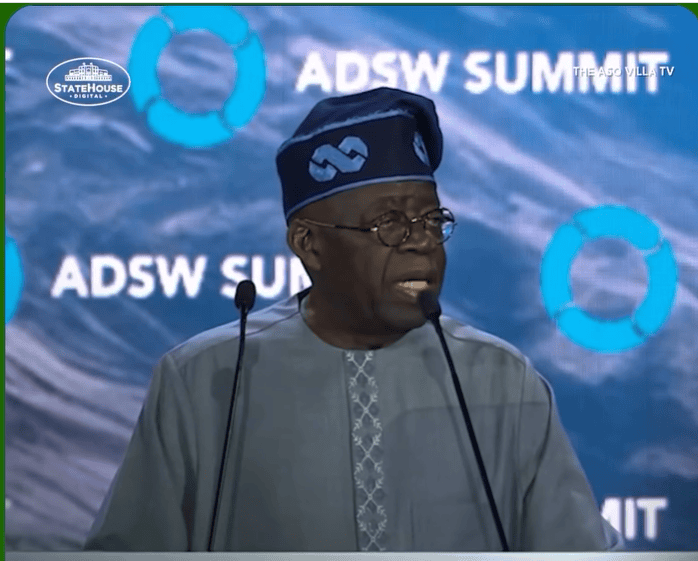
Nigeria’s President, Bola Tinubu, has highlighted what developing countries need to give full commitment to the realization of the global climate sustainability agenda.
President Tinubu, who spoke on Tuesday, January 13, at the ongoing Abu Dhabi Sustainability Week (ADSW), holding in Abu Dhabi, the United Arab Emirates (UAE), said Nigeria aligns with the global community, moving beyond ambition towards delivery of climate actions that integrate with energy access, economic growth, job creation and social inclusion.
He emphasised that sustainable development ensures that all systems, policy, finance, infrastructure, and human capital must move together.
While pointing out that climate action must be fair and just, the Nigerian leader stressed that developing countries require access to predictable climate financing, technologies, and robust capacity building to be fully committed to achieving global climate sustainability and the clean energy transition agenda, without derailing from their development priorities.
“Climate action must be fair and just developing countries require predictable climate finance, accessible technologies, and robust capacity building, to support full Climate Commitment without losing focus on advancing their developmental priorities,” Tinubu stated.
The president observed that the theme of this year’s programme, titled “The Nexus of Next: All Systems Go,” underscores the urgency required to substantiate a sustainable transition process across finance, technology, energy, and human capital and the connections between climate, and global economy, health and energy systems, as well as food security.
He highlighted regulatory and policy measures rolled out by the Nigerian government to strengthen climate governance in the country towards achieving the sustainability agenda. According to him, the country adopted the National Carbon Market Activation Policy (NCMAP) in 2025 and launched the National Carbon Registry to enhance the measurement, reporting, and verification of carbon activities. The policy moves Nigeria from fragmented carbon activities to a structured market, establishing institutions, procedures, and fiscal incentives for low-carbon growth.
“We are modernizing Nigeria’s energy architecture. The Electricity Act of 2023 now provides for decentralized, inclusive energy delivery. In practical terms, this means sustainable power to rural communities, off-grid, health facilities, educational institutions, markets and the underserved communities.”
READ ALSO: Nigeria Unveils Climate-Smart EV Recharge Hub to Accelerate Green Mobility Push
He said Nigeria recognizes the urgent need to deploy technologies to improve grid efficiency, modernize infrastructure and accelerate the delivery of sustainable energy to underserved areas.
He further stated that the country also recognizes the urgent need for the adoption of artificial intelligence (AI) to optimize efficiency.
“Therefore, as we work to ensure a stable and reliable energy supply, we are actively seeking partnerships that promote technology transfer, knowledge exchange and Innovation.”
He stated that the realization of the developmental opportunity that lies in the sustainability agenda led Nigeria to launch major climate and green industrialization initiatives, including the Climate and Green Industrialization Investment Playbook, to attract significant funding of up to $25 or $30 billion in climate finance annually.
He also stated that the Nigerian Sovereign Investment Authority has launched a $500 million distributed renewable energy fund, while the World Bank is implementing the $750 million programmes, aimed at expanding clean access to power to over 17.5 million people.
“We are deepening access to green finance. Our climate investment platform targets $500 million for climate-resilient infrastructure and our National Climate Change fund aims for a 2 billion capitalization.
“The 50 billion naira sovereign Green Bond issued in the year 2025 attracted 91 billion naira in subscriptions, while the Lagos State Green Bond was oversubscribed by 97.7 percent,” the president stated.
He explained that Nigeria’s Energy Transition Plan (ETP), “integrates energy access, climate mitigation, industrial growth and social development into a single coherent framework, achieving net-zero emission by 2060 while delivering universal energy access.”
He further stated that the country’s pilot electricity Mobility Project, aimed at reducing emissions, lowering cost, and stimulating industrial development, is also delivering on national energy efficiency programmes.
While stating that the country is also prioritizing critical minerals for a clean energy future, Tinubu noted that among other rare-earth minerals in abundant supply in Nigeria, “lithium reserves offer transformative potential for battery production, energy storage capacity.”
He invited partners to invest in the country’s solid mineral resources in a manner that “ensures not just extraction of minerals, but local processing and value addition, thus creating jobs and strengthening industrial capacity at home.”
He said Nigeria is ready for business, adding that it is “easy in, easy out; we just want value addition.”
Call for a shift in the global financial system
Tinubu called for a shift in the global financial architecture, “a move away from the restrictive requirement of sovereign guarantees, which unfairly penalized developing countries.”
He said the focus should be on “blended finance” that allows the strategic use of public, philanthropic, and private capital to fund sustainable development projects, without affecting the national balance sheet.
Nigeria, UAE Partnership Agreement
He noted the strategic partnerships between Nigeria and the UAE, especially in advancing integrated, sustainable solutions and renewable energy and clean power.
The president revealed that the UAE and Nigeria have concluded negotiations on the Comprehensive Economic Partnership Agreement. According to him, the historic partnership agreement has created a new era in both countries’ bilateral relations, as it would deepen trade, unlock sustainable investments and strengthen cooperation in renewable energy, aviation, logistics, agriculture, digital trade and climate, smart infrastructure.
As part of efforts to deepen the ties, Tinubu said Nigeria will co-host Investopia with the UAE in Lagos in February, bringing together global investors and policymakers to convert interest into commitment.
Tinubu arrived in Abu Dhabi, UAE, on Sunday, January 11, to participate in the 2026 edition of Abu Dhabi Sustainability Week (ADSW). The programme, which began on Monday, January 12, will end on January 17.
Abu Dhabi Sustainability Week is a global platform that brings together world leaders, policymakers, investors, and experts to advance dialogue and action on sustainable development, climate action, energy transition, and inclusive economic growth.
This year’s programme holding at the Abu Dhabi National Exhibition Centre (ADNEC) focuses on emerging priorities such as AI-enabled energy systems, climate finance, and innovations that support food and water security.

Victor Ezeja is a Nigerian journalist skilled in producing insightful news analyses, feature stories, and interviews that simplify complex issues and drive informed public discourse. His work combines rigorous research, balanced reporting, and compelling storytelling to highlight developments shaping industries and society. Victor, who holds a Master's Degree in Mass Communication, specializes in energy, aviation, business, and economic reporting. He can be reached via @VICTOREZEJA on X