

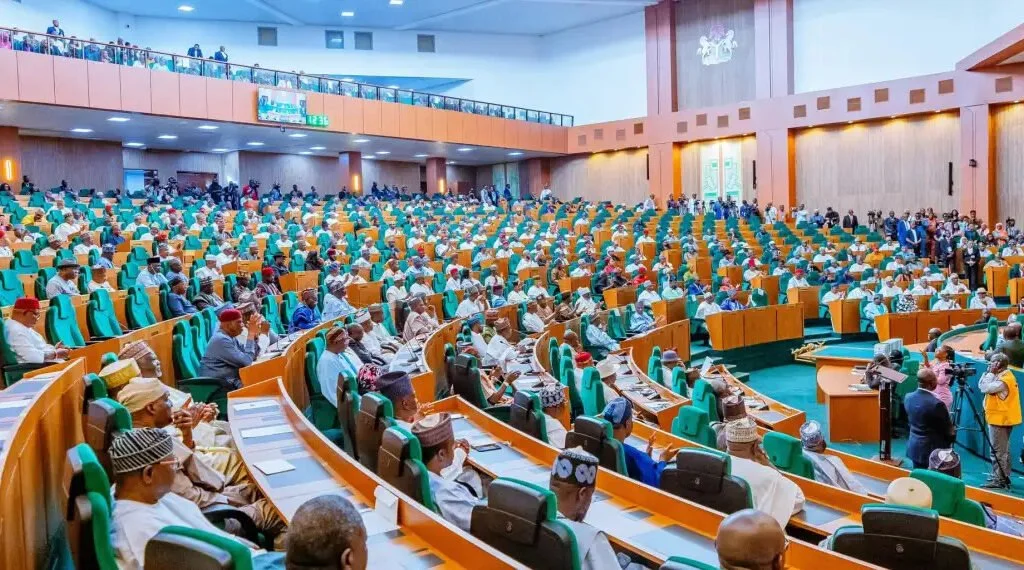
The House of Representatives has approved President Bola Tinubu’s request to borrow $2.35 billion to finance part of the 2025 budget deficit.
The lawmakers also gave the green light for the issuance of a $500 million debut sovereign sukuk in the international capital market to fund key infrastructure projects and broaden Nigeria’s financing sources.
The approval followed the consideration and adoption of the report presented by the House Committee on Aids, Loans and Debt Management on Wednesday.
Breakdown of Borrowing Plan
Under the approved plan, the House authorised the implementation of new external borrowing amounting to ₦1.84 trillion (equivalent to $1.23 billion) at the budget exchange rate of ₦1,500 to $1.
READ ALSO: Govs Decide who goes to Senate, House of Reps – Achonu
The funds will help finance the ₦9.27 trillion budget deficit contained in the 2025 Appropriation Act.
Earlier this month, President Tinubu had written to the National Assembly seeking approval for the external loan, citing Sections 21(1) and 27(1) of the Debt Management Office (Establishment) Act, 2003.
These provisions require legislative consent for new borrowing and refinancing plans.
Loan to Strengthen Reserves and Fund Projects
The President stated that the funds would be sourced through one or more instruments, such as eurobonds, syndicated loans, or bridge financing, depending on prevailing market conditions.
Tinubu explained that the federal government expected the pricing of new eurobonds to align with yields on Nigeria’s existing international bonds, currently ranging between 6.8 and 9.3 per cent depending on maturity.
On the proposed $500 million sovereign sukuk, the President said it would diversify Nigeria’s investor base and deepen the domestic government securities market.
Proceeds from the sukuk, he noted, would be used to develop critical infrastructure projects across the country.
Diversifying Funding Sources
Tinubu revealed that since 2017, the federal government had successfully raised over ₦1.39 trillion through domestic sukuk issuances to fund major road and infrastructure projects.
The external sukuk, he added, would complement these efforts.
“It is imperative to open new sources of funding for the federal government and deepen the FGN securities market,” the President said in his letter to the National Assembly.
He further explained that up to 25 per cent of proceeds from the sukuk might be used to refinance high-cost existing debt, while the remainder would go into infrastructure financing.
Economic Objectives
The borrowing plan forms part of the administration’s fiscal strategy to strengthen foreign reserves, stabilise the naira, and sustain funding for critical infrastructure projects amid rising debt obligations.
With the House’s approval, the federal government is set to begin implementing the external financing component of the 2025 budget.

Rafiyat Sadiq is a political, justice, and human rights reporter with Pinnacle Daily, known for fearless reporting and impactful storytelling. At Pinnacle Daily, she brings clarity and depth to issues shaping governance, democracy, and the protection of citizens’ rights.