

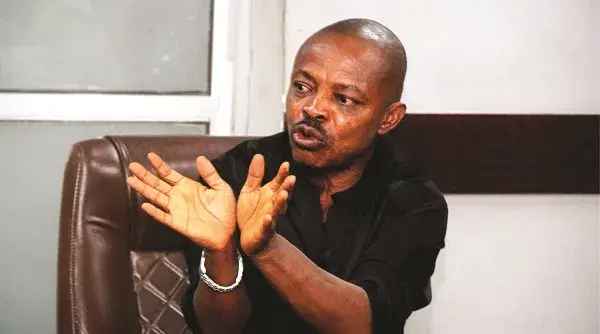
Nigeria’s long-troubled electricity sector has come under renewed fire as the President of the Nigeria Labour Congress, Joe Ajaero, described the country’s power industry as “the biggest scam in Nigeria,” accusing powerful interests of hijacking reforms and worsening electricity poverty despite decades of privatisation and reforms.
Ajaero, who also serves as General Secretary of the National Union of Electricity Employees, made the remarks while speaking on Nigeria’s persistent power crisis, rising tariffs, and structural failures across generation, transmission, and distribution.
Ajaero argued that Nigeria’s electricity challenge cannot be traced to one segment alone, insisting that generation, transmission, and distribution are all failing in a coordinated system that lacks balance.
He explained that even when generation rises, weak transmission and distribution networks collapse the gains, leaving the system stuck at an average capacity of about 4,000 megawatts for years.
According to him, the absence of a coherent national master plan has allowed investors driven mainly by profit to dominate the sector without delivering meaningful expansion.
The labour leader questioned the rationale behind Nigeria’s power sector privatisation, insisting it was never designed to improve electricity supply but to restructure ownership without expanding capacity.
He recalled that Nigeria’s then 4,000MW generation capacity under the defunct NEPA was simply split among multiple distribution companies without any significant increase in output.
He added that more than a decade after the unbundling of the Power Holding Company of Nigeria (PHCN), the country is still operating within the same generation limits, despite the creation of multiple DisCos and executive structures.
Gas, Coal and Missed Energy Opportunities
Ajaero criticised Nigeria’s energy planning, arguing that power plants are often sited far from gas sources, leading to unnecessary pipeline costs and vulnerability to disruptions.
He noted that Nigeria continues to rely heavily on gas-fired stations despite abundant coal and hydro resources, arguing that a diversified energy mix would have significantly improved stability.
He cited examples from countries such as Germany and South Africa to show how energy diversification strengthens national supply resilience.
He also advocated a unified Ministry of Energy to coordinate gas supply, generation, and transmission more effectively.
Band A, B, C Tariff System Under Fire
The labour leader also condemned Nigeria’s electricity band classification system (Band A, B, and C), describing it as unfair and discriminatory.
He argued that electricity access should be universal and not based on the ability to pay higher tariffs, warning that rural communities are being neglected under the current structure.
According to him, the system effectively commercialises electricity while undermining its role as a public utility.
Ajaero blamed successive administrations for failing to develop a new power sector blueprint after inheriting the privatisation framework initiated under previous governments.
He recalled reforms under former President Umaru Musa Yar’Adua, who temporarily suspended privatisation, and noted that despite investments under past administrations, capacity has remained stagnant.
READ ALSO:
- Power Sector Bailout: Can Tinubu’s ₦3.3trn Debt Clearance End Blackouts?
- Power Sector: Debt to GenCos Now at ₦6.5trn – APGC CEO Insists
- Nigeria’s Reserves Slide Nearly $1bn in April Despite Strong Annual Gains
- Nigeria’s Capital Market’s Share of GDP Rises to 33% – SEC
He revealed that many electricity distribution companies are now effectively controlled by banks due to loan defaults by original investors.
According to him, most DisCos were acquired using borrowed funds from Nigerian banks rather than foreign direct investment, leading to financial instability across the sector.
He also alleged widespread job losses, casualisation, and labour rights violations, including attempts to weaken union structures within the industry.
Ajaero further warned that powerful industry actors now influence regulatory and political decisions in the sector, a situation he described as “regulatory capture.”
He accused operators of consistently pushing for tariff increases while failing to improve service delivery, despite receiving government support and subsidies worth trillions of naira.
Solar Adoption Debate and Policy Contradictions
He also criticised government officials who advocate solar energy adoption while still relying on a weak national grid, arguing that such contradictions threaten the viability of the electricity distribution companies.
According to him, widespread migration to alternative energy sources could further weaken DisCos already struggling with revenue collection and debt.
Ajaero concluded that Nigeria’s power problem will persist unless the country deliberately expands generation capacity beyond current stagnation levels.
He warned that achieving temporary gains without sustained investment would only lead to repeated collapses in supply, urging government to adopt long-term, structured planning for the sector.

Esther Ososanya is an investigative journalist with Pinnacle Daily, reporting across health, business, environment, metro, Fct and crime. Known for her bold, empathetic storytelling, she uncovers hidden truths, challenges broken systems, and gives voice to overlooked Nigerians. Her work drives national conversations and demands accountability one powerful story at a time.