

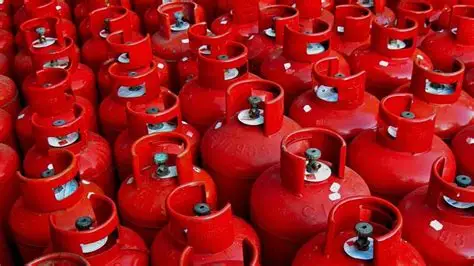
Fresh concerns have emerged following a new increase in the retail price of cooking gas, adding further strain on households already grappling with high living costs.
Latest report released by the National Bureau of Statistics (NBS) show that the average price for refilling a 5kg cylinder of Liquefied Petroleum Gas (LPG), commonly known as cooking gas, rose by 0.82 per cent on a month-on-month basis from ₦5,360.43 recorded in December 2025 to ₦5,404.19 in January 2026.
However, on a year-on-year basis, it reflects a decrease of 23.25 per cent from ₦7,040.94 recorded in January 2025.
On a state-by-state basis, Jigawa recorded the highest average price for refilling a 5kg Cylinder of cooking gas with ₦5,892.88, followed by Abia with ₦5,829.17 and Akwa Ibom with ₦5,789.85. Bayelsa recorded the lowest price with ₦4,891.87, followed by Sokoto and Katsina with ₦5,008.36 and ₦5,013.80, respectively.
Also, the average retail price for refilling a 12.5kg Cylinder of Liquefied Petroleum Gas increased by 0.83 per cent on a month-on-month basis from ₦13,438.90 in December 2025 to ₦13,551.01 in January 2026.
On a year-on-year basis, the average price for refilling a 12kg cylinder dropped by 22.27 per cent from ₦17,432.89 in January 2025.
“On state profile analysis, Jigawa recorded the highest average retail price for the refilling of a 12.5kg Cylinder of Liquefied Petroleum Gas (Cooking Gas) with ₦14,732.19, followed by Abia with ₦14,572.94 and Akwa Ibom with ₦14,474.62,” NBS LPG Price Watch report for January state.
“Conversely, the lowest average price was recorded in Bayelsa with ₦12,229.66, followed by Bauchi and Sokoto with ₦12,385.00 and ₦12,520.9,0 respectively.”
NBS data shows fluctuation in prices of cooking gas in 2025. After rising to ₦8,167.43 in May from ₦7,885.60 in April and further to ₦8,323.95 in June 2025, the average price of refilling a 5kg cylinder dropped to ₦8,243.79 in July. It further dropped significantly to ₦6,404.02 in August and ₦6,395.82 in September. It, however, jumped to ₦8,081.75 in October following the nationwide strike embarked on by the Petroleum and Natural Gas Senior Staff Association of Nigeria (PENGASSAN) over labour issues with Dangote Refinery management.
Consumers heaved a sigh of relief when the average price of cooking gas dropped to ₦5,425.78 in November and ₦5,360.43 in December.
The recent price increase raises fresh concerns about the implications for households
Industry analysts have identified several factors keeping gas prices high, which include logistics costs, infrastructure maintenance, and labour disputes, which cause supply disruption, foreign exchange volatility, and market exploitation (artificial scarcity created by marketers).
READ ALSO:
- Dangote Refinery Slashes ex-Depot Price of Cooking Gas to ₦760/kg
- Cross River Residents Spend More on Petrol in January – Report
- NNPC Records ₦60.5trn Revenue, ₦5.7trn Profit in 2025
- Competition Intensifies as Petrol Landing Costs Drop Below Dangote Prices
While the emergence of Dangote Refinery and the activities of NLNG and a couple of other indigenous operators have boosted gas production and supply, there are concerns around sufficiency.
The Fact Sheet released by the Nigerian Midstream and Downstream Petroleum Regulatory Authority (NMDPRA) recently shows that the domestic supply of LPG averaged 5,100 metric tonnes (MT) per day in January 2026, a slight drop from 5,200MT per day in December 2025.
Energy analysts argue that while the federal government has promoted gas as a transition fuel under its Decade of Gas initiative, more structural reforms are needed to stabilize the domestic LPG market. They highlighted infrastructure bottlenecks, limited storage capacity, and inadequate distribution networks as persistent challenges.
In recent statements, the Nigerian National Petroleum Company Limited (NNPCL) assured that efforts were ongoing to boost local supply and reduce dependence on imports. The company highlighted investments in domestic gas processing facilities aimed at improving availability in the medium term. This includes the Ajaokuta–Kaduna–Kano (AKK) Pipeline Project, which the Federal Government has identified as the long-term solution to gas supply across the country.
First gas from the Ajaokuta-Gwagwalada segment is expected to flow by July 2026, which is projected to lower costs significantly in Northern and Central Nigeria by reducing reliance on road trucking.

Victor Ezeja is a Nigerian journalist skilled in producing insightful news analyses, feature stories, and interviews that simplify complex issues and drive informed public discourse. His work combines rigorous research, balanced reporting, and compelling storytelling to highlight developments shaping industries and society. Victor, who holds a Master's Degree in Mass Communication, specializes in energy, aviation, business, and economic reporting. He can be reached via @VICTOREZEJA on X