

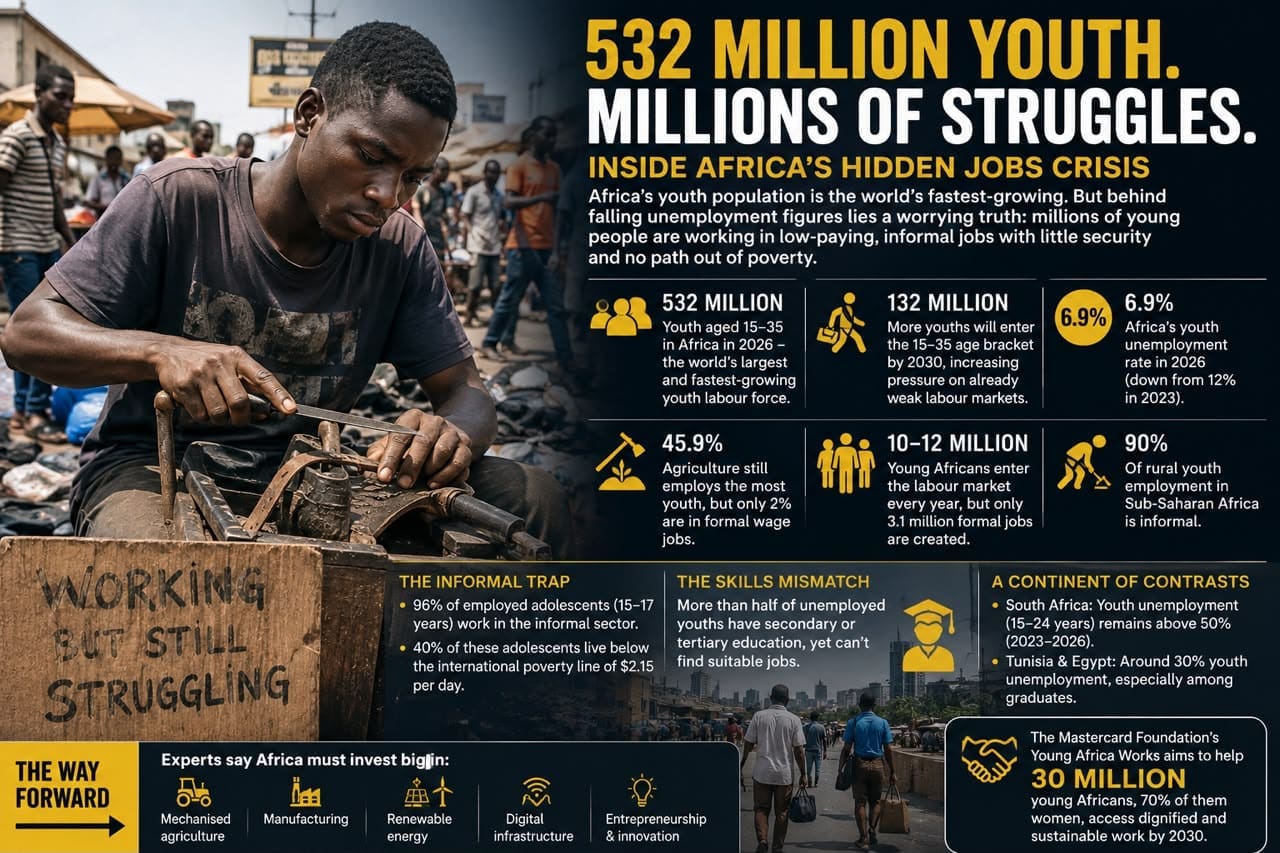
Africa’s youth population is growing faster than anywhere else in the world. Yet behind falling unemployment figures lies a troubling reality: millions of young people are trapped in low-paying, informal jobs that offer little hope of escaping poverty. As another 132 million youths prepare to enter the labour market by 2030, experts warn that the continent is running out of time to turn its demographic boom into economic prosperity.
Africa’s greatest asset may also be becoming one of its biggest economic challenges.
Across the continent, millions of young people wake up each day, head to farms, markets, workshops, construction sites, roadside stalls and digital platforms. They are counted as employed. They are working. Yet many remain poor, vulnerable and uncertain about the future.
This is the paradox at the heart of Africa’s growing youth employment crisis.
A new report, Africa Youth Employment Outlook 2026, released by the Mastercard Foundation in partnership with World Data Lab and the University of Cape Town Development Policy Research Unit, reveals that while unemployment rates appear relatively moderate across much of the continent, the true challenge is far deeper than official statistics suggest.
The report estimates that Africa’s population aged between 15 and 35 will reach approximately 532 million in 2026, making it the world’s fastest-growing youth labour force. By 2030, another 132 million young people are expected to join this demographic group, creating unprecedented pressure on economies that are already struggling to generate enough quality jobs.
The findings raise a critical question for policymakers, businesses and governments across Africa: What happens when hundreds of millions of young people have jobs, but those jobs cannot lift them out of poverty?
The Great African Employment Illusion
At first glance, the numbers appear encouraging. Africa’s average youth unemployment rate stood at around 12 per cent in 2023 and was later revised to approximately 6.9 per cent in 2026.
In many parts of the world, such figures would be interpreted as evidence of a healthy labour market. But experts caution that the statistics tell only a fraction of the story.
According to the report, unemployment figures alone fail to capture the realities confronting young Africans because millions simply cannot afford to remain unemployed.
Unlike in wealthier economies where job seekers may rely on unemployment benefits or social welfare support while searching for work, many African youths have no such safety net. Survival becomes the priority.
As a result, they take whatever work is available, regardless of income, security or long-term prospects. “The majority of youth in rural areas are engaged in unstable, low-income agricultural and informal work simply because they cannot afford to remain unemployed,” the report stated.
This means that being employed in Africa does not necessarily mean having decent work, financial security or a pathway to prosperity. For millions, employment simply means survival.
READ ALSO:
- Youths Raise Alarm Over Fresh Attacks in Plateau
- How Nigeria’s Youth Are Trading Meals for Megabytes
- 30,000 Jobs, 1.9m Applicants: Merit Overpowered by Money, Influence
- Trapped Between Policies, Neglect: 35 Million Nigerians With Disabilities Still Shut Out
Despite rapid urbanisation and technological advancement, agriculture remains the largest employer of young Africans. According to the report, about 45.9 per cent of youth employment in 2026 was concentrated in agriculture. Yet this sector remains overwhelmingly informal.
Only about two per cent of young agricultural workers are employed in formal wage-paying positions. The rest are engaged in subsistence farming, unpaid family labour, seasonal work and small-scale agricultural activities that often generate meagre earnings.
In many rural communities, young people work long hours cultivating crops, herding livestock or assisting family enterprises without contracts, insurance, pensions or income guarantees. For many households, agriculture remains less a route to prosperity and more a mechanism for survival.
The report warns that unless agricultural productivity improves significantly through mechanisation, technology adoption and better market access, millions of rural youths will remain trapped in cycles of low income and vulnerability.
The Race Africa Is Losing
Perhaps the most alarming statistic in the report is the widening gap between the number of young people seeking jobs and the number of decent jobs being created. According to data from the International Labour Organisation (ILO), between 10 million and 12 million young Africans enter the labour market every year. However, only about 3.1 million formal jobs are created annually across the continent. This leaves millions with little choice but to enter the informal economy.
The consequence is a labour market that is expanding rapidly in numbers but not in quality. Every year, the deficit grows larger. Every year, millions more young Africans join a workforce that cannot absorb them into productive and secure employment.
Economists warn that this imbalance threatens not only economic growth but also social stability, political confidence and long-term development.
The Rise of the Informal Generation
The report paints a striking picture of an economy increasingly dependent on informal labour. According to the ILO, more than 90 per cent of rural youth employment in Sub-Saharan Africa remains informal.
Many young people earn livelihoods through street trading, motorcycle transport services, small-scale farming, domestic work, casual construction jobs and other forms of precarious employment.
These jobs often lack legal protections, health insurance, pensions, paid leave or stable incomes. Workers can lose their livelihoods overnight due to illness, economic downturns or market disruptions.
For many young Africans, the informal economy is not a choice but the only available option.
For decades, education was promoted as the surest pathway to economic advancement. Today, that promise is increasingly under strain. The report found that more than half of unemployed youths across Africa possess secondary or tertiary education qualifications.
Many university graduates, diploma holders and skilled workers are unable to find jobs that match their education or career aspirations. Instead, they are forced into low-paying informal activities or remain unemployed for extended periods.
This growing mismatch between education and employment opportunities is becoming one of Africa’s most pressing development challenges. Graduates are emerging from universities with expectations of professional careers, only to encounter labour markets that are unable to absorb them.
Nigeria’s Reality: Employment Without Prosperity
The findings resonate strongly in Nigeria. Recent labour market data from the National Bureau of Statistics indicate that many young Nigerians classified as employed are engaged in survivalist and low-productivity activities.
From roadside vending and ride-hailing services to small-scale trading and freelance work, millions of youths are earning incomes that barely cover daily necessities. While they may not appear in unemployment statistics, their economic realities tell a different story.
The challenge is no longer simply creating jobs. It is creating jobs that provide sustainable incomes, career progression and economic security.
The crisis manifests differently across Africa. In South Africa, youth unemployment among people aged 15 to 24 has consistently remained above 50 per cent between 2023 and 2026, ranking among the highest in the world.
In Tunisia and Egypt, youth unemployment rates continue to hover around 30 per cent, particularly among university graduates. Djibouti has also recorded some of the highest levels of youth joblessness on the continent.
These figures reveal that while the nature of the problem varies, no region is entirely immune.
Children at Work, Poverty at Home
One of the most disturbing findings in the report concerns adolescents. Nearly 57 per cent of Africa’s youth population, representing about 304 million people, were already economically active by 2025.
Among young people aged 15 to 17, almost as many were working as were enrolled in school. Even more troubling, 96 per cent of employed adolescents were engaged in informal work.
Around 40 per cent were living below the international poverty line of $2.15 per day. These figures suggest that economic pressures are pushing many young people into work long before they complete their education, potentially limiting future opportunities and reinforcing cycles of poverty.
Despite the challenges, the report identifies signs of economic transformation. The services sector is projected to overtake agriculture as Africa’s largest youth employer by 2033.
Driven by urbanisation, digital commerce, technology adoption and expanding consumer markets, services are becoming an increasingly important source of employment.
Importantly, the report found that young Africans working in services earned approximately 2.6 times more than their counterparts in agriculture in 2024.
This income gap highlights the importance of accelerating structural transformation toward higher-productivity sectors capable of generating better-paying jobs.
Can Africa Harness Its Demographic Dividend?
Africa stands at a critical crossroads. Its youthful population has the potential to become a powerful engine of economic growth, innovation and industrial development.
But that outcome is far from guaranteed. Development economists argue that achieving it will require large-scale investments in mechanised agriculture, manufacturing, renewable energy, digital infrastructure, technology and entrepreneurship.
Without such investments, the continent risks turning a demographic advantage into a demographic burden.
The Mastercard Foundation’s Young Africa Works programme seeks to help 30 million young Africans, 70 per cent of them women, access dignified and sustainable work opportunities by 2030.
Yet experts agree that isolated initiatives will not be enough. What is required is a coordinated continental effort to create productive jobs at a scale matching the pace of population growth.
The challenge confronting Africa is no longer whether young people can find work. Increasingly, they do. The real question is whether that work can provide a decent living. As another 132 million youths prepare to enter the labour force by the end of the decade, the answer will shape not only their futures but the future of the continent itself. For now, the reality confronting millions of young Africans is stark: they are employed, but they are not thriving. They are working, but they remain poor. And that may be Africa’s most urgent economic crisis.

Esther Ososanya is an investigative journalist with Pinnacle Daily, reporting across health, business, environment, metro, Fct and crime. Known for her bold, empathetic storytelling, she uncovers hidden truths, challenges broken systems, and gives voice to overlooked Nigerians. Her work drives national conversations and demands accountability one powerful story at a time.