

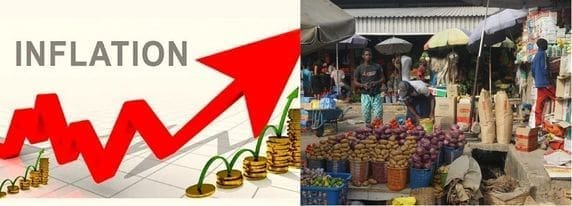
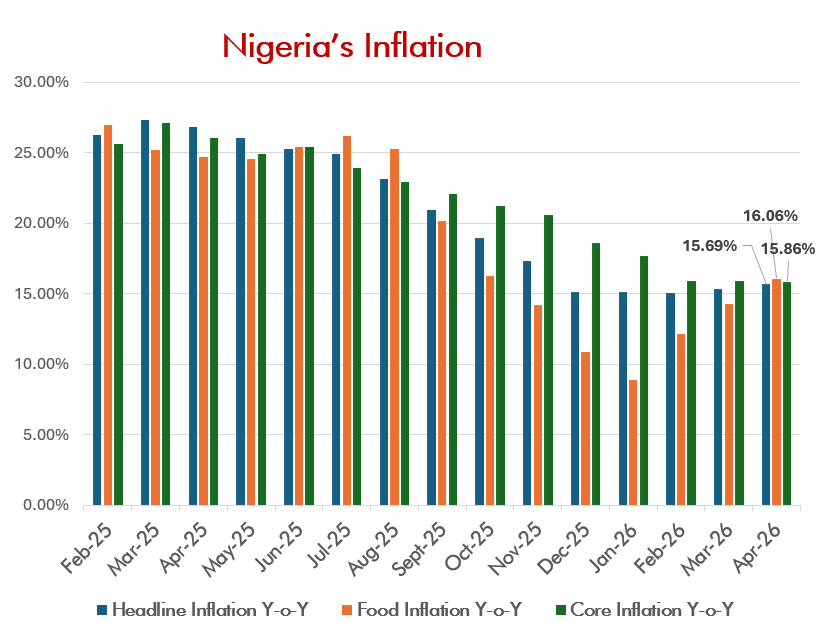
Nigeria’s headline inflation rose to 15.69 per cent in April, up from the 15.38 per cent recorded in March.
This was confirmed in the April 2026 Consumer Price Index (CPI) report released by the National Bureau of Statistics (NBS) on Friday.
This marks the second consecutive monthly increase, reversing the extended disinflationary trend seen over the past year.
The spike is heavily driven by lingering energy shocks stemming from recent global geopolitical tensions, which have directly driven up domestic transport and logistics costs.
The headline inflation figure is lower than the 26.82 per cent recorded in April 2025.
“Looking at the movement, the April 2026 headline inflation rate showed an increase of 0.31% compared to the March 2026 Headline inflation rate,” NBS stated.
On a month-on-month basis, the headline inflation rate dropped by 2.05 per cent in April to 2.13 per cent from 4.18 per cent recorded in March 2026.
“This means that in April 2026, the rate of increase in the average price level was lower than the rate of increase in the average price level in March 2026,” NBS further stated.
Food Inflation
According to the report, the food inflation rate in April 2026 was 16.06 per cent on a year-on-year basis, reflecting a drop from 24.68 per cent in the same month of the preceding year (April 2025).
However, the data reflects an increase when compared to 14.31 per cent in March 2026.
On a month-on-month basis, food inflation recorded 3.63 per cent in April 2026, compared to 4.17 per cent in March 2026.
The NBS attributed it to price hikes in staples such as millet, yam flour, garri, beef, beans, and fresh produce.
“This can be attributed to the rate of change in the average prices of the following products: Millet Whole grain, Yam Flour, Ginger (Fresh), Beef, Garri, Yam Tuber, Pepper (Fresh), Cray Fish, Cassava Tuber, Beans, Irish Potatoes, Tomatoes (Fresh), Wheat Grain (Sold loose), Soy Beans, Guinea Corn, Plantain, Carrots (Fresh) etc,” NBS stated.
Core Inflation
Core inflation, which excludes volatile agricultural produce and energy, stood at 15.86 per cent in April 2026, compared with 16.21 per cent in March 2026.
On a month-on-month basis, core inflation declined sharply to 1.03 per cent in April 2026, from 4.03 per cent in March 2026.
READ ALSO:
- Nigeria’s Headline Inflation Rises to15.38% in March – NBS
- Rising Costs Put Inflation Gains at Risk — CPPE Warns
- How Middle East War is Deepening Nigeria’s Food Crisis
- US-Iran Conflict May Force CBN to Rethink Rate-Cut
- NERC Sets New Rules to Cut Transmission Loss, Boost Mini-grid Development
Urban and Rural Inflation
The impact of current supply chain disruptions continues to hit rural areas harder due to high transport costs for moving goods.
According to the data, the urban inflation rate was 15.40 per cent in April, an increase from 14.64 per cent in March. On a month-on-month basis, the urban inflation rate was 1.86 per cent in April, down by 1.3 per cent compared to 3.16 per cent in March.
The rural inflation rate in April was 16.36 per cent on a year-on-year basis, reflecting a drop from 17.22 per cent in March 2026. On a month-on-month basis, the rural inflation rate in April was 2.80 per cent, down by 3.93 per cent compared to 6.73 per cent in March.
Primary Drivers of Inflation
The major contributors to the headline inflation push remain Food and Non-Alcoholic Beverages, Restaurants and Accommodation Services, and Transport.
With fuel price volatility directly impacting the food supply chain, analysts note that this reversal puts additional pressure on the Central Bank of Nigeria (CBN) ahead of its upcoming Monetary Policy Committee (MPC) meeting, potentially forcing a reconsideration of recent monetary easing strategies to rein in liquidity and protect the naira.

Victor Ezeja is a Nigerian journalist skilled in producing insightful news analyses, feature stories, and interviews that simplify complex issues and drive informed public discourse. His work combines rigorous research, balanced reporting, and compelling storytelling to highlight developments shaping industries and society. Victor, who holds a Master's Degree in Mass Communication, specializes in energy, aviation, business, and economic reporting. He can be reached via @VICTOREZEJA on X