

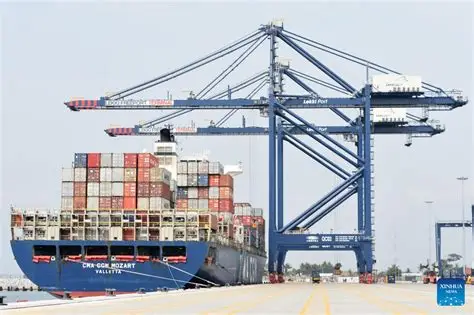
Peter Obi and others highlight benefits of decentralised ports to the Nigerian economy.
The recent approval of a $1 billion investment aimed at modernising the Apapa and Tin-Can Island ports in Lagos by the Federal Government has reignited calls for decentralisation of seaport infrastructure across Nigeria.
Analysts believe that developing seaports in other maritime corridors across the country would have positive implications for the national economy.
Pinnacle Daily reports that Minister of Marine and Blue Economy Adegboyega Oyetola, while speaking at the 2025 Chartered Institute of Logistics and Transport (CILT) Nigeria Conference, held in Lagos on Wednesday, October 22, disclosed that the Federal Government has approved $1 billion for the modernisation of Lagos ports.
The minister, who was represented by the Managing Director of the Nigerian Ports Authority (NPA), Dr Abubakar Dantsoho, said the focus is on upgrading the ports while deploying technology to ensure efficiency, curb corruption, reduce turnaround time, and increase the capacity to meet global standards.
“The Federal Government has approved a one billion US dollar modernisation project for the Lagos ports, a landmark initiative designed to upgrade infrastructure, improve cargo handling, and expand capacity to meet global standards,” Oyetola stated.
He also stated that the federal government has initiated the process for similar modernisation of other ports outside Lagos “to ensure balanced development across our maritime gateways”.
Reacting to that, former presidential candidate of the Labour Party in 2023, Mr Peter Obi, called for decentralisation of seaport infrastructure across Nigeria.
READ ALSO: Foreign Investors’ Transactions Hit 6-Month High of N387.62bn in September
In a statement via his X handle on Friday, Obi, who commended the modernisation effort targeted at improving efficiency in Nigeria’s maritime sector, warned that the latest move highlights the “longstanding concentration of port development only in Lagos”.
The former Anambra State governor stated that investment in Nigeria’s port infrastructure remains “excessively concentrated in Lagos” at the expense of other strategic ports such as Warri, Port Harcourt, Calabar, and Onne.
Obi stressed that developing other strategic ports across the country would enhance productivity, drive trade, create jobs, and open new economic corridors that would lift millions of people out of poverty across the country.
While emphasising the need for decentralising seaport development, Obi cited different countries around the world that did so and are currently reaping the economic benefits. According to him, these include Vietnam, which operates over 300 ports, ensuring nationwide connectivity; Indonesia (about 111 commercial ports distributed across its territory to boost trade); South Africa (eight major seaports spread across the country); and Egypt, Morocco, Algeria, and Ghana, among others.
READ ALSO: Nigeria @ 65: Tinubu Highlights 12 Economic Milestones Achieved in 2 Years
“These nations have grasped a simple truth: no country seeking to maximise its blue economy concentrates all maritime activities in a single city,” Obi stated.
He emphasised that developing other ports across the country would reduce congestion experienced in Lagos, improve logistics, enhance national security, and promote balanced economic growth.
He said more than 70 per cent of port activities are still concentrated in Lagos, creating “chronic congestion” which worsens the burden on the city, causing high demurrage costs, environmental degradation, and delays that discourage investors and inflate the cost of goods nationwide.
“Developing other ports is, therefore, not merely an infrastructural necessity but a national imperative,” he stated, adding that “revitalising Warri, Port Harcourt, Calabar, and Onne ports would decongest Lagos, reduce shipping costs, attract investment, create employment, and stimulate regional economies.”
Obi further stated that, given the critical link between infrastructure, trade, and national growth, a truly national blue economy must reflect regional inclusion in terms of port development.
He also called on the government to ensure that reforms address corruption, reduce bureaucracy, and embrace technology to create a port system that enhances turnaround time and global competitiveness.
He added that the Lagos modernisation project could become a model for maritime transformation across the country if properly managed.
You can’t build a $1 trillion economy on Lagos alone, expert reacts.
Also commenting on the development, economist and energy expert Kelvin Emmanuel faulted the concentration of investments in Lagos ports while neglecting those in other maritime corridors.
Mr Emmanuel, who has consistently advocated equitable development of seaports across the country, explained that it would boost water transportation and facilitate regional economic development.
While pointing out that the lack of fiscal federalism is the biggest obstacle to building a global economy, Emmanuel stated that the federal government cannot realise its ambition of building a $1 trillion economy if it continues to concentrate on Lagos alone. He therefore urged the government to “democratise access to other regions”.
The economic expert criticised the Federal Government for allegedly failing to either raise $900 million in a counterparty contribution for its 20 per cent stake in the Ibom Deep Seaport project or step down its equity stake but can mobilise $1 billion to modernise Apapa and Tin Can ports, which, according to him, “are river ports with a channel draught of 10.5 m.”
There have been growing concerns that the federal government is concentrating efforts on developing seaports in Lagos while leaving other ones in other parts of the country, especially the Eastern Maritime Corridor.
Despite assurances by the former NPA managing director, Mohammed Bello, during an inspection visit in July 2022, that the Calabar Port Channel would be revitalised to generate revenue for the Federal Government, it has remained largely abandoned.
Three years after the assurance, dredging work on the Calabar seaport has not been done, even after the resolution of the legal battle that stalled the dredging contract in 2022. The situation had prompted the House of Representatives to, on June 6, 2024, direct its Committee on Ports and Harbours to investigate the contract.
Pinnacle Daily recalls that in 2006, former President Obasanjo awarded dredging contracts worth $56 million to Dutch companies Jan De Nul and Van Oord, but the work was said to have been abandoned halfway. The administration of former President Goodluck Jonathan initiated Calabar Channel Management (CCM), a joint venture company between the Nigerian Ports Authority (NPA) and a consortium of companies led by Niger Global Engineering and Technical Company Limited, with a mandate to dredge the port. However, court battles that ensued much later stalled the work. It was resolved through an out-of-court settlement in 2022.
READ ALSO: GDP: Nigeria Needs 21.95% Growth to Achieve $1 Trillion Economy – Afrinvest
While advancing his claim that Lagos is disproportionately being favoured with infrastructural development, Mr Emmanuel stated that apart from the Calabar port, the Federal Government has also failed to start building the Akwa Ibom Deep seaport, seen as a game-changer not just for the state but the entire south-south region when completed.
“How can Lagos have three functioning seaports with a fourth one in the works, and every other place is languishing?” Emmanuel had asked in an interview some months ago, raising concerns about what he described as “economic injustice”.
He criticised the federal government’s policy that designated Onne Port for only oil and gas operations, pointing out that it makes importers pay more for goods cleared at the port that are non-oil and gas cargoes. This, according to him, makes the Onne Port uncompetitive, forcing importers of non-oil and gas goods to use Lagos ports.
While highlighting the importance of seaports in boosting trade, a tech entrepreneur and chairman of Tekedia Capital, Prof Ndubuisi Ekekwe, stressed that Nigeria needs to have more of such critical infrastructure to advance shared prosperity.
He called for the adoption of the Public-Private Partnership (PPP) model for funding such projects.
READ ALSO: How Africa Can Leverage Mineral Resources for Sustainable Growth, Global Power – Expert
Experts believe that Nigeria’s economic ambitions cannot be achieved within the congested corridors of Lagos ports, but there is a need for a network of efficient, specialised, and well-connected ports serving different regions of the country.
There is also emphasis on integrating the ports with a robust network of railways and highways to ensure smooth evacuation of cargo.
Only Apapa Port had been connected to the rail network, with a standard gauge track inside the APMT Terminal used for freight movement between Lagos and Ibadan.
Earlier this year, Minister of Transportation Saidu Alkali disclosed that the Federal Executive Council approved a $45.3 million contract for the feasibility study and engineering design of a rail network connecting all seaports to facilitate seamless movement of goods and reduce highway congestion.
Last month, the Nigerian Railway Corporation (NRC) affirmed that plans are underway to undertake the project.

Victor Ezeja is a Nigerian journalist skilled in producing insightful news analyses, feature stories, and interviews that simplify complex issues and drive informed public discourse. His work combines rigorous research, balanced reporting, and compelling storytelling to highlight developments shaping industries and society. Victor, who holds a Master's Degree in Mass Communication, specializes in energy, aviation, business, and economic reporting. He can be reached via @VICTOREZEJA on X