

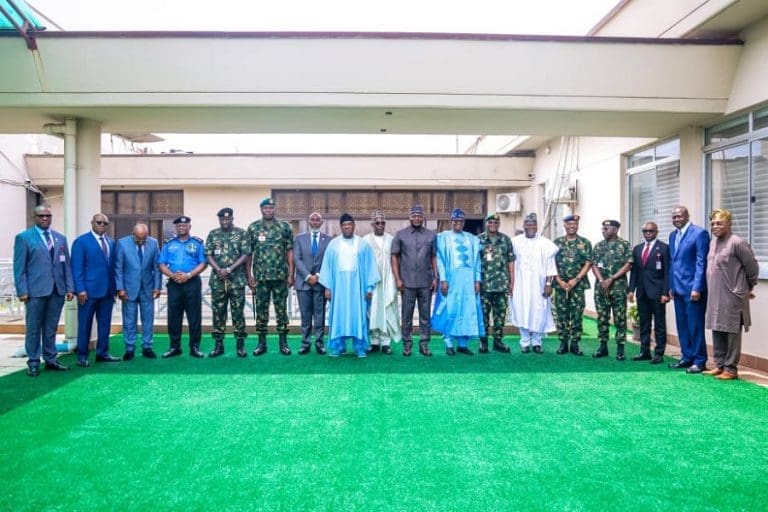
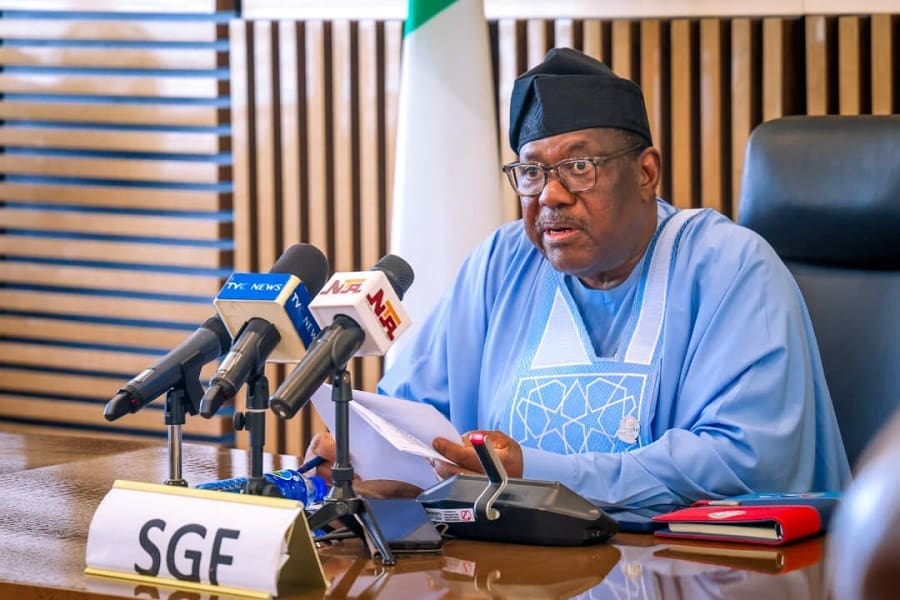
The Secretary to the Government of the Federation (SGF), George Akume, has inaugurated the Presidential Committee on the National Threat Assessment and Five-Year Strategic Defence Operations Plan, charging members to approach the assignment with professionalism, urgency, objectivity and patriotism.
The committee, established by President Bola Ahmed Tinubu, has 90 days to produce a comprehensive National Threat Assessment and a rolling five-year Strategic Defence Operations Plan for the President’s consideration and approval.
Akume said the assignment was of considerable national importance, urging members to use their collective expertise to develop a coherent framework that would improve Nigeria’s ability to anticipate, plan for and respond to current and emerging security threats.
He assured the committee of the full support of his office and authorised it to consult or co-opt representatives of relevant Ministries, Departments and Agencies where specialised expertise is required.
According to a statement by his Special Adviser on Media and Publicity, Yomi Odunuga, the SGF said the inauguration marked an important step towards strengthening Nigeria’s response to an increasingly complex security environment.
From reaction to threat anticipation
Akume acknowledged recent successes by the Armed Forces and other security agencies but said Nigeria must move beyond responding to individual threats to a system that can anticipate risks, establish priorities, allocate resources efficiently and sustain operations.
He noted that modern security threats are increasingly interconnected and capable of exploiting gaps between institutions, jurisdictions and operational theatres.
The SGF said operational responses should be guided by a shared national understanding of the security environment and a coherent short-, medium- and long-term strategy.
He warned that considering operational requirements independently, without a common threat assessment and unified capability plan, could weaken coordination and limit the effective use of scarce resources.
Linking threats to resources
The committee is expected to establish a system where threat assessments determine operational objectives, which in turn determine required capabilities and resource allocation.
“ In simple terms, we must establish a clear path from threat to objective, from objective to capability, from resource capability, and from resource to measurable outcome,” Akume said.
He explained that the National Threat Assessment would identify Nigeria’s principal security threats, their significance, likely evolution and the consequences of failing to address them.
It is also expected to distinguish immediate threats requiring urgent action from emerging threats requiring early investment in intelligence, technology, infrastructure, training, doctrine and other capabilities.
Five-year defence plan
The Five-Year Strategic Defence Operations Plan will translate the threat assessment into practical and prioritised operational requirements.
It will identify what must be achieved in each operational theatre and the forces, equipment, infrastructure, logistics, intelligence, technology and personnel needed to meet those objectives.
The plan will also identify capability gaps, establish procurement priorities based on assessed threats rather than institutional preferences, and provide timelines, responsibilities and measurable indicators for implementation.
Akume said the five-year horizon would support force development, capability acquisition, infrastructure, training, maintenance, research and development, as well as efforts to strengthen Nigeria’s defence industrial base.
The plan will operate on a rolling basis and be reviewed annually to reflect emerging threats, technological developments, changing operational realities and lessons from ongoing operations.
Committee’s terms of reference
Under its terms of reference, the committee will review existing and emerging security threats, assess their urgency and strategic implications, define operational priorities and identify capabilities required in different theatres.
It will also assess gaps in equipment, logistics, infrastructure, technology, personnel and support, while establishing procurement priorities and realistic implementation timelines.
The committee is further expected to recommend measures for monitoring progress, evaluating outcomes and ensuring effective implementation of the strategic defence plan.
Akume said military and security personnel who continue to defend the country deserve a strategic framework that clearly defines their objectives and provides the capabilities and resources needed to accomplish them.
Key security chiefs on committee
The committee will be coordinated and supported by the Office of the Special Adviser to the President on Homeland Security, Major General Adeyinka Famadewa (rtd).
Its members include National Security Adviser, Nuhu Ribadu; Minister of Defence, General Christopher Musa (rtd); Minister of State for Defence, Bello Muhammad Matawalle; and Chief of Defence Staff, General Olufemi Oluyede.
Others are Chief of Army Staff, Lt.-General Waidi Shaibu; Chief of Air Staff, Air Marshal Sunday Kelvin Aneke; Chief of Naval Staff, Vice Admiral Idi Abbas; Inspector-General of Police, Olatunji Rilwan Disu; Director-General of the Department of State Services, Tosin Ajayi; and Director-General of the National Intelligence Agency, Ambassador Muhammed Muhammed.
READ ALSO:
- Niger Mass Abduction: Tinubu Vows Rescue as Security Forces Deploy
- FG Suspends 3 Perm. Secs, Orders Arrest Over Fake Agency
- Tinubu Pledges Inclusive Development Amidst Marginalisation Claims
- Tinubu Grants Presidential Pardon to Macaulay, Vatsa, 173 Others

In his closing remarks, Famadewa thanked President Tinubu for the confidence placed in the committee and urged members to work collectively to strengthen Nigeria’s security architecture.
He stressed that the assignment should be treated as a shared national responsibility, adding that his role would be to facilitate collaboration and harness the members’ collective expertise rather than command the committee.
Famadewa disclosed that subcommittees would be established to focus on specialised areas and ensure the assignment is completed within the stipulated 90-day timeframe.

Esther Ososanya is an investigative journalist with Pinnacle Daily, reporting across health, business, environment, metro, Fct and crime. Known for her bold, empathetic storytelling, she uncovers hidden truths, challenges broken systems, and gives voice to overlooked Nigerians. Her work drives national conversations and demands accountability one powerful story at a time.