

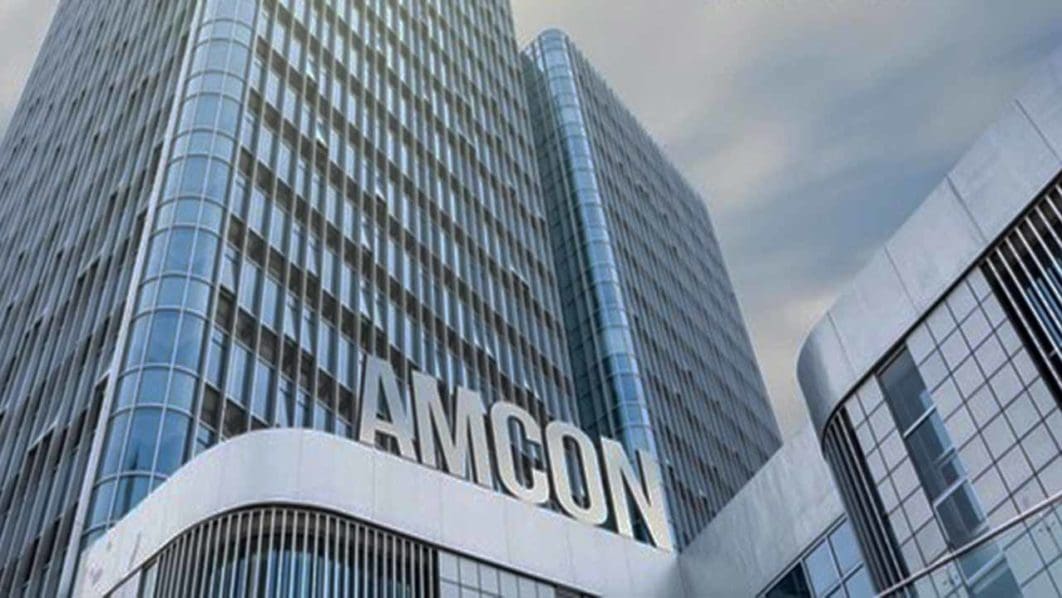
Seven deposit money banks reported a 33.14 per cent increase in AMCON Levy to N404.71 billion in the first half of the year, compared to N303.98 billion recorded by the banks in the same period in 2024.
A review of the half-year financial statements of the banks revealed this; Pinnacle Daily can report.
This comes as shareholders say enough is enough for the banking sector’s resolution cost paid to the Asset Management Corporation of Nigeria (AMCON) and insist the corporation has overstayed its welcome and should be wound up.
Analysis of the seven banks’ financial statements for the six months ended June 31, 2025, showed that Zenith Bank recorded the highest AMCON Levy of N143.84 billion compared to N92.20 billion it reported in June last year.
United Bank for Africa (UBA) followed with a similar rise in AMCON Levy to N92.88 billion from N70.33 billion, and First HoldCo with N74.85 billion from N77.26 billion.
Guarantee Trust Holding Company (GTCO) saw a rise in its AMCON Levy to N50.85 billion from N36.66 billion, followed by FCMB Group reporting N23.4 billion, up from N14.1 billion.
READ ALSO: Protest at CBN Raises Concern over Increasing Fraud in Nigerian Banks
Further look at the statements showed that Wema Bank reported an increase in AMCON Levy to N9.99 billion from N6.41 billion, and Sterling Financial Holdings Company recorded N8.89 billion from N7.03 billion in the review period.
AMCON is a special-purpose vehicle
When the Asset Management Corporation of Nigeria (AMCON) was established in July 2010, it was intended to serve a 10-year lifespan.
It came as a special purpose vehicle when the Nigerian banking sector was in crisis with toxic loans and fragile balance sheets.
It was meant to be a one-time intervention to buy non-performing loans (NPL), recapitalise distressed banks, and restore confidence in the banking system.
Based on the 2015 AMCON Act establishing the corporation, a 0.5 per cent levy was imposed on banks’ total assets plus total off-balance sheet assets as the AMCON Levy.
The surcharge has increasingly risen in value as the banks’ assets grew, posing a threat to the banking system, raising the banks’ operational expenses and reducing their profits.
Ten years have elapsed for AMCON to have been wound up, yet the corporation is still making huge deductions from banks’ earnings 15 years later.
This has been a major concern to shareholders, as the continued imposition of the AMCON Levy on banks is viewed as eroding banks’ earnings and consequently reducing shareholders’ value.
Has overstayed its welcome
Shareholders have maintained that AMCON is no longer serving its purpose and has overstayed its welcome.
READ ALSO: NDIC, CIBN Deepen Partnership to Tackle Emerging Financial Sector Risks
They pointed to the stability in the banking system and the ongoing recapitalisation mandate by the Central Bank of Nigeria (CBN) as making the banks more resilient.
The National Chairman of the Progressive Shareholders Association of Nigeria (PSAN), Boniface Okezie, asserted that AMCON has made more money than the banks it came to rescue.
He asked, “On the AMCON intervention, how many banks were rescued on its bailout, or did it help reap off many banks by the 0.5% it collects from the banks’ profits before taxes?
“We have called on AMCON to wind down its operations, but it has always fallen on deaf ears because shareholders have no funds to wage war on AMCON through the courts.
He expressed worries that Nigeria has become a country where the courts operate on a cash-and-carry basis, where the bigger the money you have, the more likely you are to carry the day and win cases, and the smaller the pocket you have, the less likely you are to win against those with deep pockets.
He lamented that AMCON’s actions portend that the corporation wants to stay as long as it wants, calling on the federal government to wind up AMCON.
“We expect the almighty Federal Government will ask them [AMCON] to stop operations,” Okezie said.
He added that on the part of shareholders, there is no justification for AMCON to still be in existence, querying, “To be doing what?
Failed in its purpose
On his part, the President of the New Dimension Shareholders Association, Patrick Ajudua, corroborated that AMCON has outlived its purpose of establishment and therefore must fold up.
He noted that shareholders have been calling for the scrapping of AMCON.
READ ALSO: Nigeria’s Economy Grows, but Nigerians Get Poorer — Bongo Adi Warns
He stressed that despite the various trillions of naira deducted from banks annually as AMCON Levy, toxic debt has not abated; rather, “we have seen an increase in bad debt and provisioning.”
“Hence, to us, the body is now irrelevant, and the levies paid to them must stop henceforth.
“If the call for the scrap of AMCON isn’t yielding results, we may be compelled to seek judicial and legislative intervention in this regard,” Ajudua said.
It’s a big disincentive to investors and should be audited.
A former general secretary of the Independent Shareholders Association of Nigeria (ISAN), Adebayo Adeleke, lamented further that shareholders have been calling for both the audit and subsequent winding up of AMCON over the past 6 years.
“The amount of money deducted from and/orcontributed by the bank over the past 16 years is mind-boggling.
“AMCON itself has become another bureaucratic cesspit of corruption. It is another rent-seeking parastatal and an emblem of the rot in the financial system in Nigeria,” Adeleke said.
He recalled that the law establishing AMCON was specific as to a ten-year lifetime.
He maintained that the corporation has outlived its usefulness, asserting that it is just manipulating the system to continue to justify its existence.
It is now an avenue for “giving food to the boys.
“Shareholders will continue to ask for the abrogation of AMCON. It should be audited and subsequently wound up.
“Continuous deduction of a banking crisis resolution fund from the banks is unnecessary, exploitative, and repulsive. It’s part of multiple or indirect taxation and a big disincentive to investors,” Adeleke added.

Alex is a business journalist cum data enthusiast with the Pinnacle Daily. He can be reached via ealex@thepinnacleng.com, @ehime_alex on X