

By Esther Ososanya
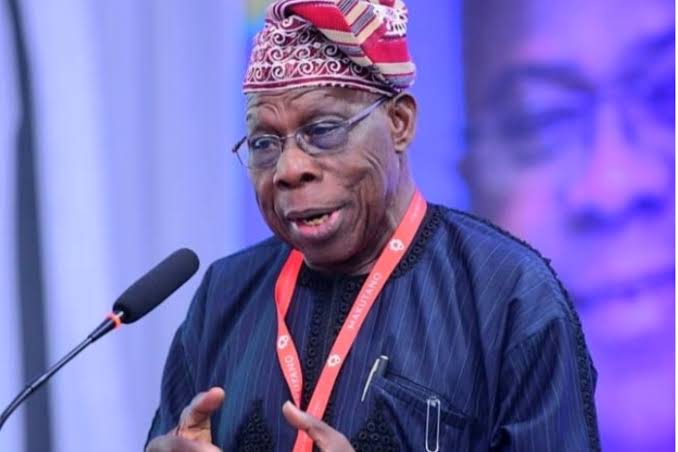
Former President Olusegun Obasanjo has delivered a searing critique of Africa’s development failures, blaming the continent’s stagnation on its dependency mindset, corruption, and a misfit political system.
Speaking on Thursday at the 32nd Annual Meeting of Afreximbank in Abuja, Obasanjo lamented that despite vast resources and human capital, African nations remain stuck in cycles of poverty and poor governance.
Africa’s ‘Lions’ Are Limping
Obasanjo singled out five of Africa’s most populous and resource-rich countries—Nigeria, Egypt, Ethiopia, the Democratic Republic of Congo, and South Africa—as the “lions” expected to lead the continent’s development. But apart from Egypt, he said, the rest have failed to deliver.
“These nations have taken two steps forward and one step back for years,” he said. “They are not growing fast enough economically or politically to inspire or support the rest of Africa.”
The Foreign Aid Trap
Obasanjo blamed Africa’s over-reliance on foreign aid and debt, particularly from countries like China, for undermining its progress.
“We all rush to China to borrow $20 billion, yet one African country alone can generate that kind of money domestically. But we won’t, because we are addicted to foreign help. That is not how we will move forward,” he declared.
He argued that African leaders often ignore the continent’s internal capacity for wealth generation, choosing instead to depend on external support that leaves countries vulnerable and uncompetitive.
A Crisis of Economic Understanding
Beyond aid dependency, Obasanjo pointed to a lack of economic literacy among African leaders as a major roadblock.
“How much of the world do our leaders even understand?” he asked. “If we understand it, we will get things right—not just nationally, but at the community, subregional, and continental levels.”
According to him, many policymakers are unaware of the mechanics of global economic trends and, as a result, cannot craft strategies that position their nations for growth.
Flawed Democracy, Failed Governance
Obasanjo also questioned the viability of Western liberal democracy in Africa, calling it a borrowed system that doesn’t reflect the continent’s realities.
He criticized what he described as Africa’s “monetocracy,” where money dictates leadership, and a “winner-takes-all” approach that alienates dissent and opposition voices.
“We must interrogate this borrowed system and reimagine a governance structure that works for us, one rooted in our realities, values, and aspirations,” he urged.
Learning from Ethiopia
Obasanjo praised Ethiopia for transforming into a wheat-exporting country, describing it as a blueprint for Africa’s future.
“If Ethiopia can transform itself into a wheat-exporting country, so can others. That’s the kind of story we need to replicate continent-wide,” he said.
He estimated that Africa could save $40 billion annually by achieving food self-sufficiency and emphasized agriculture as a key sector for food security, job creation, and economic independence.
Rethinking Currency and Trade
As part of his reform agenda, Obasanjo called for a shift to local currencies in intra-African trade, warning that continued dependence on the U.S. dollar limits the continent’s economic freedom.
“Promoting financial sovereignty will strengthen regional resilience and reduce exposure to global shocks,” he noted.
‘The Lions Must Move’
Wrapping up his keynote, Obasanjo challenged African leaders to show bold leadership, internal reflection, and political courage.
“Until the lions begin to move, the rest of the continent will remain stuck,” he concluded.

Esther Ososanya is an investigative journalist with Pinnacle Daily, reporting across health, business, environment, metro, Fct and crime. Known for her bold, empathetic storytelling, she uncovers hidden truths, challenges broken systems, and gives voice to overlooked Nigerians. Her work drives national conversations and demands accountability one powerful story at a time.