
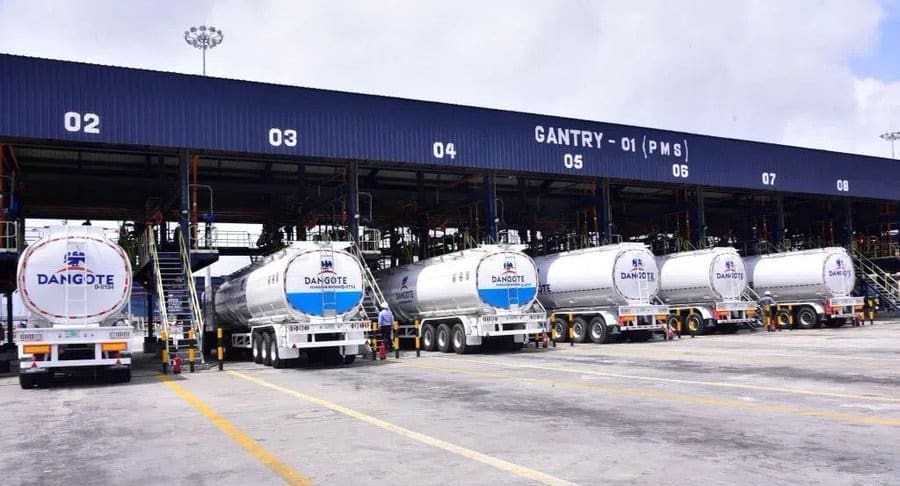
Dangote Refinery has halted loading of Premium Motor Spirit (PMS), also known as petrol, fueling speculations of a further increase in its ex-depot price of the product.
Tanker drivers who had reportedly queued at the facility have been asked to leave the premises, as all operations are currently suspended.
The fear comes from a similar pattern of sudden suspension of loading at the gantry adopted by the refinery management in the past, before a new price increase was announced.
The 650,000 barrels per day refinery has hiked its ex-depot price twice within the first week of March. The refinery had, on March 2, increased its petrol gantry price by ₦100 from ₦774 to ₦874 per litre. It further increased its gantry price by ₦121 per litre from ₦874 to ₦995 on Friday, March 6. This marks a sharp ₦221 rise within four days.
Petrol truck-out operations at the refinery were temporarily halted on March 2 and again in the early hours of March 6. Historically, these pauses have signaled imminent price recalibrations.
The price hike is driven largely by the escalating conflict in the Middle East, which has disrupted crude oil supply, leading to a sharp rise in prices in the international market.
Retail Impact
Pump prices across Nigeria have surged past the ₦1,000 mark. In Lagos, the nation’s commercial capital, pump prices are currently ranging between ₦1,040 and ₦1,090. In Abuja, the Federal Capital Territory, retail prices are currently ranging between ₦1,052 and ₦1,100.
Following the Dangote Refinery’s adjustment, the NNPCL has also hiked its prices twice in 24 hours, reaching roughly ₦1,045 per litre in Lagos and ₦1,080 per litre in the Federal Capital Territory.
Pinnacle Daily reports that crude oil prices have surged by over 40 per cent, rising above $100 per barrel in one week since the war between the United States, Israel and Iran started on Saturday, February 28, 2026. According to data published by Oilprice.com on Sunday, March 8, Brent Crude rose to $107 per barrel while the U.S. West Texas Intermediate (WTI) reached $106.2 per barrel. On Friday, February 27 (a day before the conflict started), Brent Crude had closed at $72.87 per barrel, while WTI closed at $66.40 per barrel.
Industry analysts warn that the domestic price of petrol may continue to rise if the global crude price surge persists due to the U.S./Israel-Iran war escalation.
The price surge has triggered concerns among marketers. The National President of the Independent Petroleum Marketers Association of Nigeria (IPMAN), has appealed to the Federal Government to lower the cost of crude oil supplied to the Dangote Petroleum Refinery to enable it to reduce its ex-depot price of petrol and consequently the retail price.
In a statement on Thursday, March 5, Dangote Refinery explained why it raised its ex-depot price of petrol, blaming it on rising global crude prices and its inability to get an adequate supply of feedstock domestically, prompting importation of crude to meet the required volume. While reiterating its commitment to ensuring price stability, the refinery promised a steady supply of petroleum products in the country.
The situation remains fluid as marketers reassess their pricing templates. While product availability remains steady in major cities, the increased fuel costs are already beginning to ripple through transport fares and commodity prices.

Victor Ezeja is a passionate journalist, scholar and analyst of socioeconomic issues in Nigeria and Africa. He is skilled in energy reporting, business and economy, and holds a master's degree in mass communication.