
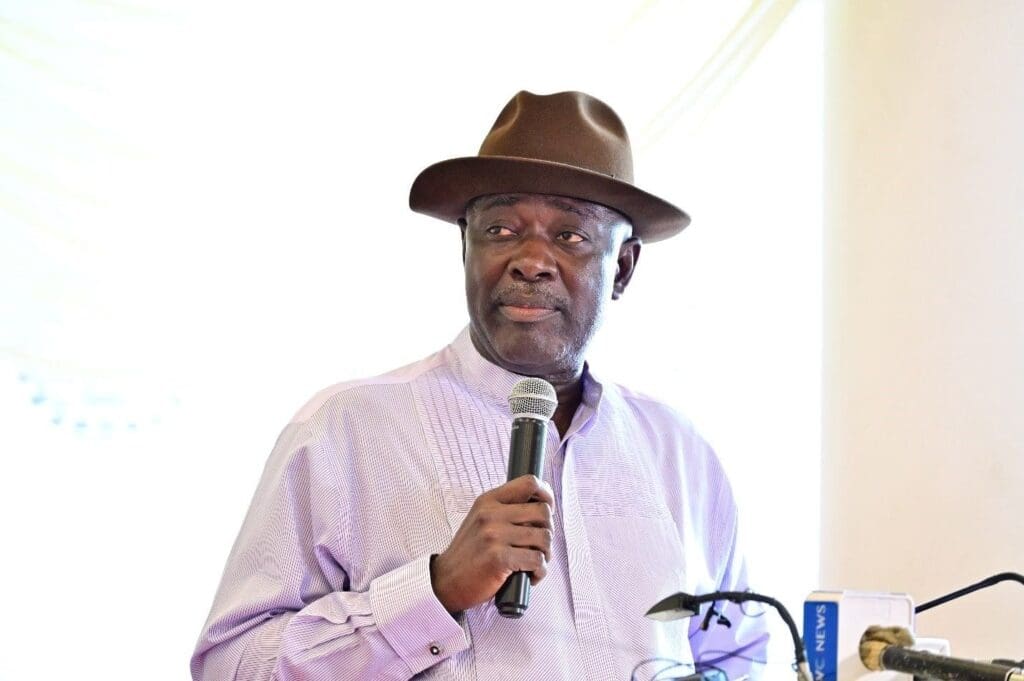
Nigeria’s Minister of State for Petroleum Resources (Oil), Heineken Lokpobiri, has said the Federal Government will enforce the “Drip or Drop” principle enshrined in the Petroleum Industry Act (PIA) to ensure the timely utilisation of oil and gas assets by licensed operators.
Lokpobiri stated this during the pre-bid conference for the 2025 licensing round held at Eko Hotel, Lagos, on Wednesday, January 14.
The pre-bid conference organised by the Nigerian Upstream Petroleum Regulatory Commission (NUPRC) drew participation from investors, operators, and other stakeholders in the oil and gas industry.
The minister expressed concerns about investors who won licences during bid rounds and held them for many years without developing the oil and gas assets, stating that it is a waste of resources and affects the economy.
Section 94 of the PIA, 2021 stipulates that oil operators are mandated to produce within three years of winning the licence or relinquish the fields.
The minister said there were cases when oil operators held licences for over 20 years without producing anything.
“I have seen cases where people hold these blocks for more than 20 years, and they have no plan to invest in them. Under the extant PIA, we are going to enforce the drill or drop principle,” Lokpobiri stated.
The minister noted that the upcoming licensing round presents an opportunity for investors and operators to participate in Nigeria’s petroleum industry.
He warned that the 2025 licensing round will deviate from the past when people would bid and win licences to operate oil blocks only to leave them undeveloped due to lack of financial or technical capacity.
“In the past, we have had situations where people have had licences but no capacity or intention to develop them. Some of them have even been held for speculation. ‘Let me keep them; one day someone would come, and I would be able to make a fortune out of it.’ That era, as I said earlier, is gone. Our approach today is firmly anchored on law – the PIA,” the minister warned.
He pointed out that Section 73 of the PIA provides that awarding Petroleum Prospecting Licences (PPLs) and Petroleum Mining Leases (PMLs) shall only be done through a fair, transparent and competitive bidding process conducted in accordance with the Petroleum Industry Act, the regulations made by the NUPRC, and the licensing round guidelines issued by the Commission.
According to him, the NUPRC has so far complied with all the extant provisions of the PIA.
RELATED NEWS:
- NUPRC Set to Host Pre-bid Conference on 2025 Oil and Gas Licensing Round
- NUPRC Lists 50 Oil Blocks, Slashes Signature Bonus to $7m
- NUPRC Targets 2.5 mbopd Oil Production in 2027 as Rig Count Surges by 762%
The minister emphasised that the provisions exist to promote transparency, remove discretion on the part of politicians and attract serious, competent investors.
Bidding Fees Non-refundable
Reflecting on what happened in the past licensing rounds, Lokpobiri made it clear that bidding fees paid by investors are non-refundable.
He said the government will not provide refunds to any investors after bidding has been concluded.
“I want to state very clearly that the petroleum industry does not provide for asset exchanges or refunds on these grounds. Once a bid is completed and an award is made in accordance with the law, the commercial and technical risk lies with the people who chose to bid for those assets.
“The government under any law has no obligation to refund your bidding fee or your signature bonus,” Lokpobiri told investors at the conference.
He said the pre-bid conference is fundamental, as it offers an opportunity to enlighten every prospective investor about how the bidding round is done.
“It is designed to ensure that all prospective bidders fully understand the assets on the bidding table, the available data, the applicable law and the risk that could be involved if you wish to bid for any asset.
“Accordingly, as government, it is important for me to say that the government will not be providing refunds or exchanges for any assets following this bid round. This position is not driven by any discretion; it is driven by law. The law doesn’t allow the government to refund any of these things,” he clarified.
He further stated that the era of discretionary awards is also over, and post-bid adjustment is also not provided for by the law.
He urged participants to approach the bidding process with “utmost clarity, diligence and realism.”
The minister encouraged investors who have technical capacity but do not have the financial resources to collaborate where necessary and form consortia to bid for oil blocks.
Energy Transition Debates
Speaking on energy transition debates, the minister asserted that the narrative has changed in the last two years. According to him, a look at the 2025 outlook of the International Energy Agency, the Organisation of Petroleum Exporting Countries (OPEC), and other stakeholders has shown that the world has changed from energy transition to “use of all forms of energy”, and that hydrocarbon remains the dominant source of energy for the foreseeable future.
He assured investors that oil and gas have come to stay, adding that proponents of energy transition have realised that the world needs all forms of energy, especially as the world population is expected to grow by another two billion by 2050, reflecting increasing demand for energy.
He maintained that fossil fuel or hydrocarbon resources would never go away, adding that they would constitute over 50 per cent of global energy sources in the foreseeable future.
Speaking on investment potential in Nigeria’s upstream oil and gas sector, the minister declared that the country is “a mature field” and therefore attracts investors.
He said the industry has grown so much in terms of confidence and investment in the last two years. According to him, Nigeria has attracted about two-thirds of FIDs in Africa in the last two years. He said this didn’t come by accident but through deliberate work and strategic partnership done over the last two years.
While assuring his support to the NUPRC for the best outcome, the minister enjoined the upstream oil and gas regulator to ensure that the best people who are financially and technically competent win the licences to operate the blocks.
In her keynote speech at the conference, the NUPRC Chief Executive, Mrs Oritsemeyiwa Eyesan, said the enactment of the PIA is a great milestone, driving reforms in Nigeria’s oil and gas sector.
Mrs Eyesan reechoed the provision in the PIA which mandates that undeveloped oil fields should be taken over by the government after some years.
According to her, most of the oil blocks on offer today were recovered fields.
She said President Bola Tinubu has approved a revision of the signature bonus, further reducing barriers to entry for investors.
The NUPRC boss added that the Commission has also reviewed some of the fees that bidders are expected to pay before first oil.
She further stated that the Commission has decided that the bid round will now be conducted annually.
Eyesan also observed that developments in recent years have proven that Nigeria’s oil and gas industry has become the preferred investment destination.
She highlighted the critical role of Nigerian banks in Nigeria’s oil industry and charged investors to always liaise with them appropriately while embarking on the licensing round.
Earlier, during the commencement of the licensing round in December 2025, the Commission had announced a reduction of the signature bonus to range between $3 million and $7 million dollars from about $10 million in the previous year.
NUPRC said it is offering 50 oil and gas blocks across deep offshore, shallow water, and onshore terrains to prospective investors.

Victor Ezeja is a passionate journalist, scholar and analyst of socioeconomic issues in Nigeria and Africa. He is skilled in energy reporting, business and economy, and holds a master's degree in Mass Communication. He can be reached via @VICTOREZEJA on X