

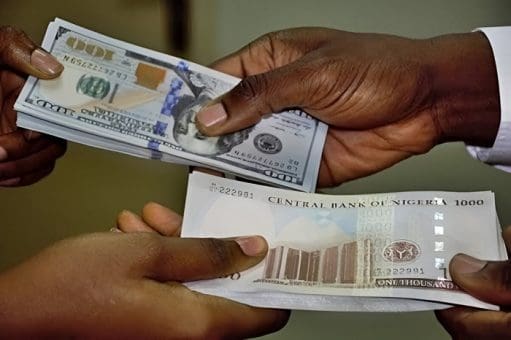
The recent appreciation of the naira is reshaping Nigeria’s economy, reducing costs for importers while cutting earnings for exporters, households receiving remittances, and government revenues.
When President Bola Ahmed Tinubu took office in May 2023, the naira traded around ₦463/$ under a controlled system run by the Central Bank of Nigeria (CBN).
In June 2023, the CBN unified the foreign exchange market and allowed the currency to trade more freely.
This led to a sharp depreciation as demand for dollars surged, and its value fell to about ₦664/$1 within days.
It weakened to around ₦907/$1 by the end of 2023, and dropped further to about ₦1,535/$1 by late 2024 amid persistent dollar shortages.
The weaker currency raised import costs, pushed up inflation, and increased pressure on businesses that rely on foreign inputs.
Analysts told Pinnacle Daily that as the naira strengthens, the effects are mixed.
It leaves importers to benefit because they need fewer naira to buy dollars, however, exporters earn less in naira when converting their foreign currency revenues.
The same applies to remittances even as government finances are affected as oil revenues are earned in dollars but shared in naira.
Annually, Nigeria receives over $20 billion from citizens abroad; it got $20.98 billion in 2024, but a stronger naira reduces the value of these inflows in local currency.
As such, when the naira strengthens, the amount distributed to federal, state, and local governments declines.
Strong Naira Creates Winners, Losers — Muda Yusuf Urges Policy Balance
Explaining this to Pinnacle Daily, a renowned economist, Muda Yusuf, said the recent appreciation of the naira is a positive development, but stressed that it creates both winners and losers in the economy.
“The recent appreciation of the naira marks a positive development for the Nigerian economy,” Yusuf, who is the Chief Executive Officer of the Centre for the Promotion of Private Enterprise (CPPE), said.
He noted that past depreciation had driven inflation, raised business costs and weakened purchasing power.
The former DG of the Lagos Chamber of Commerce and Industry pointed out that a stronger naira benefits import-dependent businesses by reducing the cost of goods such as fuel, food, pharmaceuticals and machinery.
“The recent strengthening of the naira has helped to moderate imported inflation, improve cost conditions for businesses and restore a measure of macroeconomic confidence,” Yusuf said.
He, however, stressed that the gains are uneven.

According to him, “An overly strong naira… can encourage import dependence by making foreign goods relatively cheaper, while simultaneously undermining domestic production.”
He said this could weaken incentives for local manufacturing and backward integration.
The renowned economist pointed out that exporters are among the biggest losers, as a stronger currency makes Nigerian goods more expensive in global markets.
“Export competitiveness is weakened as Nigerian goods become relatively more expensive in international markets,” Yusuf said.
He also cautioned that local producers could struggle to compete with cheaper imports, leading to lower production and possible job losses.
“When imports become cheaper, locally manufactured goods struggle to compete,” Yusuf said.
Keeping the naira stable without hurting local production, export growth
On the policy direction, Yusuf stressed that the government should not pursue a strong naira at all costs.
“The objective should not be the pursuit of currency strength as an end in itself,” he instead called for a balanced approach that supports growth.
READ ALSO:
- Naira Rebound Faces Fiscal Test, Group Says
- Cocoa Slump Puts Nigeria’s $6.1bn Export Record at Risk — Oye
- How FG Can Ease the Burden of Rising Petrol Prices on Businesses – Centre
- Dangote Urges FG to Resolve Power Challenges to Boost Industrial Growth
- Nigeria Turns to Borrowing Amid Weak Investment, Rising Reserves
“What is required is a careful calibration of exchange rate policy that balances stability with competitiveness,” Yusuf said.
He urged the monetary and fiscal authorities to ensure the exchange rate supports “domestic production, export competitiveness, macroeconomic stability and sustainable inflows of foreign exchange.”
He also advised the government to use improved foreign exchange inflows to build reserves.
“There is a compelling case for channelling a portion of these inflows into the accumulation of foreign reserves,” he said.
For long-term stability, Yusuf emphasised the need for structural reforms, adding that “a strong currency that is rooted in productivity, domestic value creation and export growth is far more sustainable.”
Strong Naira Creates Mixed Impact — Dele Oye Recommends ‘Managed Competitiveness’
The Chairman of Alliance for Economic Research and Ethics LTDGTE, Dele Oye, also explained to Pinnacle Daily that the recent appreciation of the naira reflects reform progress but also creates new economic risks that must be carefully managed.
Describing the situation as a delicate balance, he told the reporter that, “your questions touch on one of the most delicate balances in macroeconomic management—the impossible trinity of exchange rate stability, monetary autonomy, and open capital flows.”
Oye noted that the naira’s recent strength is driven by reforms led by CBN under Governor Olayemi Cardoso, which have improved transparency and boosted investor confidence.
According to him, “the current naira strength reflects genuine reform progress but also creates new vulnerabilities.”
On the winners and losers, Oye explained that a stronger naira benefits consumers and businesses that depend on imports.

“Cheaper imports benefit consumers and input-dependent manufacturers,” he said.
He, however, noted that exporters face challenges. “Export competitiveness weakens,” he said, adding that government revenues and remittance flows could also come under pressure due to currency conversion effects.
To manage these trade-offs, Oye proposed what he called a “managed competitiveness” strategy rather than allowing the currency to strengthen unchecked.
He advised the government to build fiscal buffers similar to global best practices.
“Rather than allowing naira appreciation to erode export competitiveness, the government should channel windfall oil revenues… into a Sovereign Wealth Fund invested offshore,” Oye said.
He maintained that this would help “prevent excessive domestic liquidity,” build reserves and support long-term stability.
He also stressed the need to use the strong naira to boost production, not consumption.
“The naira’s strength should fund imported capital goods for domestic manufacturing rather than consumption,” Oye said.
On remittances, he noted that reforms have improved inflows despite currency changes.
“Transparency now attracts formal flows,” he said, urging authorities to sustain policies that support diaspora investments.
To protect exporters, Oye called for targeted support.
“Rather than resisting currency appreciation wholesale, policymakers should implement sector-specific compensatory mechanisms,” he said, including export credit support and tax reliefs.
On government revenue, he said the focus should shift beyond oil. He said, “Nigeria must accelerate non-oil fiscal revenue mobilisation,” backing ongoing tax reforms to widen the revenue base.
He also urged stronger reserve management and smarter debt strategies, noting that improved currency stability has already boosted investor confidence.
According to Oye, the goal is not just a stronger currency but a stronger economy, stressing “The naira’s strength is a symptom of restored confidence, not a problem to be solved through devaluation.”
He added that Nigeria must use the current stability to drive structural reforms, warning that without this, the gains could be temporary.

Alex is a business journalist cum data enthusiast with the Pinnacle Daily. He can be reached via ealex@thepinnacleng.com, @ehime_alex on X