

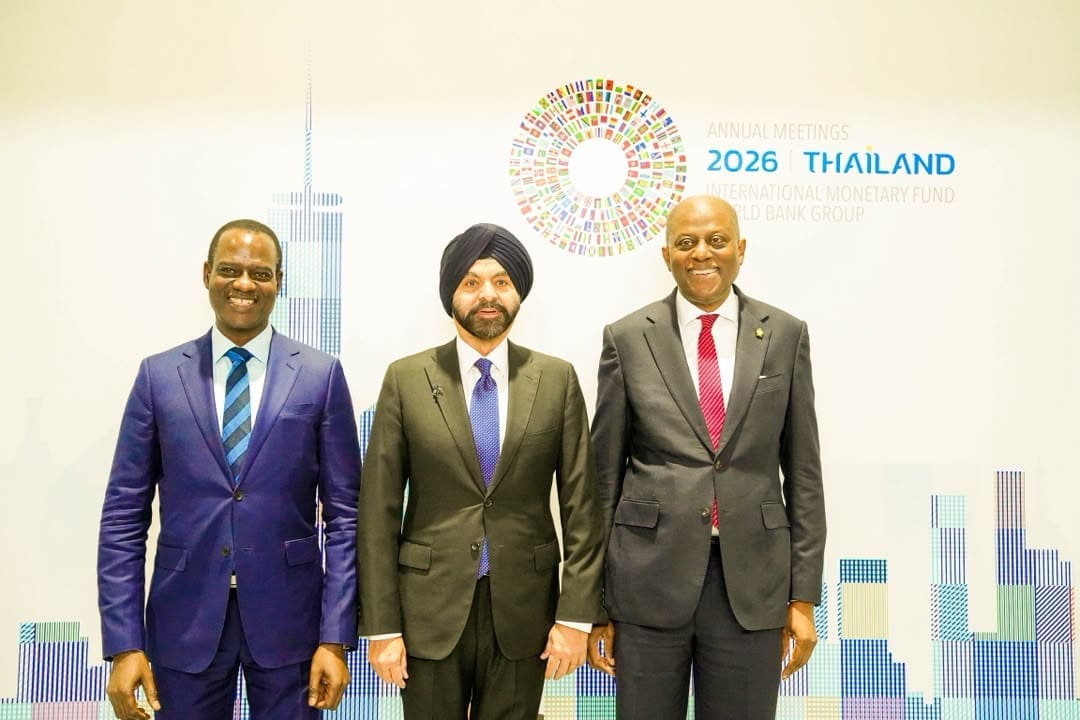
World Bank Group President Ajay Banga has praised Nigeria’s economic reforms, citing a twentyfold rise in private capital inflows, from about $300 million in 2023 to nearly $6 billion in 2026.
The meeting took place on the sidelines of the 2026 IMF and World Bank Group Annual Meetings in Bangkok, Thailand, with the Minister of Finance and Coordinating Minister of the Economy, who leads the Nigerian delegation, Taiwo Oyedele, and the Governor of the Central Bank of Nigeria (CBN), Olayemi Cardoso.
The talks reviewed the progress of the reforms and the next phase of the agenda: converting macroeconomic stability into faster growth, higher private investment and stronger domestic revenues.
Oyedele pointed to improving economic growth and said Nigeria’s tax-to-GDP ratio has risen from about 7 per cent to 12.5 per cent over the same period. He said the improvement gives the government more room to fund public investment without resorting to deficit monetisation.
Official data point to improving macroeconomic conditions. The National Bureau of Statistics (NBS) reported that the economy grew 4.43 per cent year on year in real terms in the second quarter of 2026, up from 4.23 per cent a year earlier and the strongest quarterly expansion since the third quarter of 2024. Headline inflation eased to 15.39 per cent in August from 23.14 per cent in August 2025, although it remains in double digits.
READ ALSO:
- https://thepinnacleng.com/banking-finance/war-energy-prices-record-debt-dominate-agenda-as-imf-world-bank-meetings-open-in-bangkok
- https://thepinnacleng.com/economy/nigerias-capital-inflow-hits-10-4bn-but-fdi-drought-persists
- https://thepinnacleng.com/economy/nigerias-8bn-private-capital-inflow-leaves-mid-market-firms-behind
- https://thepinnacleng.com/economy/nigerias-forex-inflows-surge-32-to-4-36bn-in-july-on-strong-domestic-supply
The officials also discussed how Nigeria can make wider use of World Bank guarantee instruments, which can unlock financing for infrastructure and draw more private capital into the domestic market.
External buffers have also strengthened. Data from the Central Bank of Nigeria show gross external reserves rose from $45.57 billion at the start of the year to $54.86 billion on September 24, which is $3.82 billion above the apex bank’s year-end projection.
On the fiscal side, tax revenue collected by the Nigeria Revenue Service rose 49 per cent year-on-year to ₦15.8 trillion in the first five months of 2026, as the government pursues its goal of raising the tax-to-GDP ratio to 18 per cent by 2030.
Power infrastructure and human capital were named as priority areas for continued public investment because of their importance to business competitiveness, productivity and job creation. The parties also stressed the quality of public spending so that every naira delivers measurable economic and social returns.
Analysts, however, caution that the composition of inflows matters as much as their size. NBS data show that portfolio investment accounted for $9.86 billion, or about 95 per cent, of the $10.37 billion in capital imported in the first quarter, while foreign direct investment was $135.08 million. That context underlines why the government is seeking guarantee-backed financing to draw longer-term capital into infrastructure and power.
The meeting forms part of the Federal Government’s wider engagement with development partners to lock in reform gains and attract new investment. With Nigeria moving from stabilisation to growth, the priority is to convert stronger fundamentals into productive investment, more jobs and better living standards.
Sunday Michael Ogwu is a Nigerian journalist and editor of Pinnacle Daily. He is known for his work in business and economic reporting. He has held editorial roles in prominent Nigerian media outlets, where he has focused on economic policy, financial markets, and developmental issues affecting Nigeria and Africa more broadly.